 Where to Plant
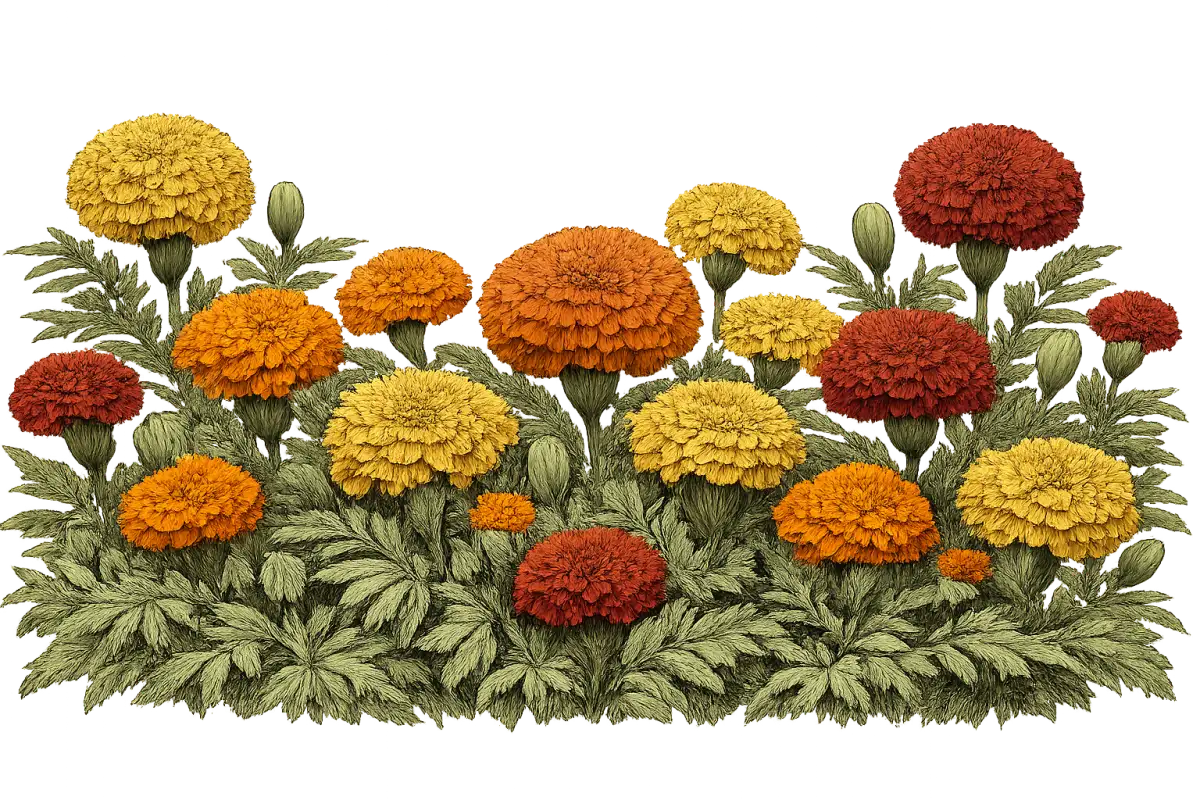


There is a particular kind of gardening confidence that a marigold gives you. You press a seed into warm soil, step back, and within fifty to sixty days you have a plant covered in blooms so vivid they look almost lit from within -- golds, burnt oranges, deep mahogany reds, creamy whites -- holding their color through summer heat that would reduce most flowers to limp surrender. For a beginning gardener, that experience is transformative. For an experienced one, it is quietly satisfying every single time.
What I find remarkable about marigolds is not that they are easy, exactly, but that their preferences are so completely different from what most gardeners assume. We are trained by years of gardening advice to reach for the fertilizer, to water generously, to fuss. Marigolds punish fussiness. Give them too much nitrogen and they spend their entire season producing leaves instead of flowers -- gorgeous, lush, useless foliage. Over-water them and their roots suffocate before you even realize anything is wrong. The marigold's lesson is restraint: give it sun, give it drainage, and then mostly leave it alone.
When you get the basics right, the payoff is months of color with minimal effort. No other annual I know of delivers this combination of boldness, adaptability, and genuine usefulness -- marigolds earn their place both as a design element and as a working partner in the vegetable garden, where their roots actively suppress nematodes and their blooms draw the beneficial insects that keep your tomatoes and peppers healthy.
This guide is everything you need to grow them well: which types to choose for your zone and your purpose, how to plant and care for them through the season, the mistakes that derail most gardeners (and how to avoid them), and how to use them as companion plants in ways that are actually supported by science.
Quick Answer: Marigolds at a Glance
USDA Zones: 2 through 11 (frost-tender annual; grown as warm-season annual everywhere)
Sun: 6-8 hours direct sun minimum; 8+ hours ideal
Soil pH: 6.0-7.0 ideal; tolerates 5.8-7.5
Soil: Any well-draining soil; average fertility or less is better than rich
Spacing: French: 8-10 inches | African: 12-14 inches | Signet: 6-8 inches | Triploid: 10-12 inches
Water: Base watering only; established plants once per week (more in heat); never overhead
Fertilizer: Minimal; single application of slow-release balanced fertilizer at planting; none in rich soil
Indoor Seed Start: 4-6 weeks before last frost
Days to Germination: 5-14 days (typically 7 at 70-75F)
Days from Seed to First Bloom: French: 50-60 days | African: 60-75 days | Signet: 50-60 days
Deadheading: Weekly; critical for extended bloom (exception: triploid hybrids, which are sterile and bloom nonstop)
Key mistake to avoid: Over-fertilizing -- excess nitrogen produces lush foliage and almost no flowers
The One Thing Every Marigold Grower Gets Wrong
Before anything else in this guide, I want you to understand one counterintuitive truth, because it will save you an entire season of frustration.
Marigolds do not want rich soil. They want sun.
Every year, gardeners plant marigolds in beautifully amended beds -- the same raised beds they built for their tomatoes, generously composted and fertilized. The plants grow magnificently. Dark green, lush, enormous. And then they produce almost no flowers, or they flower briefly in early summer and then slow to nearly nothing as the season goes on.
The culprit, almost every time, is excess nitrogen. Nitrogen drives vegetative growth -- leaves, stems, more leaves. When a marigold has more nitrogen than it needs, it redirects its energy from reproduction (flowers) to growth (foliage). The plant is doing exactly what its biology tells it to do. It is you who gave it the wrong conditions.
This is the single most common reason for poor marigold bloom, and it happens specifically because marigolds have a reputation for being easy. They are easy -- but their preferred growing conditions are not what most gardeners instinctively provide. In average garden soil, marigolds need no supplemental fertilizer at all. In containers, they need modest feeding every two to three weeks because nutrients leach out with irrigation. But the moment you start treating them like dahlias or roses, the flowers disappear.
Get this right, and everything else falls into place. Marigolds in average soil with full sun are close to self-sufficient. They do the work. You watch.
Understanding the Three Types (This Changes Everything)
One of the most useful things you can do before buying a single seed packet is understand that "marigold" is not one thing. There are three distinct species commonly grown, plus a hybrid category, and they behave so differently that choosing the wrong one for your purpose is genuinely disappointing.
French marigolds (Tagetes patula) are the workhorses. They reach 6 to 12 inches tall with 1 to 2 inch flowers in single, double, and crested forms. Their color range is the widest -- red, orange, yellow, bicolor, and rich mahogany. They bloom the fastest from seed (50 to 60 days), handle extreme heat better than any other type, and produce the highest concentrations of the thiophene compounds that make marigolds useful as companion plants and nematode suppressors. If you grow only one type, this is it. Popular series include Bonanza, Durango, Safari, Hero, and Janie.
African marigolds (Tagetes erecta) -- also sold as American or Aztec marigolds -- are the dramatic ones. They reach 12 to 36 inches tall and produce globe-shaped double blooms 3 to 5 inches across. This is the marigold of wedding arrangements, of bold back-of-border statements, of the kind of color that stops visitors at the garden gate. They take longer from seed to bloom (60 to 75 days) and are slightly more sensitive to extreme heat than French types, but in zones 5 through 10 they are spectacular. Key series: Antigua, Inca, Marvel, Discovery, and the extraordinary Vanilla, which produces rare cream-white blooms on long stems.
Signet marigolds (Tagetes tenuifolia) are the elegant understory players. Compact mounds at 8 to 12 inches, covered in tiny single flowers above lacy, fern-like foliage with a strong citrus scent. They are the best edible marigold by far -- a true citrusy, slightly spicy flavor rather than the pungent taste of the other types. They belong in herb gardens, at the front of borders, and in containers where their fine texture provides a beautiful contrast to bolder companions. Look for Lemon Gem, Tangerine Gem, and Red Gem.
Triploid hybrids are a cross between French and African types, inheriting the larger flower size of the African and the nonstop blooming of the French. The critical detail: they are sterile and cannot set seed, which means they never receive the hormonal signal to slow flower production. They bloom continuously without any deadheading. If the idea of weekly deadheading sounds exhausting, plant Zenith or Taishan and walk away. The tradeoff is that seed is more expensive and harder to find.