Vegetables

Growing Tomatoes: Stop Guessing, Start Harvesting

James Calloway

James Calloway

Vegetable & Edibles Specialist · Updated April 2026

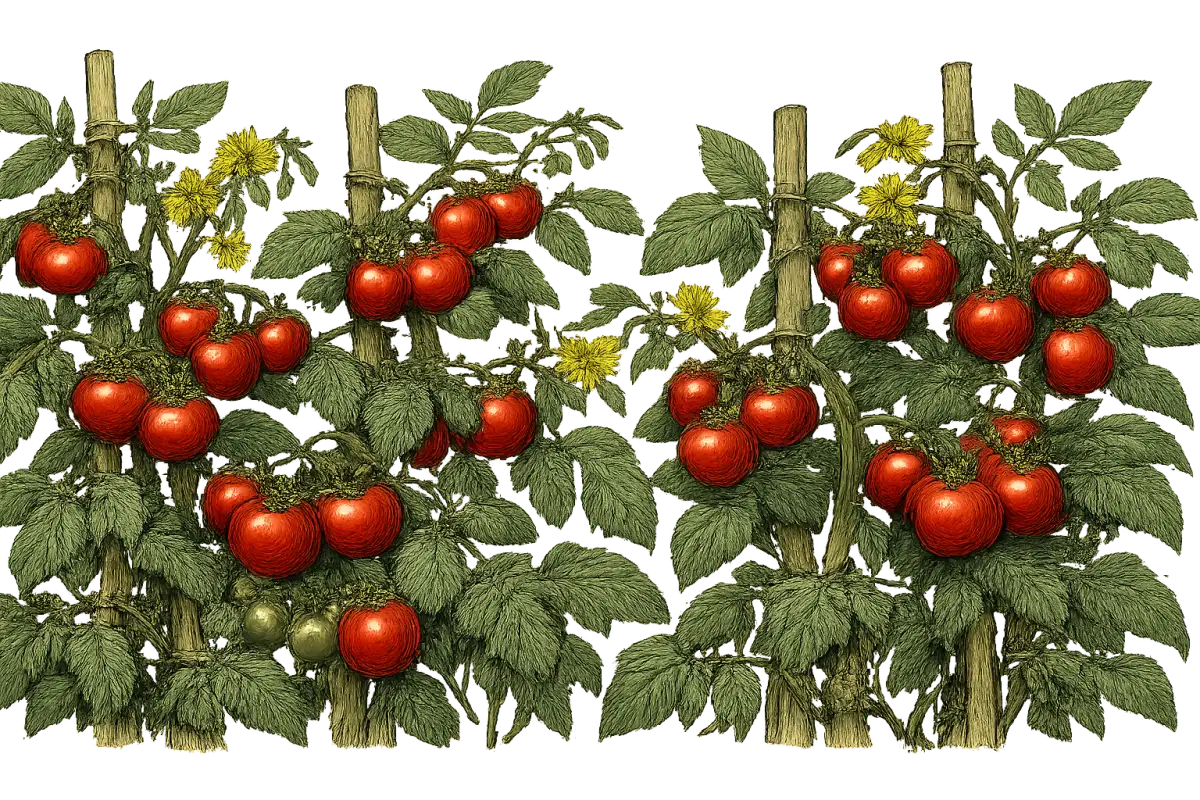
How to grow tomatoes — vintage botanical illustration showing the plant in detail

Tomatoes at a Glance

Sun

Sun

6-8 hours full sun daily

Soil pH

Soil pH

6.5

Water

Water

1-2 inches per week

Spacing

Spacing

18-36 depending on training system"

Days to harvest

Days to Harvest

45-80+ days

Height

Height

3-4 feet

Soil type

Soil

Well-drained

Lifespan

Lifespan

annual

Get your personalized growing data

Enter your zip code for frost dates, growing season, and soil type.

Every August, somebody emails me a photo of their tomato plant. Eight feet tall, dense as a hedge, leaves so dark green they look painted. Not a tomato in sight. "What am I doing wrong?" they ask.

Everything, usually. But it is fixable.

Tomatoes are simultaneously the most popular vegetable in the American home garden and the most frequently misunderstood. People treat them like they are fragile. They over-fertilize. They plant the wrong variety for their climate. They water badly and wonder why the bottom of every fruit looks like a bruise. They prune plants they should not touch and ignore ones that desperately need it.

Here is what nobody tells you: tomatoes are not a difficult crop. They are a specific one. Get the soil right, match the variety to your zone, water consistently, and support the plant properly. Four things. Do those four things and you will have more tomatoes than you know what to do with from mid-July through frost.

This guide covers everything: what types to grow, which varieties survive your particular climate, how to start and transplant correctly, what blossom end rot actually is (it is not what most people think), how to prune without destroying your yield, and how to pick and store fruit so it tastes like something instead of nothing.

Let's get into it.


Quick Answer: Tomato Growing at a Glance

USDA Zones: 3 through 10 (with the right variety and strategy)

Sun: 6-8 hours of direct sunlight daily -- non-negotiable

Soil pH: 6.0-6.8 (target 6.5 for optimal calcium availability)

Soil Temperature at Transplant: 60F minimum at 2-inch depth

Water: At least 1 inch per week; 2 inches during fruit development and heat

Fertilizer: High-phosphorus at planting; calcium nitrate as side-dress once fruit sets

Support: Cages for determinates; single stake or Florida weave for indeterminates

Days to First Harvest: 45 days (ultra-early varieties) to 85 days (late-season heirlooms)

Plants per Person: 3-5 for fresh eating; 5-10 if you plan to can or make sauce

Storage: Room temperature, stem-side down -- never the refrigerator


Determinate or Indeterminate: The Decision That Changes Everything

Before you choose a variety, you need to understand the two growth habits. This is not abstract botany. It determines how you support the plant, whether you prune it, and what your harvest looks like.

Determinate varieties grow to a genetically fixed height -- typically 3 to 4 feet -- set all their fruit within a concentrated window of 2 to 3 weeks, and then decline. They are compact, manageable, and built for processing. If you are canning salsa or making sauce and want a large harvest you can deal with all at once, plant determinates. They need minimal pruning. In fact, aggressively removing suckers from a determinate reduces your total yield because each sucker is a fixed fruiting site you eliminated permanently.

Indeterminate varieties grow continuously throughout the season, reaching 8 to 10 feet if you let them, producing fruit progressively from the bottom of the plant upward until frost shuts them down. They need strong support -- real support, not the flimsy 18-inch wire cones sold at garden centers. And they benefit from selective sucker removal to keep air moving through the canopy. If you want fresh tomatoes from mid-July through October, indeterminate is your habit.

Semi-determinate splits the difference. Varieties like Celebrity grow larger than true determinates but eventually stop, producing over a longer window. Rutgers University specifically recommends semi-determinate and indeterminate types for home gardeners who want continuous harvests.

The heirloom-versus-hybrid question matters too, though less than most people think. Heirlooms are legitimately better for flavor -- they contain 20 to 40 percent more sugar and acid compounds than hybrids, and in blind taste tests, 72 percent of participants preferred heirloom flavor. The tradeoff is real: heirlooms show 40 to 60 percent lower survival in disease-challenging conditions and yield 30 to 45 percent less than comparable hybrids. Most experienced gardeners grow both. Hybrids for reliable production; heirlooms for the tomatoes that remind you why you started growing vegetables in the first place.

The practical answer for most people: plant Brandywine or Mortgage Lifter for flavor, Celebrity or Big Beef for reliability, and Sun Gold cherry for the gardener who wanders outside and grazes.


Best Tomato Varieties by Zone

Zone selection is where most home gardeners lose before the season starts. Planting an 80-day beefsteak with 100 frost-free days remaining guarantees failure. Planting a low-chill variety into a zone 9 summer guarantees blossom drop. Match the variety to your climate first. Everything else is secondary.

What zone are you in?

Enter your zip code for frost dates, growing season, and soil type.

Short-Season Zones (3-5): Every Day Counts

Zone 3 may have as few as 90 frost-free days. Zone 5 offers 120 to 150. Success in these zones is about speed first, everything else second.

The ultra-early foundation -- 45 to 60 days -- is non-negotiable. Build your planting around it, then add one or two mid-season varieties using season extension tools.

Sub Arctic Plenty (45 days, determinate) is the safest option for extreme short seasons. It sets fruit at 45F -- a threshold that would shut down most other varieties. If you are in zone 3 or 4 and want a guarantee, this is it. Pair it with Fourth of July (49 days, indeterminate, VFN/T resistance) for an early hybrid with a better disease package.

Early Girl (50 days, indeterminate, VF) is the standard short-season slicer. It is reliable everywhere frost allows. If you grow nothing else in zone 4, grow Early Girl.

Stupice (55 days, indeterminate) is a Czech heirloom that performs remarkably well in cold weather. It brings genuine flavor to a zone where flavor variety is limited. Add it as your heirloom option.

Zone 5 opens additional options once you commit to season extension. Juliet (60 days, crack-resistant grape type) and Sun Gold (65 days, orange cherry, exceptional sweetness) both fit comfortably. Celebrity (70 days, semi-determinate, VFN/T) is worth pushing with a Wall-o-Water cloche -- it handles wide temperature swings better than almost any other variety and produces reliably. Big Beef (70 days, VFN/TMV) gives you a strong slicer with broad disease resistance when your season can accommodate it.

Zone 3-5 strategy: plant mostly ultra-early and early varieties. Add one mid-season variety under season extension. Celebrity and Sub Arctic Plenty are your two safest bets across this entire zone group.

Standard Zones (6-8): The Full Menu Opens Up

These are the tomato zones. Seasons run 150 to 220 frost-free days, and the full range of varieties is available. Disease resistance becomes your primary selection factor rather than maturity speed.

Zone 6 is where flavor variety finally opens up. Start the season with Early Girl. Move into mid-season with Better Boy (75 days, indeterminate, VFN, 12 to 16 oz slicing tomato -- the classic workhorse), Celebrity, and Big Beef. Then add an heirloom for peak-summer eating: Brandywine (80 days, indeterminate) takes time but it is the benchmark against which every other tomato gets judged. For sauce, San Marzano (80 days) is the gold standard. Mountain Magic (66 days, VF/EB) gives you early blight resistance in a cocktail-size package -- useful if your humid zone 6 summers have been brutal on foliage.

Zone 7 is premium tomato territory with a catch: heat and humidity increase disease pressure significantly. Lean on resistance packages. Jet Star (72 days, VF, crack-resistant, low acid) is worth growing here alongside Better Boy and Celebrity. Ramapo (85 days, VF) is a Rutgers heritage variety with outstanding flavor that rewards patient zone 7 growers with the time to let it develop. For heirloom sauce, Amish Paste (85 days) and Arkansas Traveler (85 days, heat-adapted heirloom that continues setting fruit in warmth) belong in every zone 7 garden. Cornell's Mountain Merit (75 days, VFN/T, late blight tolerant) is the pick if late blight has been your annual nightmare.

Zone 8 is where heat stress enters the conversation. Nematodes become a serious concern in sandy southeastern soils -- look for the "N" resistance code. BHN 589 (75 days, determinate, VF/TMV) is a commercial workhorse that handles heat reliably. Florida 91 (72 days, VF) and Heatmaster (75 days, VFN) perform well through zone 8 summers and were the top two performers in University of Maryland heat trials for both heat tolerance and eating quality. Eva Purple Ball (78 days, indeterminate, 4 to 5 oz) is a heat-tolerant heirloom worth trying if you want flavor with your heat resilience.

Hot-Climate Zones (9-10): Learn to Dodge the Heat

In zones 9 and 10, the season is long enough for anything. That is not the problem. The problem is that sustained temperatures above 90F day and 70F night shut down tomato fruit production entirely. Pollen becomes abnormal, flowers abort, and lycopene stops forming above 85F. You cannot brute-force a tomato through an Arizona July.

The correct response is the two-window strategy. Do not fight the heat. Plant around it.

Spring window: Transplant in February to March once soil reaches 60F. Use determinate varieties -- Florida 91, Heatmaster, Celebrity, BHN 589 -- for a concentrated harvest in April through June before the heat wall hits in July. These determinates ripen their crop, you harvest it, and you are done before peak summer.

Fall window: Start seeds indoors in July. Transplant in late August to September as temperatures begin dropping. This is where zones 9 and 10 actually shine -- fall tomatoes ripen in cooler weather and produce the highest-quality fruit of the entire year in hot zones. You can use indeterminate varieties here since the season ahead is long. Harvest runs October through December in zone 9, year-round in zone 10.

Skip July and August entirely. The energy is better spent starting fall seedlings than nursing a plant through conditions that will not produce fruit regardless.

For nematode management in sandy southern soils -- a genuine concern in zones 9 to 10 -- prioritize the "N" resistance code: Celebrity (VFN), Big Beef (VFN), Better Boy (VFN), Sweet Million cherry (VFN), and Viva Italia paste (VFN) are your anchors.

One important caveat: the Mi gene that provides nematode resistance breaks down at sustained soil temperatures above 86F. Organic mulch cooling the soil helps maintain resistance. Without it, even "N"-coded varieties can succumb.

Quick Reference: Top Varieties by Zone Group

Zone GroupTop 3 VarietiesTypeWhy
3-4Sub Arctic Plenty, Early Girl, StupiceDet / Indet / IndetUltra-early; cold-tolerant fruit set
5-6Celebrity, Big Beef, BrandywineSemi-det / Indet / IndetSeason-spanning; reliable disease resistance; peak flavor
7-8Better Boy, Ramapo, Florida 91Indet / Indet / DetLarge fruit; heritage flavor; heat adaptation
9-10Florida 91, Heatmaster, CelebrityDet / Det / Semi-detBest flavor in heat trials; two-window strategy

Starting Right: Seeds, Transplants, and the Hardening-Off Step Most People Skip

Seeds Indoors

Start seeds 6 to 8 weeks before your last frost date. For zones 3 to 4, that means late March to early April. Zone 5 to 6, mid to late March. Zone 7, early to mid March. Zones 8 to 10, January to February for the spring crop and July for the fall crop.

You need two things to germinate tomatoes reliably: heat and light. Soil temperature should be 70 to 80F -- use a heat mat. Once seedlings emerge, they need 16 hours of light daily from grow lights positioned 3 to 4 inches above the seedlings. If you skip the grow lights and rely on a sunny window, you will get leggy, spindly seedlings that never recover.

Reject plants that are tall and lanky, yellowish, or already flowering with small green fruit. Rutgers specifically warns against buying flowering transplants -- they are already stressed. A good transplant is 8 to 10 inches tall, dark green, with a thick straight stem. That is what you are looking for.

Hardening Off: Do Not Skip This

Here is the step that gets skipped most often and causes the most damage. Hardening off is the gradual transition from indoor to outdoor conditions. MSU is clear: skipping or rushing it causes wilting, leaf browning, stunting, or death.

The protocol: Day 1, put transplants in a shaded spot for one hour. Days 2 through 5, increase outdoor time by 1 to 2 hours daily while slowly introducing sun. Days 6 through 8, plants spend full days in full sun. Days 8 through 10, leave overnight.

Critical rule: bring plants inside if temperatures drop below 60F (UNH). Chilling injury below this threshold causes catfacing -- misshapen, scarred fruit -- on the earliest tomatoes of the season. Below 50F, MSU notes, even brief exposure stunts tomatoes.

Start hardening off 7 to 10 days before your frost-free transplant date.

Transplanting and Deep Planting

Two conditions must be met simultaneously: all frost danger has passed, and soil temperature is above 60F at 2-inch depth. The soil temperature requirement is not optional. Cold soil stresses roots, suppresses calcium uptake, and gets the season started badly.

Tomatoes are unique among vegetables in that they form roots along any buried stem section. Bury them deep. Missouri's trench method for leggy transplants is worth knowing: lay the plant at a 30-degree angle in a trench, leaving only the top 5 to 6 inches of foliage above soil. The entire buried stem will root. This turns a gangly, over-grown transplant into a plant with a massive root system.

Apply a starter fertilizer solution at transplanting -- Missouri recommends a high-phosphorus formula (9-45-15 or 15-30-15) at 2 tablespoons per gallon. Phosphorus promotes root establishment. Nitrogen promotes leaves. You want roots right now.

Install a cutworm collar extending 1 inch below and 2 inches above ground. Wrap it and forget it. And never plant tomatoes where tomatoes, peppers, eggplant, or potatoes grew within the last 2 years. Rutgers sets the minimum at 2 years; NC State recommends 3 to 5 years for fusarium, which survives in soil for a decade.


The Watering and Fertilization Problem (Understanding Blossom End Rot)

Blossom end rot kills more gardening confidence than it kills tomato plants. You work all season, the fruits set, they develop -- and then you see it. Dark brown to black, sunken, leathery patches on the bottom of fruit. First fruits of the season, usually. Looks like rot. Feels personal.

Here is what it actually is: a calcium delivery failure.

Blossom end rot is not caused by low soil calcium in most cases (Wisconsin Extension, MSU, UGA). It is a calcium transport problem. Calcium moves through a tomato plant exclusively via water transpiration -- the loss of water through leaves creates the pressure that pulls calcium-laden water upward through the plant's vascular system. Calcium moves preferentially to leaves, which transpire heavily, rather than fruit, which transpire minimally.

When water delivery fluctuates -- drought followed by heavy watering, or overhead irrigation that delivers unevenly -- calcium transport to developing fruit stops during dry periods. The fruit develops without adequate calcium reaching the blossom end. You get BER.

This explains why foliar calcium sprays do not work. Calcium deposited in leaves is permanently immobile -- it cannot be redistributed to fruit. This also explains why fungicides and insecticides do nothing. BER is physiological, not pathological. Stop spraying things on it.

The fix is consistent moisture. At least 1 inch of water per week from drip irrigation or soaker hoses. Apply 2 to 4 inches of organic mulch to buffer soil moisture swings. Switch to calcium nitrate as your primary side-dress fertilizer -- it provides both calcium and nitrate-form nitrogen, which does not compete with calcium uptake.

The Nitrogen Form Problem

Speaking of nitrogen form: this is the second most important fertilization concept for tomatoes, and most bag labels obscure it completely.

Nitrate nitrogen does not compete with calcium for root uptake. Ammonium nitrogen competes directly with calcium uptake AND promotes excessive leafy growth that diverts calcium away from developing fruit. High-ammonium fertilizers give you beautiful dark green plants with no fruit and BER on everything that does set. This is the "all vine, no tomato" problem that drives people crazy.

Use high-phosphorus fertilizer at planting. Side-dress with calcium nitrate once fruit sets -- approximately 3.5 lbs per 100 feet of row. A second application two weeks after first ripe fruit. A third application one month after that for indeterminate varieties still producing. Stop fertilizing after early fall -- late nitrogen on plants near the end of the season is wasted.

One more warning: do not apply Epsom salt without a soil test. Epsom salt provides magnesium, and excess magnesium blocks calcium uptake through the same root pathways. People read that tomatoes like Epsom salt, apply it liberally, and increase their BER risk. Soil test first. Maintain a calcium-to-magnesium ratio of approximately 3:1 to 5:1.


Support Systems and Pruning: Know What You Have Before You Cut

Every tomato needs support. Ground sprawl increases soil disease contact, pest damage, and fruit rot. Rutgers says it directly: do not do it.

Three support systems work well.

Wire cages are the easiest system and best for determinates and most semi-determinates. Build them from cattle fencing or concrete reinforcing mesh with 4 to 6-inch openings -- the standard commercial cones are too small and too flimsy for anything other than a very compact plant. A 6-foot length of heavy mesh creates a cylinder about 22 inches across. Anchor with 2 to 3 stakes to prevent tipping. Cage plants need the least ongoing maintenance.

Single stakes work best for indeterminate varieties in tight spaces. Drive a stake at least 6 feet long into the soil 4 inches from the plant at transplanting. Tie with a figure-8 pattern -- loop around the stake, cross, loop around the stem -- leaving half an inch of slack for stem growth. Single-staked plants get slightly earlier fruit and larger individual fruit, but total yield is lower because pruning removes potential fruiting sites.

The Florida weave is the most efficient system when you have multiple plants in a row. Drive wooden stakes between every other plant along the row, then weave UV-resistant twine back and forth to create a wall of string supporting both sides of the row. Rutgers' system starts the first string at 8 to 10 inches above ground when plants reach 12 to 15 inches tall, then adds strings every 6 to 8 inches. Most semi-determinate varieties need 4 total strings. This is what small-farm growers use. It works.

The Pruning Rule That Changes Based on What You're Growing

Here it is plainly: do not prune determinate tomatoes aggressively. Their fruiting sites are genetically fixed. Every sucker you remove below the first flower cluster is production you eliminated forever. Missouri and UGA both make this point clearly. At most, remove suckers below the first flower cluster for airflow.

For indeterminate varieties, selective sucker removal improves air circulation and produces larger individual fruit. Remove suckers when they are 2 to 4 inches long using a twisting motion for a clean break. Rutgers recommends pruning in the morning after dew has dried -- bacterial diseases spread easily through open wounds on wet tissue.

Two rules that apply everywhere: never prune wet plants, and never remove mature foliage from fruiting plants. That foliage is shading your fruit. Remove it and you get sunscald -- white or yellowish patches on sun-exposed fruit that turn papery. In hot climates especially, Rutgers is emphatic: removing mature foliage creates more problems than it solves.

What zone are you in?

Enter your zip code for frost dates, growing season, and soil type.


Season Extension for Cold Zones (And Why Most People Under-Invest Here)

Zone 5 gardeners who do not use season extension are leaving 4 to 6 weeks on the table. That is the difference between barely getting ripe tomatoes before frost and harvesting beefsteaks in September.

Four tools. Use them together for maximum effect.

Wall-o-Water cloches are the most effective single tool. Water-filled plastic tubes surrounding the plant absorb solar heat during the day and release it overnight, protecting plants down to 16F (-9C) and warming the interior 8 to 12F above ambient. In zone 5, you can transplant in late April -- two to three weeks earlier than bare-ground planting. Pre-warm the soil for a week before transplanting by placing the empty cloche in position first. They are reusable for multiple seasons.

Red plastic mulch increases tomato yields 12 to 20 percent according to Clemson University research. It warms soil 3 to 5F at root depth and reflects specific light wavelengths that promote plant growth. Lay it 2 weeks before transplanting to pre-warm the soil, with drip irrigation installed underneath. It outperforms black plastic for tomato yield specifically.

Floating row covers (1.5 oz/sq yd) create a 4 to 6F warmer microclimate. Use them in spring to protect newly transplanted seedlings and again in fall to extend harvest by 1 to 2 weeks when September frosts threaten. Remove during the day once temperatures exceed 70F -- tomatoes need pollinators, and row covers block them.

Raised beds reach transplant-safe soil temperature 7 to 10 days earlier than ground-level beds and run 2 to 4F warmer overall. They are the passive foundation that makes every other technique more effective.

The most aggressive combination: raised bed plus red plastic mulch plus Wall-o-Water cloches. Zone 5 with this setup has an effective season of 150 to 160 days -- enough for mid-season varieties that would otherwise be too slow.

For end-of-season management, about 6 weeks before your expected first frost, pinch the main growing tip to stop new vegetative growth. Remove any flowers that will not have time to develop into ripe fruit. Force the plant's remaining energy into ripening what is already on it.

When frost threatens, harvest all full-size green tomatoes. Ripen indoors at 65 to 70F -- never below 50F, which destroys ripening enzymes. Keep them away from direct sunlight (counterintuitive but correct). Place a ripe apple nearby to release ethylene gas and trigger ripening. Expect 7 to 21 days depending on maturity at harvest.


Harvesting: Pick It Right or Waste the Season

Missouri Extension is direct on this: for optimal flavor, fruits should ripen fully on the vine but be harvested before they begin to soften. The ideal tomato is firm, fully colored, and just beginning to yield to gentle pressure.

The optimal ripening temperature is 75F average daily. Above 92F, fruit flavor, texture, and color degrade (Missouri, SDSU). Above 85F, lycopene -- the red pigment -- stops forming while carotene persists, causing the yellow shoulder discoloration you see on sun-exposed fruit in hot weather.

In hot climates where temperatures exceed 90F for extended periods, picking at the first blush of color and ripening indoors at 70 to 75F can actually produce better results than leaving fruit in extreme heat. Tomatoes are climacteric -- they produce ethylene internally and will continue ripening after picking. You lose some complexity compared to full vine ripening, but you lose even more to sustained heat damage.

Do not refrigerate tomatoes. Ever. Refrigeration destroys volatile flavor compounds and produces the mealy texture of supermarket tomatoes. This is not a preference -- it is chemistry. Store at room temperature, stem-side down, in indirect light. Use within 4 to 7 days of peak ripeness.

Cherry and grape types: harvest frequently. Picking encourages continued production and the fruit detaches easily with a light twist when ripe. Harvest every 5 to 7 days. Slicing and beefsteak types: one day past peak and the texture deteriorates rapidly. Check daily during the ripening window. Determinate varieties ripen their entire crop in 2 to 3 weeks -- process quickly or have a plan.

For planning purposes: 3 to 5 plants per person for fresh eating, 5 to 10 if you intend to can or make sauce.


The Mistakes That Actually Kill Yields (Ranked by How Often We See Them)

Inconsistent watering. This is the top killer of fruit quality, not plants. Blossom end rot, fruit cracking, flavor that tastes watery -- all trace back here. The fix is not complicated: consistent soil moisture via drip or soaker hose, plus 2 to 4 inches of mulch to buffer swings. Do not let plants go dry and then drown them.

Wrong variety for the zone. Zone 3 gardeners planting 80-day beefsteaks. Zone 9 gardeners planting low-vigor varieties through a Texas July. Zone 5 gardeners skipping season extension and then blaming the plants when they do not ripen. Match variety to zone first. Read the days-to-maturity on the label and compare it to your frost-free window.

Over-fertilizing with nitrogen. Huge, lush, beautiful dark green plants with no fruit is a classic nitrogen overdose. Excess nitrogen promotes vegetative growth at the expense of flowering and fruiting. It also diverts calcium to leaves and away from developing fruit, increasing BER risk. Use high-phosphorus fertilizer at planting. Use calcium nitrate for side-dressing. Do not exceed recommended rates.

Pruning determinate varieties. Every sucker you remove from a determinate is fruit you eliminated. This is not a subtle mistake -- it is the difference between a productive harvest and a nearly empty plant. Check whether your variety is determinate before you pick up the scissors. If it is, put them down.

Buying bad transplants. You cannot compensate for a weak start. Reject leggy, yellowish, or flowering transplants. Rutgers specifically warns against transplants already setting fruit -- they are already stressed and will establish poorly. Healthy transplants are 8 to 10 inches, dark green, with thick straight stems.

Applying foliar calcium or Epsom salt without testing. Foliar calcium does not fix blossom end rot -- calcium cannot move from leaves to fruit. Epsom salt without a soil test risks tipping the calcium-to-magnesium balance in the wrong direction, potentially making BER worse rather than better. Both are widespread, confident, useless recommendations. Get a soil test. Amend based on actual data.

Ignoring crop rotation. Fusarium survives in soil for up to 10 years. Verticillium produces microsclerotia that persist indefinitely. Planting tomatoes, peppers, eggplant, or potatoes in the same bed year after year builds up exactly the pathogens that resistance codes are trying to protect against. Rotate on a minimum 2-year cycle -- NC State recommends 3 to 5 for fusarium pressure.


Frequently Asked Questions

What is the single best tomato variety for a beginner?

Celebrity (VFN/T, 70 days, semi-determinate). It sets fruit across a wide temperature range, carries resistance to verticillium, fusarium, nematodes, and tobacco mosaic virus, produces reliably in zones 5 through 10, and does not require aggressive pruning. It is not the most exciting tomato you will ever eat. It is the one that will actually be there in August when others have failed. Start with Celebrity. Once you know what you are doing, branch out.

Why are my tomatoes dropping flowers without setting fruit?

Temperature. Blossom drop occurs when night temperatures drop below 55F, day temperatures exceed 95F, or night temperatures stay above 75F (Missouri). The damage happens 7 to 15 days before flowering -- by the time you see flowers falling, those blooms were already compromised. In cold zones, do not transplant too early. In hot zones, this is why the two-window strategy exists: you cannot will a tomato to set fruit in a 100F afternoon.

Should I grow heirlooms or hybrids?

Both. Grow Celebrity or Big Beef for reliable production. Grow Brandywine or Mortgage Lifter because they taste the way tomatoes are supposed to taste. Grow Sun Gold cherry because it consistently ranks in the top 10 percent for flavor preference and produces prolifically from July through frost. The either-or framing is a false choice.

Can I grow tomatoes in containers?

Yes, and for zones 9 to 10 where native soils can be challenging, containers give you complete control. Use pots at minimum 14 inches in diameter with drainage holes, and use potting media formulated for large containers -- composted pine bark blended with peat moss and perlite (Penn State). Never use regular garden soil or homemade compost in containers. Penn State-tested container varieties include Bush Early Girl (excellent flavor, needs support), Patio Princess (good salad-size fruit), Window Box Roma (paste type, no support needed), and Tumbler (very compact). Install support structures shortly after planting and water more frequently than in-ground -- containers dry faster.

How do I know when a tomato is actually ready to pick?

Color first, then give. The fruit should be fully colored across the entire surface with no green patches. Then apply gentle pressure -- a ripe tomato yields slightly without being soft. Cherry types release with a light twist; if you have to tug, wait. For fall harvest in cold zones, pick any fruit showing a color change before temperatures regularly dip below 50F. They will finish ripening indoors more reliably than on a stressed, cold plant.

My tomatoes have black bottoms. What do I do?

Stop reaching for calcium spray and fertilizer. What you have is blossom end rot, and the cause is almost certainly inconsistent watering, not low soil calcium. MSU, Wisconsin Extension, and UGA all confirm that BER is a calcium transport problem, not a soil calcium deficiency. The black-bottomed fruit is already lost -- cut off the affected portion and eat the rest. Fix the watering going forward: consistent moisture, organic mulch, drip irrigation. Side-dress with calcium nitrate. Your next set of fruit will be fine.

What zone are you in?

Enter your zip code for frost dates, growing season, and soil type.


The Bottom Line

Tomatoes are not hard. They are specific.

Match the variety to your zone. Give the plant consistent water -- not heroic amounts, not occasional floods, just consistent. Fertilize with phosphorus at planting and calcium nitrate once fruit sets. Support every plant before it needs it, not after it falls over. And read the label before you prune anything.

Do those things and the plants will handle the rest. A few indeterminate varieties under good conditions will produce more tomatoes than your household can eat fresh. Add one or two determinates for a processing harvest and you have enough to fill jars for winter.

Grow Celebrity if you want reliability across every zone. Grow Brandywine if you want to remember what a tomato is supposed to taste like. Grow Sun Gold cherry if you want to stop whatever you are doing every time you walk past the garden.

Then get out of the way and let them grow.

Research for this guide draws from extension service publications at Rutgers University, University of Missouri, Michigan State University, University of New Hampshire, Penn State University, University of Georgia, Clemson University, University of Maryland, University of Florida/IFAS, South Dakota State University, and North Carolina State University.

Where Tomatoes Grows Best

Tomatoes thrives in USDA Zones 5, 6, 7, 8. Explore each zone's complete guide for growing tips, companion plants, and seasonal advice.

Also possible in: Zone 4, Zone 9 (challenging but possible with the right conditions).

Not sure of your zone? Look it up by zip code →