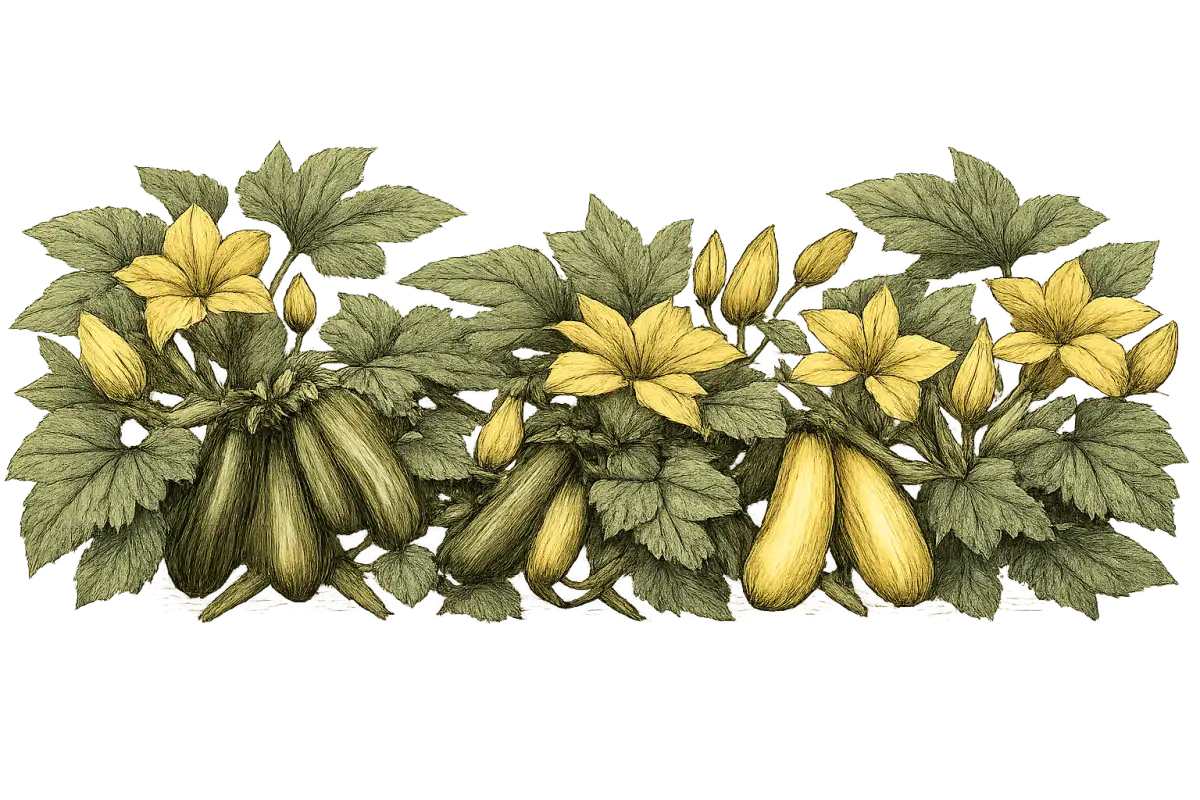
Cold Zones (3-4): Race Against the Calendar
The growing window in zones 3 and 4 is tight -- 90 to 110 days between last and first frost. Soil reaches 70F in late May to early June. First frost arrives by mid-September. You get 2-3 succession plantings if you move quickly, and every day of maturity time matters.
Fast-maturing, disease-resistant varieties are the only logical choice here.
Green Machine (F1, 45 days) is your first-choice green zucchini. Fast to harvest, disease-resistant, open habit that makes finding fruit easy. From a late-May or early-June planting, you are eating by July. Sunglo (F1, 38-42 days) is the fastest disease-resistant variety on the market -- ideal for your last succession planting in late June to early July. If you need squash on the table quickly before frost closes the window, Sunglo gets there first.
Spineless Perfection (F1, 45 days) is worth growing for a practical reason: standard squash stems and leaf petioles are prickly. In zones 3-4 where you are checking plants every single day to maximize your short window, spineless plants are a quality-of-life improvement.
Dunja (F1, 47 days) brings genuine disease resistance -- powdery mildew, watermelon mosaic virus, zucchini yellow mosaic virus, and papaya ringspot virus -- which keeps plants productive for the entire short season instead of collapsing early.
For something different, Black Beauty (open-pollinated, 50 days) is the classic heirloom. Reliable producer. You can save seeds from year to year, which matters to some growers.
Zone 3-4 strategy: use black plastic mulch at every planting to gain that 5-10F soil warming advantage. Choose varieties 50 days or under for all plantings. Your last succession goes in late June to early July -- count back 55 days from your first frost date to confirm you have enough time.
Standard Zones (5-6): Great Conditions, One Serious Threat
Zones 5 and 6 offer 130-160 growing days and plenty of sun. Conditions are excellent for squash. The catch, if you garden east of the Rocky Mountains, is squash vine borer. In zones 5 and 6, adults emerge in late June to early July. A single larva can kill an otherwise healthy plant in days.
Variety selection here is partly about disease resistance and partly about timing your way around vine borers.
Dunja (F1, 47 days) is the gold standard for zones 5-6. Its disease resistance -- powdery mildew, watermelon mosaic virus, zucchini yellow mosaic virus, papaya ringspot virus -- extends productive plant life well into late summer when less-resistant varieties are already succumbing. Desert (F1, 48 days) adds cucumber mosaic virus resistance on top of everything Dunja covers, making it the broadest disease package available in a green zucchini.
For yellow squash growers: Success PM (F1, 50 days) is the right call. Its powdery mildew resistance is exceptional -- it stays green and productive in humid Midwest and Mid-Atlantic summers when other yellow squash are dead or dying.
Costata Romanesco (open-pollinated, 52 days) is worth growing for flavor alone. This Italian heirloom produces ribbed, gray-green fruit with dense, nutty flesh unlike anything you get from a hybrid. Less disease-resistant than Dunja, but worth the trade-off for at least one planting.
For vine borer defense: Tromboncino (C. moschata, 60 days) is the weapon of choice. This long-necked Italian squash is the most vine-borer-resistant summer squash available because its hard stem tissue is nearly impenetrable to larvae. It needs trellis space or room to sprawl, but if vine borers have destroyed your squash three years running, this is the solution. Plant it alongside a standard variety for reliability.
Zone 5-6 strategy: plant your first succession mid-May, then every three weeks through mid-July. Your July plantings naturally dodge the vine borer egg-laying window -- adults in most northern areas finish by mid-July. This is the most underused strategy in zone 5-6 gardening. Later plantings also face less squash bug pressure and carry into fall.
Long-Season Zones (7-8): Managing Heavy Pressure
Zones 7 and 8 give you 180-240 growing days. That sounds great, and it is -- if you can manage the pests. Two generations of squash vine borer. Persistent squash bugs all season. High summer humidity that drives powdery mildew and fungal disease. And extreme heat above 95F that causes blossom drop in midsummer.
Disease resistance is not optional here. It is the price of admission for a productive summer.
Dunja and Desert both belong in zone 7-8 gardens for the same reasons they work in zones 5-6, but the stakes are higher because disease pressure is heavier and the season is longer. Sunglo (F1, 38-42 days) earns its place at the other end of the spectrum: its speed lets you squeeze in extra successions before and after peak heat and pest windows.
Tatume (open-pollinated, 55 days) is a Mexican heirloom that deserves wider recognition. It is unusually heat-tolerant, handles temperatures that cause standard zucchini to stall, and has good vine borer tolerance. Round, light green fruit with a vining habit. If you have experienced midsummer production crashes from heat or vine borers, Tatume is worth growing.
Tromboncino (C. moschata, 60 days) is even more valuable in zones 7-8 than in zones 5-6, because two generations of vine borer rather than one dramatically raises the risk. Plant it on a trellis and let it climb -- it is a vigorous viner.
University of Maryland recommends planting the fall crop on July 1-15 in zone 7. This is the move that most zone 7-8 gardeners do not make, and it changes the game. Fall squash misses peak SVB pressure, faces reduced squash bug populations, and produces into November. Do it.
When temperatures exceed 95F, consider 30-40% shade cloth to prevent blossom drop. Extreme heat shuts down pollination -- pollen becomes nonviable, female flowers drop before setting fruit. Shade cloth and consistent watering are your tools against this.
Hot Zones (9-10): Two Windows, One Heat Gap
Zone 9-10 gardeners have nearly year-round potential -- and a brutal summer gap. Spring planting runs February through March. Spring harvest runs through May and June. Then temperatures hit 100F+ and production stalls. Fall planting begins again in August and September, with harvest running October through December (and longer in frost-free areas).
Work the two windows aggressively. Accept the gap.
Tatume is the standout variety for zones 9-10. It is genuinely heat-tolerant in ways that standard zucchini varieties simply are not. Where most zucchini stall and sulk above 95F, Tatume keeps going. Its vining habit is an advantage in this zone -- the long rambling stems can be trained away from paths and onto trellises. Desert (F1, 48 days) is the disease-resistance workhorse -- named appropriately, it performs in hot, dry conditions with broad disease protection.
Green Machine (F1, 45 days) and Sunglo (F1, 38-42 days) earn their spots through speed. Fast maturity means you produce more fruit before heat or cold closes each window. A 38-day variety planted in late February can have you harvesting before mid-April.
Tromboncino (C. moschata, 60 days) adds another C. moschata option for heat tolerance and pest resistance. Give it a trellis and room to run.
Zone 9-10 strategy: plant fast-maturing varieties (38-50 days) for both spring and fall windows. If attempting summer production, 30-40% shade cloth is nearly mandatory. Choose the sunniest spot in your yard for all plantings -- 8-10 hours of direct sun is your target even in hot zones.
Quick Reference: Top Picks by Zone
| Zone Group | Top 3 Varieties | Type | Why |
|---|
| 3-4 | Green Machine, Sunglo, Dunja | F1 Hybrids | Fast maturity; disease resistance for short seasons |
| 5-6 | Dunja, Desert, Tromboncino | Hybrid + C. moschata | Disease resistance; vine borer insurance |
| 7-8 | Dunja, Tatume, Tromboncino | Hybrid + OP | Heat and pest pressure; two SVB generations |
| 9-10 | Tatume, Desert, Green Machine | OP + F1 Hybrid | Heat tolerance; fast maturity for two short windows |
Watering: The Method Matters More Than the Amount
The target water requirement for summer squash is simple: 1 inch per week from rainfall or irrigation. The University of Minnesota, University of Maryland, South Dakota State, and Oregon State extension programs all land on the same number. Adjust upward during hot spells above 90F, during peak fruit production when plants transpire heavily, and in sandy soils that drain quickly. Reduce when rain is abundant.
That part is easy. What trips people up is how they deliver that water.
Drip Irrigation Is the Answer
Every major extension program recommends drip irrigation or soaker hoses for squash. This is not a matter of debate or gardener preference. Overhead watering is genuinely harmful to squash in a way that is not true for every plant.
Here is the mechanism: wet foliage creates the warm, humid microclimate that powdery mildew, downy mildew, anthracnose, and bacterial leaf spot all require to establish and spread. The powdery mildew spores germinate on dry leaf surfaces in humid air -- and overhead watering creates exactly that combination, warm air thick with moisture and leaf surfaces that stay damp for hours. Soil splashing onto lower leaves carries soilborne pathogens directly to plant tissue.
Drip irrigation eliminates all of this. Water goes to the root zone. Foliage stays dry. Disease pressure drops dramatically. The setup is not expensive -- lay drip tape along the base of plants with emitters 6-12 inches from the stem, run 30-60 minutes per session, and add a $15-30 battery timer for automated consistency.
Soaker hoses work nearly as well and are cheaper to set up. They are less precise than drip emitters but keep leaves dry and deliver water slowly to the root zone.
If overhead watering is your only option, water before 7 AM so leaves dry quickly. Never water in the evening. Wet leaves overnight dramatically increases disease risk, full stop.
Water Deeply, Not Frequently
The goal is moisture at 6-8 inches deep. Shallow, frequent watering grows shallow roots. Shallow roots cannot sustain a large squash plant through heat stress. Water deeply and let the top inch of soil dry between waterings. Push a finger or a probe into the soil -- if it is moist at 6-8 inches, you have done your job.
Flowering and Fruit Set: The Critical Window
Inconsistent watering during flowering and early fruit set is the direct cause of blossom end rot. That dark, water-soaked rot on the bottom of developing fruit is not caused by low calcium in most cases -- most soils have plenty of calcium. It is a calcium transport failure. Calcium moves through the plant only via transpiration, and when water supply fluctuates, calcium transport stops. Developing fruit cells that do not get calcium at the right moment die and rot.
This is the period where drip irrigation with an automated timer most clearly pays for itself. Rock-steady moisture delivery during the four to six weeks of peak flowering and fruit set prevents blossom end rot more reliably than any other single action.
Normal Afternoon Wilt: Do Not Panic
Large-leaved plants like squash wilt on hot afternoons even with perfectly adequate soil moisture. This is normal transpiration stress -- the leaves are losing water faster than roots can replace it during peak heat. If the plant recovers fully by the next morning, your watering is fine. Check soil moisture at 6-inch depth before reaching for the hose.
Pests: The Ones That Actually Matter
Six pests account for nearly all insect damage to summer squash in home gardens. Three of them require active management. The others can be handled reactively.
Squash Vine Borer: Know Your Geography
If you garden east of the Rocky Mountains, squash vine borer is a real threat and you need a plan for it. If you garden west of the Rockies, vine borers are rare to absent. Pacific Northwest and California gardeners can largely ignore this section and focus elsewhere.
For everyone east of the Rockies: the adult is a day-flying moth that resembles a wasp -- metallic greenish-black front wings, orange-red abdomen. It lays flat, reddish-brown eggs singly at the base of squash stems. Eggs hatch in 7-10 days. Larvae bore directly into the stem and feed inside for 4-6 weeks, destroying the vascular tissue. By the time you notice the wilting, they have been at work for days.
The diagnostic sign is frass at the stem base -- moist, greenish or orange sawdust that looks like someone sprinkled wet wood shavings at the soil line. If you see frass, you have vine borers.
Timing varies by zone:
- Zone 8-10 (Deep South): adults emerge late April to May
- Zone 7 (Mid-Atlantic, Southeast): late May to early June
- Zone 5-6 (Midwest, Northeast): late June to early July
- Zone 3-4 (Upper Midwest, New England): early to mid-July
Zones 3-6 see one generation per year. Zones 7-10 see two -- which is why the problem is so much harder to manage in the South.
Prevention options, ranked:
1. Row covers from planting through flowering. Remove for pollination (unless using parthenocarpic varieties that set fruit without bees). Prevents moth access entirely.
2. Delayed planting. In zones 5-6, a July planting naturally misses the adult egg-laying window. Shorter season, zero vine borer damage. This works.
3. Stem wrapping. Wrap the bottom 2-4 inches of stems with aluminum foil. Prevents egg-laying and blocks young larvae. Rewrap every 10 days as stems thicken.
4. Trap crop with Blue Hubbard squash. Plant Blue Hubbard around the garden perimeter 2-3 weeks before your main crop. Vine borers preferentially attack Hubbard. Monitor the trap crop and destroy concentrated pests before they reach your main planting.
5. Grow resistant species. Tromboncino (C. moschata) is the most vine-borer-resistant summer squash you can grow. Its stem tissue is hard enough that larvae struggle to penetrate it. Butternut (C. moschata) is practically immune -- but that is a winter squash.
If you find frass: Perform vine surgery immediately. Slit the stem lengthwise at the entry point with a sharp knife. Find the cream-colored grub with the brown head -- it can be up to an inch long -- and kill it. Mound moist soil over the wound and keep the plant well-watered. Plants can recover if caught early enough.
Squash Bugs: Check the Undersides
Squash bugs -- dark brown, 5/8-inch shield-shaped insects that smell terrible when crushed -- overwinter as adults and emerge to lay neat rows of orange-yellow eggs on leaf undersides. Adults and nymphs suck plant juices and inject a toxin that causes leaves to wilt, blacken, and die. Heavy infestations kill plants outright.
The most effective single action is checking leaf undersides weekly and scraping off egg masses with a butter knife or tape. Do this consistently and you manage squash bugs without ever reaching for a spray bottle. Hand-pick adults and nymphs in the morning when they are sluggish. Place boards under plants at night -- bugs congregate underneath -- and destroy them in the morning. Remove all plant debris at season end to eliminate overwintering habitat.
Cucumber Beetles: The Disease Problem
Striped cucumber beetles (yellow-green with three black stripes) and spotted cucumber beetles (yellow-green with 11 black spots) are present through most of the eastern United States. The feeding damage is bad enough on its own. But the real danger is that cucumber beetles are the primary vector for bacterial wilt (Erwinia tracheiphila). Once a plant has bacterial wilt, there is no cure. Row covers at planting, kaolin clay (Surround) applied to leaves and stems, and neem oil repellent all reduce exposure. Yellow sticky traps monitor population levels.
Aphids, Spider Mites, and Pickleworms
Aphids (melon aphid, Aphis gossypii) cluster on leaf undersides, transmit cucumber mosaic virus, and spread rapidly. A strong spray of water knocks them off and, repeated every few days, keeps populations down. Encourage natural predators -- ladybugs, lacewings, parasitic wasps. Avoid broad-spectrum insecticides that wipe out the beneficial insects doing your pest management for free.
Spider mites explode in hot, dry conditions. The giveaway is fine webbing on leaf undersides and pale, stippled leaf surfaces. Strong water spray and two applications of insecticidal soap five days apart handle most outbreaks.
Pickleworms are primarily a problem in zones 8-10. They tunnel into flowers, buds, and fruit. Spinosad spray applied in the evenings when buds and flowers first appear -- repeat every seven days -- is the organic control of choice.
 Where to Plant