Flowers

Dahlias: Everything You Need to Know to Grow Them Spectacularly

Margaret Chen

Margaret Chen

Flower & Ornamental Specialist · Updated April 2026

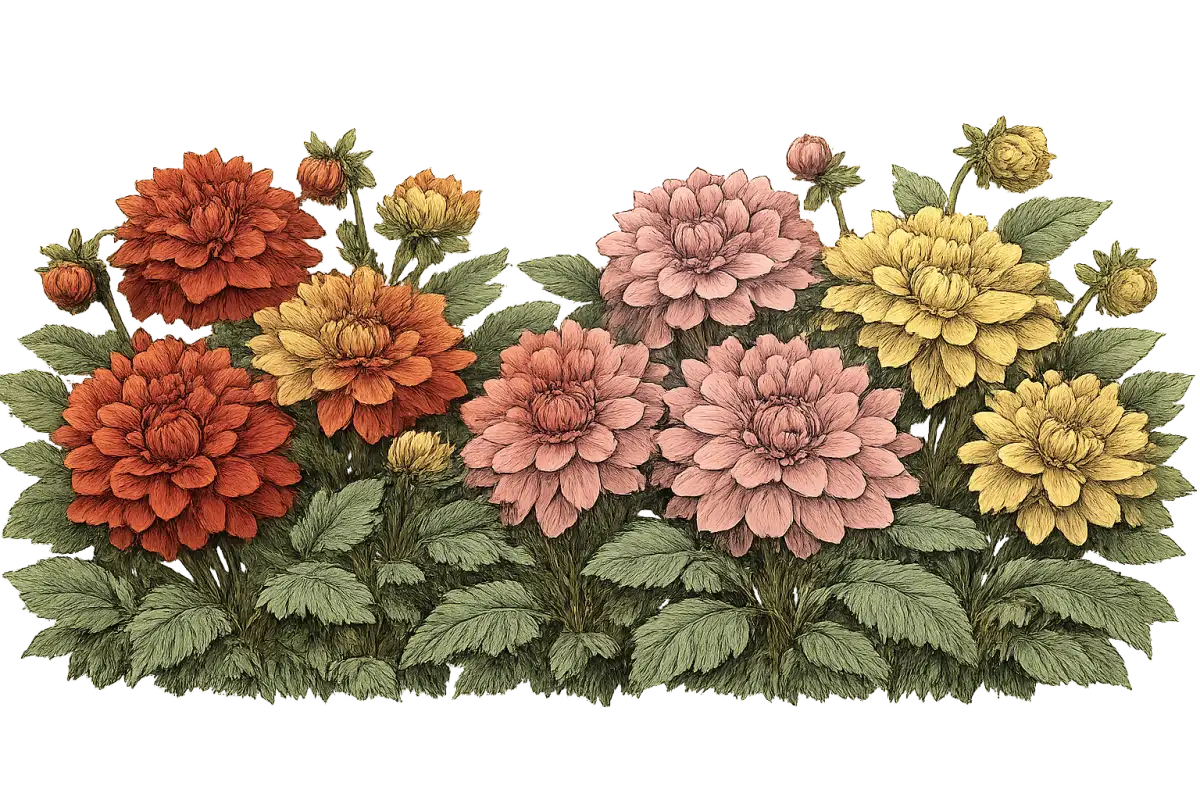
How to grow dahlias — vintage botanical illustration showing the plant in detail

Dahlias at a Glance

Sun

Sun

6-8 hours full sun

Soil pH

Soil pH

6.0-7.0

Water

Water

1 inch per week once actively growing (none before shoots emerge)

Spacing

Spacing

18-24"

Height

Height

3-5+ feet

Soil type

Soil

Well-drained soil

Lifespan

Lifespan

Tender perennial

Get your personalized growing data

Enter your zip code for frost dates, growing season, and soil type.

There is a moment in late August when a dahlia garden reaches its full expression -- dinner plate blooms the size of a child's face, ball dahlias in lacquered coral and burgundy, cactus types with petals that spiral like fireworks -- and it stops people mid-step. I have seen it happen in gardens I have visited across the country. The plants command attention in a way almost nothing else in the ornamental world can match.

What makes that moment remarkable is how unlikely it seems from the starting point. You begin with a tuber that looks like a small, shriveled hand. You place it in the ground in spring, and if you do not touch it -- do not water it, do not fuss over it -- it slowly becomes something extraordinary. Dahlias reward patience and restraint in their early weeks, then reward generosity and attention in their peak weeks, and then ask you to tuck them safely away for winter. They operate on their own clear terms.

Those terms are the subject of this guide. Dahlias are not temperamental plants, but they do have specific needs -- and two or three of those needs are the kind where getting them wrong means nothing grows at all. Understanding drainage, knowing when not to water, choosing varieties suited to your zone, and keeping up with deadheading are what separate a garden that stops people in their tracks from one that produces a few straggling blooms before sulking into September.

Whether you are planning your first planting or trying to understand why last year's tubers never came up, this guide covers everything from soil preparation through overwintering, with specific variety recommendations for every zone from Minnesota to Southern California.


Quick Answer: Dahlias at a Glance

USDA Zones: 3-11 (dig tubers in zones 3-7; leave in ground in zones 8-11)

Sun: Minimum 6 hours direct sunlight daily; 8+ hours ideal

Soil: Well-drained, slightly acidic to neutral (pH 6.0-7.0); drainage is non-negotiable

Planting depth: 4-6 inches deep, eye facing up; cover with 2-3 inches initially

Spacing: 18-24 inches; dinner plate varieties up to 3 feet apart

Water: Do NOT water after planting until shoots emerge; then deep, infrequent watering

Fertilizer: Low nitrogen, higher phosphorus and potassium (5-10-10); stop by late August

Stakes: Install at planting time, before covering the tuber -- never after

First blooms: Approximately 8 weeks after planting; peak bloom August through September

Bloom colors: Every color except true blue -- white, cream, yellow, peach, orange, pink, red, dark red, purple, near-black, and countless bicolors


The One Thing That Kills Most Dahlias (And It Is Not What You Think)

Before we talk about beauty and variety selection and how to build a cutting garden that carries you through autumn, there is something you must understand. It is not glamorous, but getting it wrong ends your dahlia season before it starts.

Do not water your tubers after planting.

Not even a little. Not "just to settle the soil." Not "just a quick drink to get them going." Every source on dahlia growing agrees on this single rule more than any other: dormant tubers sitting in moist soil rot. They rot because a dormant tuber cannot absorb or use water. The moisture simply sits around it, providing the perfect environment for fungal and bacterial rot to take hold. You plant a firm, healthy tuber in May and dig up a soft, disintegrating mass in June -- and wonder what went wrong.

The tuber contains enough moisture to initiate growth on its own. Your job is to leave it alone. Shoots typically emerge within 2-3 weeks but can take up to 5 weeks. The patience required during this waiting period is the hardest thing about growing dahlias. Resist it.

The only exception is genuinely bone-dry soil with no rain forecast for weeks -- in that rare situation, a single light watering is acceptable. But in most spring gardens, the soil has more than enough residual moisture. Trust the tuber.

The second piece of this same problem: drainage. Dahlias require well-drained soil with an almost-unreasonable conviction. Even when you are not actively watering, a low-lying bed or heavy clay soil that holds water after rain creates the same conditions as overwatering. Before you plant a single tuber, test your drainage. Dig a hole 12 inches deep, fill it with water, let it drain, fill it again. If that second fill takes more than four hours to empty, your soil needs amendment or you need raised beds. A 12-inch raised bed filled with a mix of garden soil, compost, and perlite solves drainage problems permanently and warms up faster in spring -- both significant advantages.

Get the drainage right. Do not water before shoots emerge. These two things prevent the vast majority of dahlia failures.


Choosing Your Dahlias: Form, Color, and Purpose

This is where dahlia growing becomes genuinely delightful, because the range of choice is staggering. The American Dahlia Society recognizes approximately 14 flower forms. Nine of them appear regularly in home gardens, and each creates a different effect.

Dinner plate dahlias -- officially called decorative dahlias in the large and giant classes -- are what most people picture when they imagine a dahlia at its most dramatic. Blooms reach 8-12 inches across on plants that stand 3-5 feet tall. Cafe au Lait is the most requested dahlia in the world right now, and with reason -- its creamy, blush-peach tones photograph beautifully and work in everything from cottage gardens to modern arrangements. Thomas Edison offers a deep, saturated royal purple that makes a vivid statement at the back of a border. Kelvin Floodlight produces enormous clear yellow blooms with surprising stem strength. Penhill Dark Monarch brings a dark burgundy-plum so rich it reads almost black in certain light. All dinner plate varieties require heavy staking and are best grown with disbudding -- removing the two side buds when three appear at a branch tip -- to concentrate the plant's energy into one spectacular central bloom.

Ball dahlias are among the best-designed cut flowers in existence. Their globe-shaped blooms are densely packed with petals that spiral precisely to the center, and they last significantly longer in a vase than dinner plates. Wizard of Oz in salmon pink is both prolific and stunning in arrangements. Jomanda in dark orange-red has exceptional vase life. Cornel in dark red is a reliable, unfussy producer that blooms steadily from midsummer through frost.

Pompon dahlias are ball dahlias scaled down to under 2 inches -- perfectly round, endlessly charming, and extraordinarily prolific. Franz Kafka in purple is one of the best-known pompons, producing masses of round blooms with geometric precision. Little William in red and white bicolor adds a playful note to borders and mixed arrangements. Pompons tend to bloom earlier than dinner plates and handle heat somewhat better, making them particularly good choices in zones 3-5 where the season is short.

Cactus and semi-cactus dahlias have pointed, reflexed petals that spiral outward like fireworks, giving them an architectural quality that suits modern and naturalistic gardens equally well. Nuit d'Ete in dark red and Alfred Grille in a pink-and-yellow blend are two cactus classics. Karma Choc in dark chocolate-maroon is a semi-cactus type that has become enormously popular for its unusual coloring.

For pollinator gardens and relaxed, naturalistic plantings, single dahlias -- open-centered, daisy-like blooms -- are the most ecologically generous choice. Bees access the pollen with ease, something they cannot do in the dense doubles. The Bishop series -- Bishop of Llandaff with its scarlet blooms against near-black foliage, Bishop of Canterbury in purple -- are among the most striking dahlias in any form, and their dark foliage extends their ornamental value well beyond bloom time.

Collarette and anemone types offer beautiful mid-sized flowers with interesting centers. Boogie Woogie in yellow and pink is one of the most distinctive anemone dahlias available, with a pincushion center that draws the eye in the garden. Waterlily types like Karma Sangria produce broad, cupped blooms with a refined elegance that reads as more restrained than dinner plates -- beautiful in gardens where you want impact without drama.

The one color missing from this entire genus: true blue. Dahlias come in virtually everything else -- white through cream through gold through every shade of orange, the full spectrum of pinks, cherry red through dark maroon, lavender through purple through near-black -- but blue does not exist in dahlias. If your garden palette requires blue, pair dahlias with salvias, agapanthus, or Russian sage.


Best Dahlias by Zone: What to Grow and When to Plant

Dahlias are native to the highlands of Mexico, tender perennials that are only truly cold-hardy in USDA zones 8-11. In zones 3-7, which is where most American dahlia gardeners live, tubers must be dug and stored each winter. This is less inconvenient than it sounds -- the digging process is simple, and the storage requirements are modest -- but it does mean your zone shapes not just which varieties you grow but how you manage your entire season.

What zone are you in?

Enter your zip code for frost dates, growing season, and soil type.

Cold Zones (3-4): Racing the Frost

In zones 3 and 4 -- the upper Midwest, northern Minnesota, the Dakotas, northern New England -- winter lows reach -40F to -20F and the growing season runs only 90-140 days. Tubers cannot stay in the ground. They must be dug, stored, and replanted each year without exception.

The strategic challenge here is time. Without intervention, dahlias need roughly 8 weeks from planting to first bloom. In a zone 3 garden where the soil is not workable until June and frost returns in September, that math leaves very little margin. Pre-sprouting is the solution, and in zones 3-4 it is essentially mandatory for anyone who wants a real dahlia season.

Start tubers indoors 4-6 weeks before your outdoor planting date. Place them in shallow trays with damp potting mix in a bright, warm location -- 65-75F. Do not water until you see green sprouts emerging; the same no-water rule applies indoors as in the garden. When sprouts are 2-4 inches tall and all frost danger has passed, transplant outdoors carefully. Pre-sprouted dahlias can begin blooming by late June instead of mid-July, adding 4-6 meaningful weeks to your bloom window.

Choose varieties that bloom relatively quickly and produce reliably in shorter windows. Bishop of Llandaff is a proven performer in northern zones, blooming faster than most dinner plates. Mystic Illusion in yellow with dark chocolate foliage is another quick-to-bloom single with outstanding ornamental value. Among pompons, Franz Kafka earns its place in zone 3 and 4 gardens with reliable, prolific bloom production. For cut flowers with reasonable bloom speed, Wizard of Oz in salmon pink delivers beautifully. Smaller flower types -- balls, pompons, singles -- generally reach bloom faster than dinner plates, which is an important consideration when every week counts.

Plant outdoors in early to mid-June once soil reaches 60F. Install stakes at planting time. Dig tubers 1-2 weeks after the first killing frost, label everything before cutting back stems, and store at 40-50F through the long winter.

Standard Zones (5-6): The Dahlia Sweet Spot

Zones 5 and 6 offer a growing season of 140-180 days -- long enough for every dahlia type to perform beautifully, including the slow-developing dinner plates. This is where dahlia growing is most straightforward, and the variety options are essentially unlimited.

Plant in late May to early June when soil temperature reaches at least 60F. Pre-sprouting is beneficial but not essential here; with a full-length season you will get excellent bloom even from direct-planted tubers. Bloom runs from mid-July through October, and with frost cloth and a bit of late-season vigilance you can often push into the first weeks of November.

For garden display, Cafe au Lait is one of the most compelling plants you can put in a zone 5 or 6 border -- it blooms prolifically, requires only that you stake and deadhead faithfully, and the color works with almost everything. Pair it with Thomas Edison for a sophisticated contrast of blush and deep purple. Kelvin Floodlight provides bright, clear yellow that reads beautifully at the back of a border or against a dark fence.

For cut flowers, Otto's Thrill in large pink produces excellent stem length and is a favorite among dahlia growers who cut heavily. Labyrinth in peach-apricot blends creates arrangements that look effortlessly complex. Jomanda and Cornel in the ball forms give long vase life to any mixed bouquet.

For pollinator support, the Honka series -- open-centered orchid and stellar types -- provides excellent bee access. Bishop of Llandaff is perhaps the most beautiful pollinator dahlia in existence, with its open scarlet blooms burning against near-black foliage.

Tubers must be dug in fall in both zones 5 and 6. The window between first frost and hard ground freeze gives you reasonable time; in zone 5 especially, keep an eye on your 10-day forecast in early October so you are not caught off guard.

The Borderline Zone (7): More Options, More Decisions

Zone 7 offers a 180-210 day growing season and bloom from July into November -- one of the longest dahlia seasons in the country. The defining question here is overwintering: can you leave tubers in the ground?

The honest answer is: sometimes. Zone 7 winters vary significantly by year, and success in the ground depends heavily on your microclimate (south-facing slopes and urban areas run warmer), your soil drainage (wet, cold soil is far more damaging than cold alone), and the severity of any given winter. Some zone 7 gardeners report years of success leaving tubers in the ground under 6-8 inches of heavy mulch. Others lose their entire collection in a cold snap. The safest approach is to dig and store your best varieties as you would in colder zones, while experimenting with a few expendable tubers left in the ground to see what your specific site allows.

The full range of dahlia types performs beautifully in zone 7. The long season allows even late-blooming dinner plates to reach their peak. If you have never grown dahlias before and are in zone 7, start with a dinner plate variety like Cafe au Lait, a ball type like Jomanda, and a single like Bishop of Llandaff -- this combination covers three forms, several color families, and a range of bloom timing.

Warm Zones (8-11): Year-Round Roots, Summer Patience

In zones 8-11, tubers generally survive winter in the ground with minimal protection -- cut back dead foliage, leave a few inches of stem to mark locations, apply 2-3 inches of mulch, and they will be waiting for you in spring. In zone 8, an exceptional cold snap can still damage tubers, so mulch is important rather than optional. Some zone 8-11 growers still dig and divide every 2-3 years to prevent overcrowding as clumps expand.

Planting can begin as early as mid-April in zone 8, March in zones 9-10 once frost risk has passed. The bloom season runs from July through November in zone 8 and from June through November in zones 9-10 -- but there is a catch in the hottest zones. When temperatures exceed 95F, dahlias typically pause blooming entirely. This is a normal physiological response, not a sign of distress. Plants resume flowering as temperatures moderate in early fall, often producing their most beautiful blooms in September and October. Managing for this mid-summer pause means providing afternoon shade, deep mulching to keep roots cool, consistent watering during heat waves, and patience.

In zones 9-10, smaller-flowered types -- balls, pompons, singles, and collarettes -- handle heat better than dinner plates. The Bishop series performs reliably in warm zones. Dark-foliage varieties often show less visible heat stress than green-leaved types. For the best results in hot climates, think of dahlias as autumn-flowering plants that you are cultivating through summer rather than summer-flowering plants that happen to survive heat.

Quick Reference: Top Varieties by Zone

Zone GroupTop VarietiesFormWhy
3-4Bishop of Llandaff, Mystic Illusion, Franz KafkaSingle, PomponFast to bloom; reliable in short seasons
5-6Cafe au Lait, Otto's Thrill, JomandaDinner Plate, Decorative, BallFull season allows all forms; proven performers
7Cafe au Lait, Thomas Edison, CornelDinner Plate, BallLong season; no form restrictions
8-9Bishop of Llandaff, Wizard of Oz, Franz KafkaSingle, Ball, PomponHeat tolerance; reliable in warm zones
9-10Bishop series, ball and pompon typesSingle, Ball, PomponSmaller forms handle heat better

Soil, Planting, and the Art of Getting Started

Preparing the Soil

Dahlias prefer a pH of 6.0-7.0 -- slightly acidic to neutral, which is the range most garden soils already fall within. Unlike some ornamentals with demanding pH requirements, dahlias are flexible on acidity. What they are not flexible about, as we have already established, is drainage.

Sandy loam is the ideal native soil for dahlias -- it drains freely while retaining enough moisture and nutrients to support vigorous growth. If you have it, a light amendment of 1-2 inches of compost worked into the top 8-10 inches is all you need. Most gardeners are not so lucky.

Heavy clay is the most common problem. Clay retains too much water and compacts around tubers, inviting the rot that kills so many dahlia plantings. Amend generously: spread 3-4 inches of compost or aged manure across the planting area and work it in to 8-10 inches deep. Add coarse perlite or horticultural grit. Do not use fine sand -- it combines with clay to create something approaching concrete. If your clay is severe, build raised beds and fill them with a 50/30/20 mix of garden soil, compost, and perlite. The investment pays itself back within a single season.

Sandy soil presents the opposite problem -- it drains too quickly and holds few nutrients. Add 3-4 inches of compost or aged manure for water and nutrient retention, and plan for more frequent fertilization since nutrients leach rapidly through sand.

At planting time, mix a balanced fertilizer -- 5-10-10 or 10-10-10 -- into the soil across the planting area. Phosphorus (the middle number) is what drives bloom production, so a ratio that emphasizes it over nitrogen is ideal for dahlias. Add a small handful of bone meal to the bottom of each planting hole for direct phosphorus at the root zone.

Planting Step by Step

Install stakes before you plant. This is the golden rule of dahlia staking, and it prevents a world of problems later. A 5-6 foot stake driven into empty soil at planting time creates a clear guide for the plant as it grows. Driving stakes after the fact -- when roots and tubers are established underground -- risks spearing the tuber or breaking the root system. If you find you cannot stake at planting time for whatever reason, tomato cages placed over the planting site work well for medium-sized varieties.

Then plant:

1. Dig a hole 4-6 inches deep.

2. Place the tuber horizontally with the eye facing up. Examine the tuber carefully before planting -- the eye is a small bump, pink or green nub located on the crown or neck where the tuber connects to the old stem. Not on the body of the tuber. If you cannot find an eye, do not plant that tuber. A tuber without an eye will never grow regardless of how perfect your soil is.

3. Cover with 2-3 inches of soil initially, not the full depth. As sprouts emerge, gradually fill the remaining hole. This gradual backfilling reduces the moisture that sits around the still-dormant tuber.

4. Do not water. Apply iron phosphate slug bait (Sluggo or equivalent) around the planting area immediately -- before shoots emerge, not after you see damage.

5. Wait. Shoots typically emerge in 2-3 weeks but can take 5. Once green growth appears above the soil, begin watering.

Once shoots are 8-12 inches tall with 3-4 sets of leaves -- typically 2-4 weeks after emergence -- consider pinching. Identifying the central growing tip and removing the top 3-4 inches transforms one tall stem into 4-8 branching stems, each capable of flowering. The trade-off: more blooms, slightly smaller individual flower size, shorter stems. For garden display and mass color, pinching is almost always the right choice. For cut flowers or exhibition blooms where stem length and size are paramount, skip it.

Apply 2-3 inches of organic mulch -- straw, shredded bark, or aged wood chips -- once shoots are growing actively. Not before. Premature mulching over dormant tubers traps moisture and creates exactly the conditions you are trying to avoid. Keep mulch a few inches away from stems.


Watering and Feeding: What Dahlias Need Once They Are Growing

Watering the Growing Plant

Once shoots have emerged and the plant is actively growing, the watering approach shifts entirely. Now you want deep, infrequent watering that encourages roots to grow downward. The standard guideline is to water deeply whenever weekly rainfall falls below one inch. Push a finger into the soil near (but not against) the plant -- if the top 2-3 inches are dry, water deeply enough to soak the top 6-8 inches of soil. If still moist, wait.

Drip irrigation is the preferred delivery method. It brings water directly to the root zone without wetting foliage, which matters because wet foliage is the primary driver of powdery mildew -- the most common fungal disease in dahlias. Soaker hoses work equally well for rows of plants. If overhead watering is your only option, do it in early morning so foliage dries quickly. Never water in the evening; leaves that stay wet through the night invite both powdery mildew and botrytis (gray mold).

During heavy bloom in July and August, and during heat waves in warm zones, dahlias consume more water than at any other point in the season. Increase accordingly. In zones 9-10 during summer heat spikes, daily watering may be necessary. Persistent morning wilting -- not afternoon wilt, which is normal and temperature-related -- indicates genuine drought stress.

Container dahlias need significantly more attention. Check soil moisture daily and water when the top inch is dry. In summer, twice-daily watering is sometimes necessary. Make sure drainage holes are clear and that the pot is not sitting in standing water.

Fertilizing for Blooms

Dahlias are heavy feeders -- they grow from a small tuber to a 3-5 foot plant covered in dozens of large blooms in a single season, and that takes substantial nutrition. The key is feeding the right nutrients: low nitrogen, higher phosphorus and potassium.

Nitrogen makes plants grow big and green. Too much of it produces exactly that -- tall, lush, impressive-looking plants with remarkably few flowers. This is one of the most common and frustrating dahlia mistakes: the garden that looks healthy in July and barely blooms in August, because someone fed it lawn fertilizer or a high-nitrogen all-purpose blend. A 5-10-10 fertilizer applied monthly as a side-dressing from June through early August is the reliable standard. Scatter it around the drip line of the plant, not against the stem, and water it in.

For organic growers, bone meal is an excellent phosphorus source and can be mixed into the soil at planting and applied as a side-dressing once flower buds begin forming. Kelp meal provides potassium and trace minerals that strengthen stems and support overall vigor. Fish emulsion works well early in the season when some nitrogen is welcome for initial growth, but transition away from it once buds appear. OSU Extension notes that dahlias produce abundantly with organic fertility methods -- this is not a plant that requires synthetic inputs to perform.

Stop all fertilizing by late August. This is not a guideline; it is a hard rule. Fertilizing in September stimulates soft new growth that will not harden off before frost and prevents the plant from redirecting energy into tuber development for winter storage. Tubers that have not hardened off properly store poorly and fail at higher rates. Feed generously through summer, stop cleanly at the end of August.

What zone are you in?

Enter your zip code for frost dates, growing season, and soil type.


Deadheading: The Task That Multiplies Your Flowers

If there is one ongoing maintenance practice that separates a spectacular dahlia planting from an adequate one, it is deadheading. The difference between a faithfully deadheaded plant and a neglected one is not subtle -- it is 3-5 times as many flowers over the course of the season.

When a dahlia bloom finishes and the spent flower remains on the plant, the plant reads this as a signal to produce seeds. Energy that would have gone toward forming new buds is diverted into seed maturation. What started as a prolific bloomer in late July slows noticeably through August and may produce only scattered blooms by September -- not because it has run out of ability, but because it has been told, by the presence of spent flowers, to stop.

The trick is knowing what a spent bloom looks like before it deteriorates completely. The most reliable method: look at the stem behind the flower rather than at the flower itself. A pointed, cone-shaped stem means the flower is finished. A rounded stem means a new bud is forming. Cut spent blooms back to a strong leaf joint -- a side branch junction -- rather than simply removing the flower head. Cutting back to a branch point triggers rapid re-branching and accelerates the appearance of new buds.

Deadhead at minimum once a week. Every few days is better. Some growers who are primarily interested in cut flower production deadhead daily. The season runs from first bloom through the killing frost, and the plant will produce continuously if you do not let it shift into seed production. Do not let it shift into seed production.


Pests, Diseases, and What to Do About Them

Dahlias are relatively trouble-free plants. That said, a few pests and diseases appear consistently enough that knowing them in advance prevents losses.

The Threats That Matter Most

Slugs are the primary pest threat, particularly to dahlias, and the threat is concentrated in the earliest weeks of the season. Emerging dahlia shoots are extraordinarily tender, and slugs can eat them to the ground overnight before you ever see them. By the time you notice the damage, the plant may have lost its only chance at growth from a given eye. The defense is simple and must be preemptive: apply iron phosphate bait (Sluggo or equivalent) immediately after planting, before shoots appear. Reapply through the early season. Once stems harden and thicken after a few weeks of growth, slug vulnerability decreases significantly. In cool, moist climates -- the Pacific Northwest especially -- slug control is not optional.

Powdery mildew is the most common fungal disease in dahlias. The white, powdery coating that appears on leaves and stems in late summer is driven by warm days, cool nights, high humidity, and poor air circulation -- conditions that exist in most gardens by late August and September. It rarely kills plants but weakens them and reduces late-season bloom quality. Prevention is far more effective than treatment: space plants properly for air circulation (18-24 inches minimum), avoid overhead watering, plant in full sun, and remove affected leaves promptly at the first sign of infection. Preventive neem oil or potassium bicarbonate sprays applied in late summer slow the progression.

Japanese beetles, where they occur -- primarily the eastern US in zones 4-8 -- skeletonize leaves by eating the tissue between veins. Hand-picking into soapy water is the most effective control for home gardens. Avoid pheromone traps; they attract far more beetles to your garden than they catch.

Aphids cluster on new growth and flower buds, sucking plant juices and excreting sticky honeydew. They are worth controlling promptly not just for the direct damage but because they are the primary vector for dahlia mosaic virus -- a disease for which no cure exists and which requires destroying infected plants. A strong blast of water from a hose knocks off most aphid infestations. Insecticidal soap handles persistent cases. Avoid excessive nitrogen fertilization, which produces the soft, lush growth that aphids find most attractive.

Earwigs chew ragged holes in petals, primarily at night, and hide inside double blooms during the day -- a particular nuisance for cut flower growers who bring blooms inside only to discover earwigs emerging from the petals. Rolled newspaper traps set out at night collect them efficiently. Soaking cut stems in lukewarm water for 10-15 minutes before arranging flushes them out.

Dahlia mosaic virus bears special mention because once it is present, there is nothing to be done. Mottled, yellowed foliage with light and dark green patterning, stunted growth, and distorted leaves are the signs. Infected plants must be dug up and destroyed -- not composted, burned or landfilled. Tubers from infected plants must not be saved. Purchase tubers from reputable sources that test for viruses, control aphid populations to prevent spread, and disinfect tools with a 10% bleach solution after working with any suspect plant.


Overwintering: Saving Your Tubers Through Winter

The Zone-by-Zone Decision

In zones 3-6, there is no decision to make: tubers must be dug and stored. No amount of mulch keeps the ground warm enough in these zones, and tubers left in the ground will freeze and die. Digging is the only path to keeping your collection.

Zone 7 is the complicated one. Some gardeners successfully leave tubers in the ground under 6-8 inches of heavy mulch; others lose their collections in harsh winters. The safest approach is to dig and store your most valued varieties while experimenting with a few expendable tubers left in the ground to understand what your specific microclimate allows. If your zone 7 garden has excellent drainage and a relatively sheltered position, you may find tubers survive reliably. If it is in a low spot with heavier soil, dig everything.

In zones 8-11, tubers generally stay in the ground year-round. Cut dead foliage back to a few inches above the soil (the stub marks the location), apply 2-3 inches of mulch, and they will be ready in spring. In zone 8, an unusual cold snap can still damage tubers -- do not skip the mulch.

When and How to Dig

The signal is the first hard frost -- temperatures below 28F that kill all above-ground growth, turning foliage and stems black overnight. But do not dig immediately. Wait 1-2 weeks after the first killing frost. Tubers continue developing slightly during this period, and the skin toughens, which improves storage outcomes. Do not wait so long, however, that the soil freezes around them. In zones 3-4, the window between first frost and hard ground freeze can be very short.

Before you cut a single stem: label every variety. Once foliage is removed, all dahlia clumps look identical. Losing track of which clump is which means losing the ability to intentionally replant your favorites. Use weather-resistant stakes or labels. Make a garden map if you have a large collection.

Cut dead stems to 4-6 inches above ground level. Dig with a garden fork starting at least 12 inches from the stem -- clumps can be 12-18 inches across and equally deep, and a fork slides between tubers where a sharp spade cuts through them. Lift the entire clump gently from below rather than pulling by the stem; tubers snap like carrots under tension. Air-dry clumps in a frost-free location for 1-2 days to toughen the skin.

Dividing and Storing

A single tuber planted in spring becomes a clump of 6-12 tubers by fall. You can store clumps undivided or divide them now; many experienced growers prefer to wait until spring for division because the growth eyes are more swollen and visible after winter dormancy, making it easier to ensure each division has at least one viable eye.

If you divide in fall: wash the clump clean, examine the crown area for small bumps or pink-green nubs, and cut individual tubers from the clump using a sharp, clean knife. Each division must include a piece of the crown with at least one visible eye -- this point cannot be overemphasized. A beautiful, plump tuber without an eye will never grow. Dust cut surfaces with sulfur powder or ground cinnamon to reduce rot risk; allow 24 hours for cut surfaces to callus before packing for storage.

Store tubers in slightly damp vermiculite or peat moss in cardboard boxes or plastic bins. Layer the medium, then tubers (not touching each other), then medium again. The ideal storage temperature is 40-50F, with 45F being the sweet spot. An unheated basement is often ideal in zones 3-5. An attached garage works in zones 5-7 but should be monitored closely in severe winters. An unheated detached garage in zones 3-5 is not acceptable -- these structures reach freezing temperatures that will kill stored tubers.

Check tubers monthly throughout winter. Shriveled tubers need a light misting or additional damp packing material. Soft, mushy, or moldy tubers must be removed immediately to prevent spread to healthy ones. Expect 10-20% loss even with good practices; factor this into how many divisions you save.


The Mistakes That End Dahlia Seasons Prematurely

We have covered the principles throughout this guide, but it is worth naming the most consequential errors directly, ranked by how frequently they destroy dahlia plantings.

Watering before shoots emerge is number one, and we have covered it thoroughly. It causes tuber rot, and tuber rot is the most common reason dahlias fail to emerge at all.

Planting tubers without eyes is number two. A tuber without a growth bud on its crown will never produce a plant regardless of how perfect your conditions are. Examine every tuber before it goes into the ground.

Skipping slug protection claims more emerging shoots than most gardeners realize, because the slugs feed at night and hide during the day. By the time you notice shoots are gone, the window for easy intervention has often closed. Apply bait before you see damage, not after.

Planting in cold soil is a close relative of the watering mistake. Cold soil (below 60F) keeps dormant tubers sitting in cool, damp conditions without sprouting, which dramatically increases rot risk. The same bloom timing results from planting two weeks early; the only difference is higher failure rates. Wait for 60F soil temperature. If you use the tomato rule -- if it is too early for tomatoes, it is too early for dahlias -- you will not go wrong.

Too much nitrogen fertilizer produces the deeply frustrating outcome of a lush, thriving-looking plant that barely flowers. Dahlias need low nitrogen, higher phosphorus and potassium. Use 5-10-10 or a bloom formula, not lawn fertilizer, and not the high-nitrogen all-purpose blends that work well for leafy plants.

Neglecting deadheading allows the plant to shift from flower production to seed production, and bloom output drops sharply. A deadheaded dahlia and a neglected dahlia are nearly different plants by September.

Wrong storage temperature during winter kills tubers that survived the growing season in perfect health. Below 35F and they freeze; above 55F and they sprout prematurely or rot from warmth. Maintain 40-50F.

What zone are you in?

Enter your zip code for frost dates, growing season, and soil type.


Frequently Asked Questions

How deep should I plant dahlia tubers?

Plant tubers 4-6 inches deep, placing them horizontally with the eye facing up. Cover initially with only 2-3 inches of soil, and fill in the rest gradually as sprouts emerge. This gradual backfilling reduces the moisture that sits around the dormant tuber during those critical early weeks.

When will my dahlias bloom?

Most dahlias bloom approximately 8 weeks after planting. Early varieties may bloom in 6 weeks; large dinner plate types can take 10-12 weeks. Peak bloom runs from August through September in most zones, with bloom production actually accelerating as nights cool in late summer and early fall. In zones 5-7, that mid-August-through-October window is when dahlias are at their most spectacular.

Do I have to dig dahlias every year?

In zones 3-7, yes -- tubers will not survive winter in the ground. In zones 8-11, tubers generally survive year-round with minimal protection. Zone 7 is the borderline; success in the ground depends on microclimate, drainage, and winter severity. When in doubt, dig your best varieties and experiment with a few expendable tubers left in the ground.

Why are my dahlias leafy but not blooming?

Almost certainly a nitrogen problem. High-nitrogen fertilizer drives vegetative growth at the expense of flower production -- the plant is thriving, just in the wrong direction. Switch to a low-nitrogen, higher-phosphorus fertilizer like 5-10-10 or apply bone meal, and stop any nitrogen-heavy feeding immediately. The plant will redirect its energy toward blooming as the nitrogen effect fades.

Can I grow dahlias in containers?

Yes, and they perform beautifully in containers with the right setup. Use a pot at least 12 inches in diameter for smaller varieties (pompons, balls, singles) and 18 inches or larger for dinner plate types. Fill with high-quality potting mix amended with 20-25% perlite for drainage -- never use garden soil in a container. Check moisture daily and water when the top inch is dry; container dahlias dry out significantly faster than in-ground plants. Figaro Mix and Unwin's Dwarf Mix are among the best seed-grown options for containers; for tuber-grown types, pompons and balls are the most compact and manageable.

What is the best dahlia for a beginner?

For someone growing dahlias for the first time, I recommend starting with a ball type. Wizard of Oz or Jomanda give you a flower form that is elegant but not demanding, excellent cut flower performance so your efforts have immediate rewards, and reliable bloom production without requiring disbudding or extraordinary staking. Pair it with Bishop of Llandaff for a complete planting that covers different forms, color families, and a range of ornamental interest. These are not beginner compromises -- they are genuinely beautiful plants that experienced growers also love.


The Bottom Line

Dahlias are not difficult plants. They are specific plants. The gardener who understands what dahlias need -- drainage above everything, no water before shoots emerge, stakes at planting time, low nitrogen, faithful deadheading, and protection in winter -- grows dahlias that stop people in their tracks. The gardener who does not understand these things tends to replace tubers every few years and wonder why their results are never quite what they hoped.

Get the soil right. Choose varieties suited to your zone. Install stakes at planting and walk away without watering. Once shoots appear, water deeply and feed with a bloom formula. Deadhead every few days from first flower through frost. In zones 3-7, dig and store your tubers before the ground freezes.

Do these things, and by late August you will have a garden that is almost unreasonably beautiful -- one of those plantings that makes visitors ask what you planted and how you managed it, when the answer is simply that you understood what dahlias asked of you and gave it to them.

Sources for this guide include Oregon State University Extension Service, the American Dahlia Society classification standards, and research and grower guides from multiple university extension programs. Variety recommendations reflect cultivar performance data and experienced grower consensus across USDA zones 3-11.

Where Dahlias Grows Best

Dahlias thrives in USDA Zones 5, 6, 7, 8, 9. Explore each zone's complete guide for growing tips, companion plants, and seasonal advice.

Also possible in: Zone 3, Zone 4, Zone 10 (challenging but possible with the right conditions).

Not sure of your zone? Look it up by zip code →