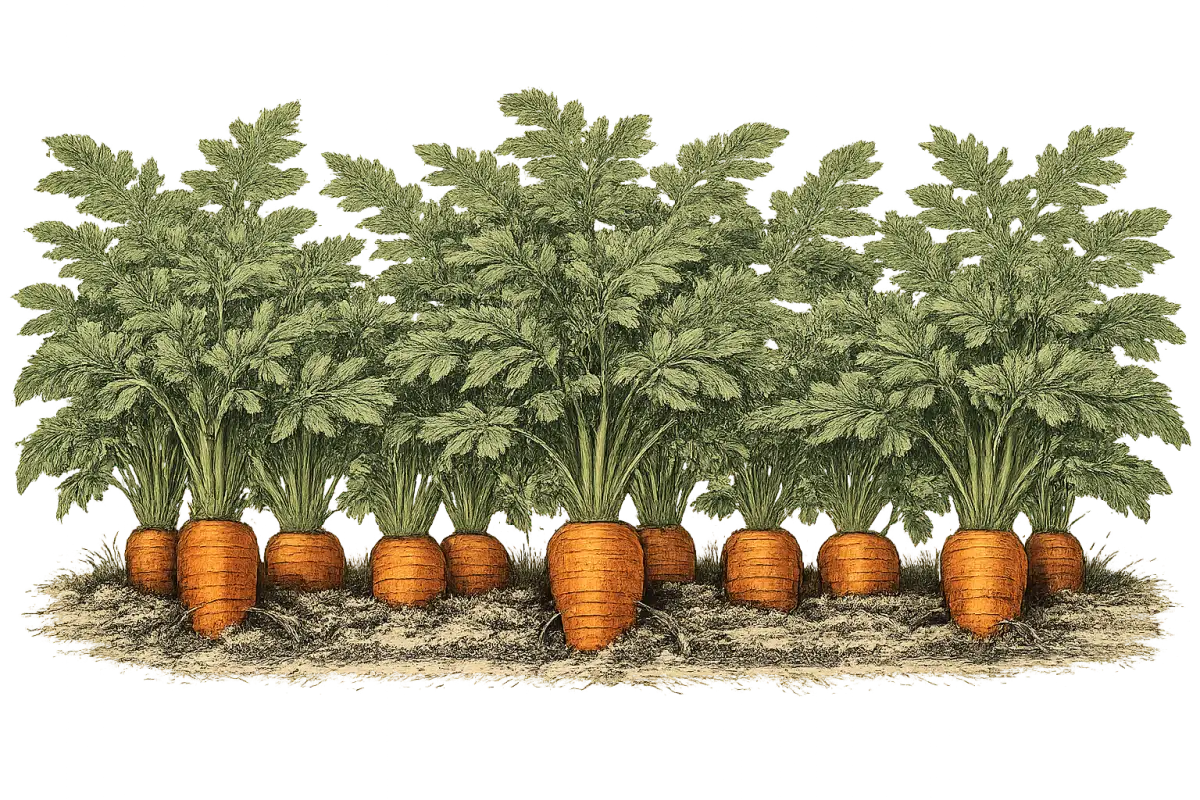
There are five main carrot types, and each belongs in a specific situation. Let me walk through them and then map them to zones.
The Five Types
Imperator — The long, slender grocery store carrot, up to 10 inches, with high sugar content and excellent fresh-eating quality. Demands 18 inches of loose, rock-free, sandy loam. It is the most rewarding type and the most unforgiving. If your soil preparation falls short, you'll know it at harvest. Best in zones 5-8 with deeply prepared beds or raised beds 18 inches or more deep. Key varieties: Imperator 58, Sugar Snax.
Nantes — 5-7 inches, cylindrical with a blunt tip and nearly uniform diameter. Widely considered the sweetest type with the best fresh-eating texture. This is the top choice for most home gardeners — sweet, reliable, and less demanding than Imperator while still needing loose, well-amended soil. Performs well in zones 4-9. Key varieties: Scarlet Nantes, Nantes Half Long, Bolero (also disease-resistant), Napoli, Yaya.
Chantenay — About 5 inches long but broad — 3-4 inches across at the widest point — with a sharply tapered cone shape. Strong flavor, excellent for cooking and storage. Its critical advantage: Chantenay tolerates heavy or clay soil with high organic matter better than any other type. The go-to when native soil is difficult and you're not ready to build raised beds. Key varieties: Red Core Chantenay, Royal Chantenay, Hercules.
Danvers — 6-7 inches, classic medium-length with rounded shoulders and a pointed tip. The original American all-purpose carrot, developed in Danvers, Massachusetts. More forgiving than Imperator in heavier soil, longer than Chantenay, and broadly adaptable across zones 4-9. The reliable default if you're unsure where to start. Key varieties: Danvers 126, Danvers Half Long.
Paris Market — Round or nearly spherical, golf-ball sized, ready in 50-65 days. The solution for containers, shallow beds, rocky soil, or any situation where standard depth isn't available. Requires only 6-8 inches of soil. Not a high-volume crop, but excellent for snacking, kids' gardens, and pots. Key varieties: Paris Market, Atlas, Thumbelina, Romeo.
Cold Zones (3-4): Work Fast and Choose Short
In zones 3 and 4 — Minnesota, Wisconsin, North Dakota, Vermont, northern Michigan — your window is short and soil stays cold into spring. Prioritize fast varieties with days-to-maturity under 75 days.
Paris Market (50-65 days) and Chantenay (65-75 days) are your best options. They give you a harvest before fall shuts things down. Nantes varieties in the 65-75 day range also work well. Danvers 126 at 70-75 days is widely recommended for this zone and delivers good flavor for a quick crop. Avoid long Imperators entirely — they need 80-100 days and the season rarely cooperates.
Spring sowing in zone 3 runs April 15 to June 1. Fall sowing is July 10 to July 31 — a narrow window, so mark your calendar. Use floating row cover to warm soil in spring and get seeds germinating 1-2 weeks ahead of schedule.
Zone 4 opens up slightly: spring sowing from April 1 to May 25, fall sowing July 20 to August 20. Succession sow every 2-3 weeks through May to avoid a single compressed harvest. Fall-sown carrots can overwinter in ground under 12-18 inches of straw mulch.
Classic Carrot Belt (5-6): All Five Types, Right Soil Required
Zones 5 and 6 — the Midwest, mid-Atlantic, Pacific Northwest valleys, Tennessee — are where all five carrot types are theoretically available to you. The limiting factor is soil, not climate.
If you have well-prepared soil or raised beds at 12 inches, Nantes and Danvers are your workhorses. Bolero — a Nantes type with disease resistance to Alternaria leaf blight — is an excellent choice if you've had foliar disease problems in past seasons. If you've built an 18-inch bed or have deep sandy loam, Imperator 58 or Sugar Snax will reward you.
For spring crops in zone 5, start from March 20 through May 10. Zone 6 opens earlier — March 10 through April 30. In both zones, avoid mid-summer sowings (June through mid-July) unless you can provide afternoon shade; heat causes bitterness and poor germination. Fall sowings — zone 5 from July 15 to August 30, zone 6 from August 1 to September 15 — often produce the sweetest carrots of the year as temperatures cool through the harvest window. Plan overwintering in-ground with 8-12 inches of straw mulch for zone 5; 8-10 inches works for zone 6.
Transition Zones (7-8): Fall Is the Real Season
If you're in zones 7 or 8 — Virginia, the Carolinas, Oklahoma, Texas, Georgia, the Pacific Coast — stop thinking of fall as the backup plan. Fall is the main event.
Spring planting must be fast: zone 7 from February 25 to April 15, zone 8 from February 10 to March 30. Get seeds in by early March in zone 8 before heat arrives. Avoid sowing June through August entirely — summer heat causes germination failure and bitter roots.
Fall is where zone 7 and 8 shine. Zone 7 sows from August 15 to October 1; zone 8 from September 1 to October 20. September sowings in zone 8 grow into October and November under ideal conditions. For fall crops in these zones, prioritize flavor: Nantes types and Bolero perform well. Texas A&M recommends Danvers 126, Danvers Half Long, Imperator 58, Nantes, Scarlet Nantes, Red Core Chantenay, Royal Chantenay, and Sugar Snax for the southern growing region — a solid starting list.
Zone 7 overwintering works easily with 6-8 inches of mulch. Zone 8 needs only light cover or none at all in mild winters.
Hot Zones (9-10): Winter Is Carrot Season
In zones 9 and 10 — Central California, San Antonio, the Gulf Coast, South Florida, Hawaii — summer planting is not an option. The heat shuts down germination and ruins root quality. Plan to grow carrots entirely in the fall through early spring window.
Zone 9 sows from January 15 to March 15 in spring and September 15 to November 1 in fall. Zone 10 runs January 1 through February 28 in spring and October 1 through November 30 in fall. The University of Florida Extension recommends August to March for North and Central Florida, and September to March for South Florida — essentially treating the entire cool season as fair game.
All four standard types — Imperator, Nantes, Danvers, Chantenay — are appropriate in these zones during the cool season. Fall and winter crops in zones 9-10 are frequently the sweetest you can produce. Purple Haze, Cosmic Purple, and Purple Dragon are popular options in Florida and warm-climate gardens for both flavor and visual appeal.
Quick Reference Table: Top Picks by Zone Group
| Zone Group | Top 3 Varieties | Type | Why |
|---|
| 3-4 | Paris Market, Chantenay, Danvers 126 | Short/medium | Fast maturity; cold-tolerant |
| 5-6 | Bolero, Nantes Half Long, Danvers 126 | Nantes/Danvers | Reliable, adaptable, disease resistance |
| 7-8 | Scarlet Nantes, Royal Chantenay, Danvers Half Long | Nantes/Chantenay | Fall season excellence; clay tolerance |
| 9-10 | Imperator 58, Nantes, Cosmic Purple | Imperator/Nantes | Cool-season window; flavor and variety |
When and How to Plant
The One Rule That Is Not Negotiable
Direct sow only. Full stop. Carrots cannot be transplanted. The moment you disturb the developing taproot — even moving a seedling a few inches — the root forks permanently. Every carrot you grow starts from seed exactly where it will grow to harvest. No seed starting indoors. No transplanting from pots. No exceptions.
Timing
Follow your zone's window from the calendar above. The core principle: carrots prefer night temperatures around 55F and daytime around 75F. At those temperatures, roots develop steadily, accumulate sugar, and stay tender. Heat causes bitterness, poor germination, and bolting. Time your plantings to avoid the root development phase during peak summer heat.
Soil temperature governs germination. The minimum is 40F; at that temperature germination happens but takes three or more weeks. The optimal range is 50-75F with best performance at 55-65F. Above 85F, germination drops sharply. Above 90F, it nearly fails. Check soil temperature before sowing, not air temperature — they diverge significantly in early spring and fall.
The Planting Process
Step 1: Prepare the bed to depth. This has to happen before seeds go in. Twelve to eighteen inches, rocks out, clods broken, all debris removed.
Step 2: Test and amend pH. Target 6.0-6.8. Amend and allow time for the adjustment to stabilize — ideally the season before planting.
Step 3: Fertilize the bed. Work in 1 cup of 10-10-10 per 10 feet of row. Nothing higher in nitrogen than that.
Step 4: Sow at 1/4 to 1/2 inch depth. Shallower is often better for germination. Sow 18-20 seeds per foot — you're deliberately over-seeding because carrot germination is unpredictable and you'll thin later.
Step 5: Cover with compost or fine sand, not garden soil. This prevents the soil crust that will block tiny seedlings from emerging. Vermiculite works well too.
Step 6: Mark your rows. Mix a small number of radish seeds with your carrot seeds before sowing — roughly 1 radish per 10-12 carrot seeds. Radishes germinate in 3-7 days and emerge before you've even started waiting for the carrots. They mark your row so you can weed without second-guessing yourself, and the leaf canopy they create retains surface moisture and buffers hard rain. The radishes are ready to pull before the carrots need the space. This technique is underused and worth adopting immediately.
Step 7: Keep the surface moist. Every day. Until every seedling has emerged. This is discussed in detail in the next section — don't skip it.
The Germination Problem (Why Patience Isn't Enough)
Carrots take 14-21 days to germinate. That is a long time. Most gardeners water on day one, check on day five, water again on day ten, and then wonder why nothing came up. Here is what actually happened: the soil surface dried out between waterings during the critical germination window, and seeds that had begun swelling and cracking their seed coat desiccated and died. You can lose an entire germinating batch this way without a single obvious sign of failure.
The soil surface must stay moist — consistently, every single day — from sowing until every seedling has emerged. Not damp. Not wet. Moist, like a wrung-out sponge. Carrot seeds are tiny and planted only 1/4 to 1/2 inch deep. The moisture reservoir above them is minimal. Even one fully dry day can kill seeds mid-germination.
Water lightly once or twice daily during this period. Misting is better than heavy overhead watering — heavy watering crusts the surface and can wash tiny seeds around. Early morning is ideal to minimize evaporation. If you need to skip a day, cover the seeded row with burlap, shade cloth, or even a board to retain moisture; check daily and remove it at the first sign of sprouting.
A thin layer of vermiculite, fine compost, or peat moss over the seeds retains moisture and prevents crusting without blocking emergence. This is a material upgrade worth making.
Old seed is a real problem too. Carrots have a maximum viability of about three years, and germination rates decline before that. If you're using seed from the back of a drawer, do a paper towel germination test before committing a full bed to it.
Thinning: You Will Do This or You Will Regret It
You over-seeded intentionally. Now you thin intentionally. There is no version of carrot growing where you skip this step and get good results. Overcrowded carrots stay undersized from competition, deform and twist as roots grow into each other, develop disease faster from poor air circulation, and yield less total weight than properly thinned beds.
Texas A&M Extension is blunt: "Overcrowding and rocky soils result in poor quality roots." They listed it together for a reason.
Two-stage thinning is the correct approach:
First thinning at 2-inch seedling height: thin to 1 inch between plants. Use scissors to snip at soil level if plants are extremely close — scissors cause less root disturbance than pulling.
Second thinning at 4-inch height: thin to 2-3 inches between plants (final spacing). Wider final spacing of 3-4 inches produces larger individual roots. Closer spacing of 2 inches produces more roots but smaller ones. Your call based on your goals.
When thinning, water the bed first so moist soil releases roots more easily. Grasp the unwanted seedling at soil level, pull firmly and steadily. Water immediately after thinning to resettle soil around remaining plants. Remove all thinned seedlings from the bed — don't leave them on the surface.
One practical note: bruised carrot foliage releases a scent that attracts carrot rust fly. Thin on cool, overcast days when possible, and water well immediately afterward to wash away the odor.
Watering: The Boring Thing That Makes or Breaks Everything
Consistent moisture is the second most important factor in carrot success, after soil preparation. This is not glamorous advice. It is the correct advice.
Target 1 inch of water per week throughout the growing season. Water at least twice weekly unless the garden receives 1 inch or more of natural rainfall. Deep watering should penetrate to 6-8 inches — this encourages roots to grow deep rather than staying shallow. Texas A&M Extension recommends maintaining consistent moisture to at least 3 inches deep.
Simple field test: push a finger 3 inches into the soil beside your carrot row. Dry at that depth — water. Still moist — wait. Don't rely on surface appearance.
Why Inconsistency Is So Damaging
The consequences of irregular moisture are not abstract. They are physical and immediate.
The single most damaging event is a dry period followed by heavy rain or resumed watering. Here is the mechanism: the dry period causes the outer skin of the carrot to tighten and growth to slow. When moisture suddenly returns, the inner root expands rapidly. The outer skin can't stretch fast enough. The root cracks or splits. This can happen after a single heavy rainfall following an extended dry period. Maturing roots in the final weeks before harvest are the most vulnerable.
When soil stays too dry for an extended period, the root responds by developing a profusion of fine feeder roots to scavenge whatever moisture is available. The main taproot looks hairy or brush-like, and the texture becomes tough and unattractive. Utah State University Extension is direct: "Avoid over-watering as hairy roots will form and forking will occur." Note they're warning against over-watering too — the goal is even moisture, not saturation.
Drought stress causes bitterness by diverting plant energy from sugar storage to survival mechanisms. The flavor turns unpleasantly sharp or earthy. This compounds when dry periods are followed by heat.
Drip Irrigation Is Worth the Setup
Drip irrigation is the best delivery method for carrots. It provides consistent moisture directly to the root zone without wetting foliage, which meaningfully reduces Alternaria and Cercospora leaf blight pressure — both require extended wet foliage periods to infect. Soaker hoses are an excellent lower-cost alternative. Overhead watering works if you water early in the morning so foliage dries before evening, but it increases disease risk in humid climates.
During germination, overhead misting is still necessary to keep the surface uniformly moist. Switch to drip or soaker once seedlings are established.
Reduce watering slightly as carrots near maturity — slightly drier conditions in the final weeks before harvest concentrate sugars and reduce splitting risk from rapid expansion. Don't eliminate watering entirely; maintain a regular schedule at reduced frequency.
Mulch Is Not Optional
A 2-3 inch layer of mulch is the most practical tool for maintaining the consistent moisture carrots require. It buffers both extremes: slows evaporation during dry periods, slows water infiltration during heavy rain. Both swings are damped, which is what carrot roots need.
Straw, wood chips, shredded autumn leaves, or compost all work. Apply mulch after seedlings are established and 4-6 inches tall — don't smother tiny seedlings. Keep mulch 1 inch from plant stems to prevent crown rot.
Pests and Diseases: What Actually Matters
Most pest and disease guides throw everything at you and expect you to manage a dozen threats simultaneously. The reality is that one pest causes the majority of serious carrot damage in most regions, and one group of diseases is responsible for most foliar problems. Focus there.
Carrot Rust Fly: The Big One
This is the pest carrot growers fear most, particularly in the Pacific Northwest, upper Midwest, and northeastern states. The adult is a small (1/4 inch) blackish fly with an orange head. You probably won't see the adult — you'll see the damage: rust-colored tunnels throughout the root from maggot feeding, and secondary bacterial soft rot that turns the root into a foul-smelling, unusable mass.
Two generations per year. Spring-generation adults emerge mid-May and lay eggs through early June. A second generation emerges mid-August through mid-September and can damage carrots stored after fall harvest.
Row covers applied immediately after sowing are the single best defense. Apply floating row cover and seal the edges by burying them in soil or weighting with boards — any gap defeats the purpose. This is also your best defense against carrot weevil, flea beetles, aphids, and the leafhoppers that spread aster yellows. One intervention, five threats addressed.
Cultural options help too: plant after late May to miss the first-generation egg-laying window, harvest spring plantings by mid-June before larvae penetrate taproots, and remove all carrot-family host plants (parsley, celery, coriander, parsnips) from the area the year before planting.
Root-Knot Nematodes: A Southern Problem
Microscopic soil-dwelling organisms you'll diagnose from symptoms — characteristic galls or knots on roots, forked and distorted growth, reduced yields. Particularly prevalent in southern states with sandy soils. Florida Extension specifically identifies nematodes as a major pest concern.
Control requires patience: minimum 3-year crop rotation away from carrots and all carrot-family plants. Soil solarization — covering moist soil with clear plastic for 4-6 weeks during summer heat in zones 7-10 — kills nematode eggs in the top 6 inches. Texas A&M recommends neem oil and sulfur as chemical options.
Alternaria Leaf Blight: The Primary Foliar Disease
The most common foliar disease of carrots worldwide. It is seedborne — the pathogen survives on and is distributed with carrot seed from infected stock. This is why seed source matters. Buy from reputable dealers.
Symptoms start on older, lower leaves: small, dark brown to black irregularly shaped lesions with yellow halos, expanding until leaves look burned and die back. Infection requires only 8-12 hours of continuous leaf wetness at 61-77F. Overhead irrigation in warm, humid conditions is the highest-risk scenario.
Bolero (a Nantes type) is resistant to Alternaria and is recommended across multiple university extension sources as the go-to for humid regions. Other resistant varieties include Apache, Caro-choice, Caropak, Early Gold, Nevis, and SugarSnax 54. Use drip irrigation, irrigate early so foliage dries, rotate away from carrot-family plants, and apply fungicide when disease reaches 25% incidence (25% of examined leaves show one or more lesions). Copper-based fungicides work as the organic option.
Aster Yellows: Remove and Move On
Multiple tops growing from one root, yellowing foliage, hairy and pale roots, bitter flavor. Spread by aster leafhoppers feeding on garden carrots after picking up the phytoplasma from infected weeds. There is no cure. Once a plant shows aster yellows symptoms, remove and destroy it immediately — do not compost. Row covers exclude leafhoppers before transmission occurs. Aggressive weed control removes the reservoir hosts.
 Where to Plant