 Where to Plant
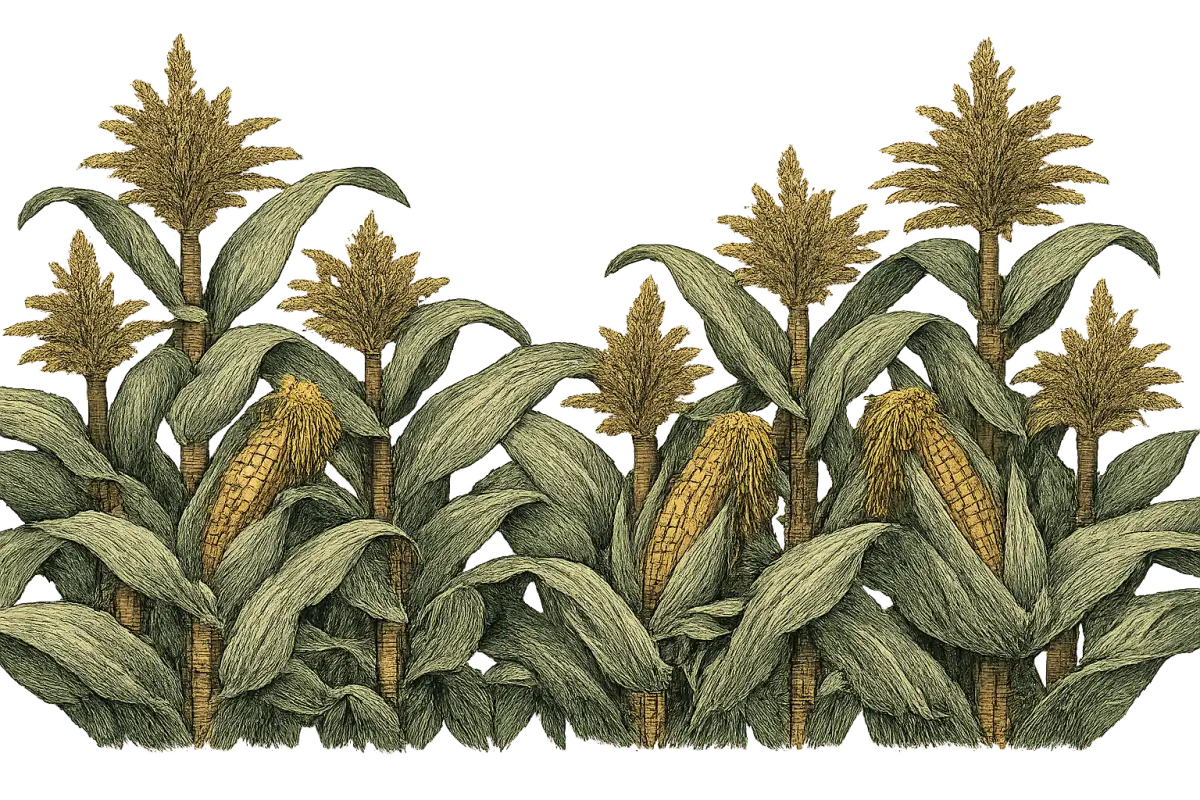


Let me tell you what grocery store corn actually is. It was picked 2-5 days ago, loaded onto a refrigerated truck, shipped across the country, stacked under fluorescent lights, and then purchased by someone who microwaved it for dinner. By the time it hits your plate, the sugar is mostly gone. You are eating starch in a husk.
Garden corn is a different food entirely. The old maxim -- don't pick the corn until the water is boiling -- exists because the sugar-to-starch conversion in a standard variety starts within hours of harvest. Pick an ear at 7 AM, sit down to eat it at 7:15, and you will understand immediately why people plant 40-plant blocks in backyard gardens. That flavor is not available in any store.
But here is the honest version: sweet corn is not the forgiving crop that tomatoes are. It has specific requirements that trip up even experienced gardeners. Wind pollination means planting layout is non-negotiable. Genetic type determines whether your seeds rot in the ground or germinate cleanly. One night without your electric fence means raccoons eat your entire harvest. And there is a harvest window -- sometimes only a few days wide -- that you either hit or miss.
Get those details right and you will grow the best corn you have ever eaten. Get them wrong and you will grow a lot of tall green stalks that produce nothing worth eating. This guide is about getting them right.
Quick Answer: Sweet Corn Growing at a Glance
USDA Zones: 3 through 10 (with the right variety and timing)
Sun: 8 hours of direct sunlight minimum -- corn is a C4 plant and rewards every hour of light
Soil pH: 6.0-6.8
Soil Temperature at Planting: 55F for su and se types; 60-65F minimum for sh2 supersweet
Planting Depth: 1 to 1.5 inches
Spacing: 8-12 inches within rows; 2.5-3 feet between rows
Block Minimum: 4 rows by 4 plants (16 plants) -- single rows fail
Water: 1-1.5 inches per week; 1.5-2 inches during silking
Nitrogen: Approximately 1 pound actual nitrogen per 1,000 square feet, split across three applications
Harvest Trigger: Milky white juice when a kernel is punctured, 18-21 days after silks appear
Harvest Window: 3-5 days at peak per ear; entire planting ripe for 7-10 days
Main Threats: Raccoons, corn earworm, poor pollination from bad layout, cold soil with sh2 varieties
The Pollination Problem (Why Corn Is Different From Everything Else)
Every other vegetable you grow relies on insects for pollination. Sweet corn does not. Corn is wind-pollinated -- bees are irrelevant. Each silk on an ear connects to one potential kernel. There can be 600-1,000 silks on a single ear, and each one must catch a windblown pollen grain for that kernel to develop. A missed silk means a missing kernel.
That mechanism explains the single most important rule in corn growing: plant in blocks, never in single rows.
Think about what happens in a single long row. Pollen falls from the tassel above, gets picked up by the wind, and blows perpendicular to the row. It lands in the garden path, or the lawn, or the neighboring flower bed. The plants in that row are pollinating everything except each other. The result is ears with missing kernels, gaps in the rows, kernels on only one side, or completely blank ears that look fully developed from the outside.
Iowa State University Extension calls this the most common sweet corn mistake home gardeners make. After reviewing what actually happens when people plant single rows, that assessment is hard to argue with.
A block planting -- at least 4 rows by 4 plants deep -- solves the problem. In a block shape, pollen drifts in any direction and hits surrounding plants. The 4x4 minimum (16 plants in roughly 50 square feet) is a real minimum. A 4x10 block of 40 plants will give you reliably full ears and a meaningful harvest. Four rows of 2 plants is not a block -- it is a suggestion.
If you genuinely cannot fit 16 plants, hand-pollination is your backup. In the morning, when tassels are actively shedding pollen, shake them over a paper bag to collect what you can. Dust the collected pollen onto silks with a small brush. Do this on calm, dry mornings during the pollination window. It works. It is more effort than anyone wants to spend in their garden, which is a good argument for finding 50 square feet.
Understanding the Five Genetic Types (Before You Buy a Single Seed)
Most vegetable crops have varieties that differ in flavor, color, and days to maturity. Sweet corn has all of that -- plus five distinct genetic types that differ in fundamental ways. Buy the wrong type for your situation and you will either have seeds that rot in cold soil or corn that tastes starchy despite every other thing going right.
Standard Sugary (su) is what your grandparents grew. Traditional sweet corn flavor, moderate sugar, easy germination in cool soil starting at 55F. The downside: sugar converts to starch fast. Within 1-2 hours of picking, the quality of a su variety is already declining. The "boiling water" rule was written about su corn. If you love old-school corn flavor and can cook immediately after picking, su varieties are honest, reliable, and easy to grow. Silver Queen (92 days), Golden Bantam (78 days), and Jubilee (84 days) are the workhorses of this type.
Sugar Enhanced (se) is the best all-around choice for most home gardeners. Higher sugar than su with tender, creamy kernels. Sugar-to-starch conversion is slower -- you have 6-8 hours instead of 1-2. Germinates well at 55-60F. The flavor and texture are genuinely better than su, and the practical flexibility is better too. Bodacious (75 days), Incredible (83 days), and Ambrosia (75 days, bicolor) are the top se varieties and represent the middle ground where most gardeners should start.
Supersweet (sh2) is where the marketing gets loud and the requirements get strict. These varieties carry 2-3 times more sugar than su types and can be refrigerated for 5-7 days without losing their sweetness -- an enormous practical advantage. The trade-offs: sh2 kernels are less tender and more crunchy than se, germination requires 60-65F soil (seeds rot in cold, wet soil), and sh2 must be isolated from all other corn types or cross-pollination will ruin every ear. Illini Xtra Sweet (85 days), Early Xtra Sweet (71 days), and How Sweet It Is (87 days) are the leading varieties. If you want to grow sh2, commit to it fully and grow nothing else in your garden.
Synergistic (syn) types split the difference in a clever way: each ear contains approximately 75% se kernels and 25% sh2 kernels. You get the tenderness of se with meaningful sweetness from sh2, and germination is more forgiving than pure sh2. Serendipity (82 days) and Montauk (73 days) have gained real followings among gardeners who want a single high-quality variety without the strict management of sh2. Isolation requirements still apply between syn and sh2.
Augmented Supersweet (shA/aug) is the newest category, stacking the se gene on top of sh2 for tender and extra sweet kernels with slow starch conversion. The technology is sound; the variety selection is still catching up.
Isolation: The Rule Nobody Follows Until They Ruin a Harvest
If you plant sh2 within 250 feet of any other corn -- su, se, field corn, popcorn, your neighbor's ornamental corn -- and their bloom times overlap, the resulting kernels will be starchy and tough. Wind carries corn pollen over 250 feet easily. The isolation requirement is not a suggestion.
Your options: 250 feet of distance (rarely practical in a home garden), or a 2-week difference in maturity dates between types so bloom times do not overlap. The simplest path in a small garden is to grow one type only. If you want sh2, grow only sh2. If you want to mix types, choose varieties whose maturity dates differ by at least 2 weeks and plant them on a schedule that ensures their silking periods do not coincide.