Vegetables

Growing Pumpkins: Everything You Need to Know Before You Plant

James Calloway

James Calloway

Vegetable & Edibles Specialist · Updated April 2026

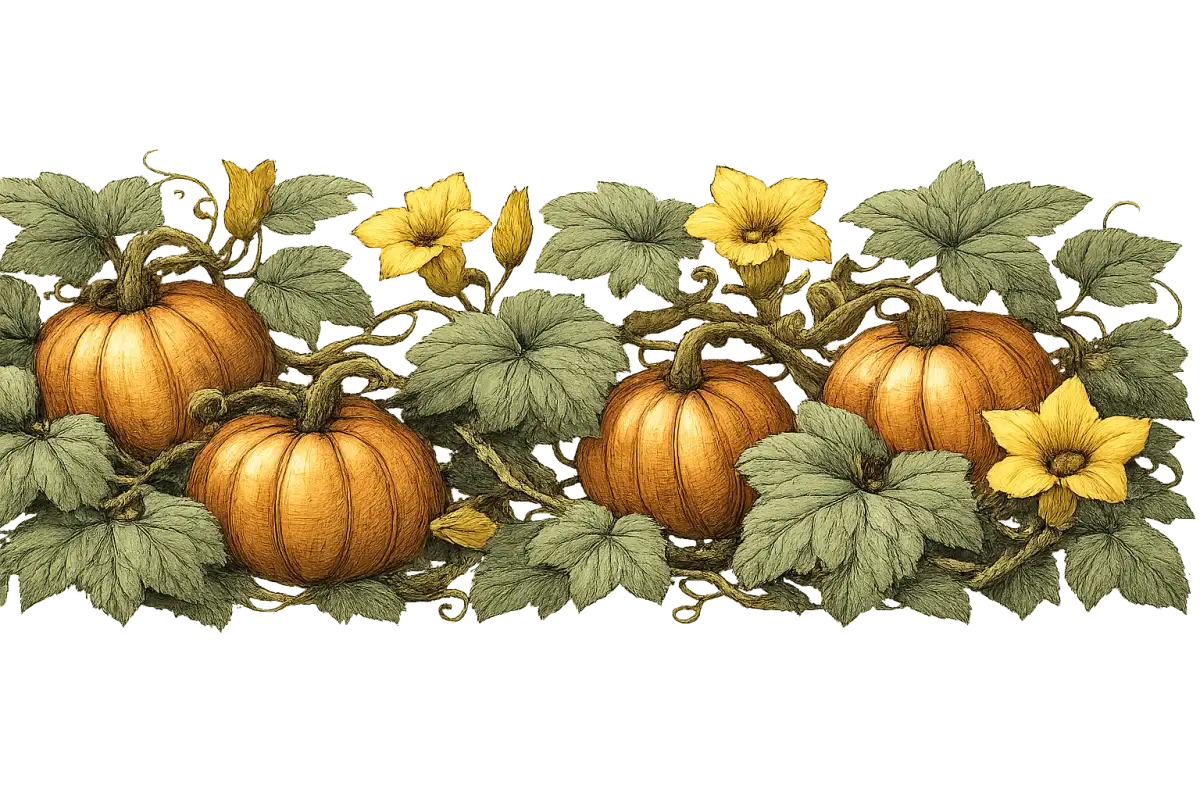
How to grow pumpkins — vintage botanical illustration showing the plant in detail

Pumpkins at a Glance

Sun

Sun

Minimum 8 hours full sun per day

Soil pH

Soil pH

6.0–6.8

Water

Water

1 inch per week vegetative

Spacing

Spacing

Vining: 50–100 sq ft per hill"

Days to harvest

Days to Harvest

85-125 days

Height

Height

Vining types spread 8-20 feet

Soil type

Soil

Fertile

Lifespan

Lifespan

annual

Get your personalized growing data

Enter your zip code for frost dates, growing season, and soil type.

Pumpkins are one of the most satisfying crops you can grow. They are also one of the easiest to get spectacularly wrong. Not because they are delicate — they are not. They are aggressive, sun-hungry vines that will try to take over your garden given half a chance. The problems come from underestimating what they need: space, heat, water at exactly the right moments, and pollinators in a two-hour window every morning.

Get those things right and you will have more pumpkins than you know what to do with. Get them wrong and you will have a lot of vine, a lot of flowers, and no pumpkins.

The biggest mistake I see is treating pumpkins like a casual garden afterthought. You throw a few seeds in the ground and wait. Then July arrives and the plants are piled on top of each other, powdery mildew is spreading across every leaf, and the female flowers are opening and dying unpollinated because nobody was outside at 7 AM to notice. By September you have a yard full of orange-tinged regrets.

This guide covers everything: which variety actually fits your yard (they range from 4 square feet to 1,000), when to plant by zone, how to feed and water at each stage, what the pests are and when to act, and how to get your pumpkins off the vine and into storage without losing them to rot in the first week. There is also a section on giant pumpkins for the ambitious, the competitive, and the slightly unhinged.

Let's do this correctly.


Quick Answer: Pumpkin Growing at a Glance

USDA Zones: 3 through 11 (with zone-appropriate timing)

Sun: Full sun, minimum 8 hours daily — no exceptions

Soil pH: 6.0–6.8, target 6.5

Soil Type: Fertile, well-drained sandy loam; 3%+ organic matter

Planting Method: Hill (mound) planting — not optional

Seeds per Hill: 4–5 seeds; thin to 2–3 seedlings

Soil Temperature to Plant: 60°F minimum; 65–95°F optimal

Watering: 1 inch/week vegetative; 1.5 inches/week during flowering and fruit sizing

Irrigation: Drip or soaker hose strongly preferred — never overhead

Pollination: Insect-dependent; flowers open at dawn and close by 10 AM

Days to Maturity: 85–125 days depending on variety

Space: 4 sq ft (miniatures on trellis) to 1,000 sq ft (giants) — know before you plant

Storage: 50–60°F, 50–70% RH after curing at 80–85°F for 5–20 days


The Space Problem (Why Most Home Pumpkin Patches Fail)

Before we talk about anything else, we need to talk about square footage. Because this is where most home gardens go wrong with pumpkins, and getting it wrong cascades into every other problem you will encounter.

Standard vining pumpkins need 50 to 100 square feet per hill, with rows spaced 10 to 15 feet apart. Vines reach 15 to 20 feet in multiple directions. If you plant them 4 feet from your tomatoes — which I see constantly — you will have a vine situation by August that looks like something from a nature documentary. The tomatoes lose. The pumpkins win. Nobody is happy.

Crowded plants also get powdery mildew faster and worse. This is not a coincidence. Packed vines trap humidity, restrict airflow, and create exactly the microclimate that Podosphaera xanthii needs to thrive. You will spend the back half of your season spraying fungicide on problems that adequate spacing would have prevented.

Here is the honest assessment of your options:

If you have 50 to 100 square feet of open, full-sun ground, grow standard vining varieties. If you have less than that, grow compact types. Spirit and Bushkin spread only 5 to 6 feet. Cinderella (Rouge Vif d'Etampes) is technically a large pumpkin but grows on a bush-type vine in about 6 square feet. For truly small spaces, Jack Be Little miniatures grow on a trellis in a 4-square-foot footprint. You can grow a trellis full of miniature pumpkins in a strip of ground next to a fence.

What you cannot do is plant a Howden Field in a 10×10 garden bed and expect it to behave. It will not.


Best Pumpkin Varieties by Zone

Choosing the right variety is less about climate and more about your goals and your available days. Pumpkins are warm-season annuals — they do not have "cold-hardy" and "heat-loving" types the way fruit trees do. What matters is whether your frost-free window is long enough for the variety to mature, and whether your planting timing lines up with your target harvest date.

That said, zone still shapes the conversation, because it determines how long your window is and when your planting deadlines fall.

What zone are you in?

Enter your zip code for frost dates, growing season, and soil type.

Cold Zones (3–4): Short Windows, Pick Fast Varieties

In zones 3 and 4 — the northern Great Plains and upper Midwest — your frost-free window is tight. You are planting in late May to early June and hoping the first hard frost holds off until September. That gives you, generously, 90 to 110 days.

Standard large carving pumpkins at 105 to 115 days are a gamble here. Spirit at 95 days is your workhorse — semi-bush habit, AAS Winner, heavy yield, and it comes in well within the window. Autumn Gold at 100 days is another solid choice with the added benefit of earlier color development, which matters in a zone where you want every possible warning that the pumpkin is ready to beat the frost.

For pie pumpkins, Baby Bear at 105 days earns its place. It is compact, blight tolerant, and the semi-hull-less seeds are a bonus if you want to roast them.

Use transplants started indoors in peat pots 20 days before last frost. Pumpkins hate root disturbance — never bare-root transplant. Cover transplants with floating row covers until the soil is reliably warm. Avoid anything with a days-to-maturity over 105; you are simply asking for a frost to beat you to the finish line.

Mid-Zones (5–6): The Sweet Spot for Classic Varieties

Zones 5 and 6 — the upper Midwest, Mid-Atlantic, northern California, Colorado — give you a proper pumpkin-growing window. Most standard varieties mature comfortably here if you plant in the May 15 to June 10 window. The July 4th deadline for Ohio and Indiana is real; plant after that and you are rolling the dice on a fall frost.

Connecticut Field is one of the oldest American varieties, and it earns its place on this list. For Halloween carving it is exactly what you want: 15 to 25 lbs, classic shape, reliable. Pair it with Howden Field if you want the larger, more symmetrical carving standard — 20 to 25 lbs and the pumpkin that shows up in every "how to carve" photo.

For pie pumpkins in zones 5 and 6, Small Sugar (also called New England Pie) is the answer. It is a pre-Civil War heirloom for a reason — best-tasting pie pumpkin in the category, dense finely grained flesh, and it keeps well after curing. Winter Luxury is worth mentioning too: introduced in 1893, 7 to 8 lbs, sweet and juicy flesh with a distinctive fine gray netting on the skin. Both clock in at 100 to 105 days — well within the zone 5 and 6 window.

Transition Zones (6–7): More Flexibility, More Options

In zones 6 and 7 — Virginia, North Carolina, Kentucky, Missouri, Kansas — you have enough growing season to get deliberate about variety selection. You can target Halloween specifically and plan your planting to the week.

For standard carving, Pankow's Field is worth growing if you care about symmetry. It runs 100 to 120 days at 20 to 30 lbs and produces excellent Jack-o'-lantern candidates. Ghost Rider at 110 to 115 days with heavy ridging is distinctive — if you want a pumpkin that does not look like every other pumpkin on the block, this is it.

Virginia growers have a specific deadline to know: the extension services peg the fall market planting cutoff at July 10. Kentucky growers have a wider window — late May to mid-June. Missouri growers in the southern part of the state can push to mid-to-late April.

For small-space growers in these zones, Cinderella (the French heirloom Rouge Vif d'Etampes) is worth growing purely for the look. Coach-pumpkin shape, deeply lobed, vivid orange. Bush-type vine in about 6 square feet. It matures in 84 to 100 days — one of the faster large varieties.

Warm Zones (7–9): Beat the Heat, Plan the Calendar

In zones 7 through 9 — Tennessee, Georgia, Alabama, South Carolina, Texas — heat is the variable you are managing. Temperatures consistently above 95°F cause flower abortion regardless of pollination. Your pumpkins do not care whether you hand-pollinated them. If it is 98°F and you have female flowers, they are aborting.

The strategy in these zones is usually to plant later — mid-June to early July depending on location — so that flower set happens as temperatures begin to moderate in August and September. Alabama Extension pegs the window at mid-June to early July. Tennessee growers are targeting mid-June to July 15.

Spirit performs reliably in this range at 95 days. For pie pumpkins, Baby Pam (also sold as "Oz") with its deep orange flesh and vigorous 10 to 12 foot vines suits the longer growing season here. Texas growers planting in July need compact, fast varieties — Spirit and Autumn Gold are the picks.

In southern Georgia and coastal South Carolina, you are pushing toward zone 8 to 9 conditions. Southern California growers can run a second planting in late August or early September.

Cold-Climate Quick Reference Table

Zone GroupTop 3 VarietiesTypeWhy
3–4Spirit, Autumn Gold, Baby BearCompact/fastFits short frost-free window
5–6Connecticut Field, Howden Field, Small SugarStandard viningFull window, Halloween-optimized
6–7Pankow's Field, Ghost Rider, CinderellaLarge carvingLong season, shape and size options
7–9Spirit, Baby Pam, Autumn GoldCompact/fastLate planting avoids peak heat
9–11Jack Be Little (trellis), Baby Pam, SpiritMini/compactYear-round planting windows; space efficiency

When to Plant: Count Backward from Your Harvest Date

Here is the single most useful pumpkin timing concept: count backward from when you want them ripe.

Look up the days to maturity on your seed packet. Count backward from your target harvest date. Then add 20 to 25 days as a buffer — fall temperatures slow ripening, and the seed packet number assumes warm-season growing conditions. The fall slowdown is real. Skip the buffer and your pumpkins will be two to three weeks behind where you expected them.

The formula: Target harvest date − (days to maturity + 20–25 day buffer) = latest safe planting date.

For a Halloween harvest with a standard 110-day carving variety: October 31 minus 110 days minus 25 days puts your latest safe planting date at about mid-June. For a 115-day large variety like Howden, you need to be in the ground by early June. For Dill's Atlantic Giant at 125+ days, giant pumpkin growers are planting outdoors in late May and starting seeds indoors in peat pots in late April.

The opposite mistake — planting too early — is worth flagging too. Early-planted pumpkins can ripen in September and start softening before Halloween. If that happens, harvest early, cure properly, and store them. A well-cured pumpkin keeps through Christmas. A pumpkin that sat in the field too long after ripening does not.

Minimum soil temperature is 60°F. This is not a suggestion. Below 60°F, seeds rot instead of germinating. Pumpkins planted in cold soil either fail entirely or limp into the season weeks behind where they should be. Test at 4-inch depth before planting.

Zone Timing Cheat Sheet

  • Zones 3–4: Late May to early June. Transplants only.
  • Zones 5–6: May 15 through June 10. Hard deadline July 4 in Ohio and Indiana.
  • Zones 6–7: Mid-May through mid-June. Virginia fall market deadline July 10.
  • Zones 7–9: Mid-June through early July. Tennessee deadline July 15.
  • Zones 8–11: Florida late March through early July. Louisiana nearly year-round. Southern California March onward with second planting late August to early September.


Soil Preparation and Hill Planting

Pumpkins want pH 6.0 to 6.8, with 6.5 as the sweet spot. Outside this range, nutrients lock up and plants underperform. Test your soil in late summer or fall before your planting year — lime takes months to adjust pH, and there is no rushing it.

The ideal soil is fertile, well-drained sandy loam with at least 3% organic matter. The sandy loam part matters more than most people realize. Sandy soils warm quickly in spring and drain fast. Slow drainage is the primary pathway for Phytophthora crown rot, which kills plants suddenly and is nearly impossible to treat once established. If you have clay, you need to address it before you plant — not after.

UMass Extension's guidance on organic matter is refreshingly direct: "You cannot put too much compost in the area where pumpkins will grow." Apply 2 to 3 bushels of well-rotted compost or aged manure per 100 square feet and work it in. Fresh manure burns roots. Only fully decomposed material.

Hill planting is the standard method. Mounds — 12 to 18 inches high, 2 to 3 feet in diameter — improve drainage, warm faster in spring, concentrate amendments at the root zone, and make base irrigation easier. Plant 4 to 5 seeds per hill, 1 inch deep. Thin to the best 2 to 3 seedlings after emergence. For giant pumpkins, thin to one.

Spacing between hills:

  • Vining types: 8 to 10 feet between hills
  • Bush and semi-bush: 4 to 6 feet
  • Giants: one plant per 1,000 square feet

Do not skip the mound. Flat planting in heavy or marginally-draining soil is a direct invitation to Phytophthora problems.


Watering: Get It Right at Each Stage

Pumpkins have clear water requirements at each growth stage, and the consequences of getting it wrong are stage-dependent. Drought during vegetative growth sets the plant back but is recoverable. Drought during flowering causes female flowers to abort — and aborted flowers are gone. You cannot make up that fruit set later.

Growth StageWeekly RequirementNotes
Seedling / establishmentConsistently moistLight and frequent until established
Vegetative1 inch per weekWater deeply; encourage deep roots
Flowering and fruit set1.5 inches per weekCritical — water stress = aborted flowers
Fruit sizing1.5 inches per 10 days minimumHeaviest demand of the season
Pre-harvestReduce graduallySome growers cut water 1–2 weeks out to concentrate flavor

Use drip irrigation. Both Alabama Extension and Utah State Extension call it "highly recommended" and they are right. Drip delivers water to the root zone, keeps leaves dry, and dramatically reduces powdery mildew. Overhead sprinklers that wet foliage are a direct contributor to the single most common pumpkin disease. If you absolutely must use overhead irrigation, do it only in early morning so leaves dry completely before evening.

Check soil moisture 2 to 3 inches deep before watering — it should be moist, not wet. Mulch around plants to conserve moisture and reduce watering frequency. And reduce water as fruit approaches maturity — waterlogged soil at the end of the season causes rot.


Fertilizing: Three Stages, Different Needs

Pumpkins are heavy feeders, but what they need shifts significantly through the season. Dumping the same fertilizer on them start to finish is a waste of money and misses the biology.

Base application before planting: Broadcast granular fertilizer and incorporate it 4 to 6 inches deep. The hill itself should concentrate amended soil at the planting site.

Three-stage feeding:

  • Seedling (first 2–3 weeks): High-phosphorus formula (15-30-15). This builds the root system. Roots first, everything else later.
  • Fruit set (after pollination): Balanced formula (20-20-20). Supports fruit initiation.
  • Sizing (late July onward): Continue 20-20-20. This is what drives fruit size.

Side-dress with nitrogen during the growing season if foliage turns pale green. For giant pumpkin growers, the rate from fruit set through end of season is 1 pound of water-soluble fertilizer per week per plant — plus foliar feeding after pollination. Calcium applications during rapid growth prevent splitting and reinforce rind integrity.

For standard home growing, the three-stage program above is sufficient. Do not over-complicate it.


Pollination: The Two-Hour Window You Cannot Miss

Pumpkins cannot pollinate themselves by wind. The pollen is large and sticky — it goes nowhere without a bee carrying it. If bees are not working your flowers during the opening window, you get no fruit. This is non-negotiable biology.

How pumpkin flowers work: Pumpkins produce separate male and female flowers on the same plant. The first 8 or so buds are all male. This is normal. Female flowers — identifiable by the tiny miniature pumpkin at the flower's base — appear roughly one week after the first males. If you have flowers but no fruit, wait. You may simply not have females yet.

Both flower types open at dawn and close before noon. In hot weather, they close by 9 or 10 AM. Pollination must happen in that window. After noon, the opportunity is gone for that day.

The most important pollinator you have never heard of: Penn State Extension found squash bees (Peponapis pruinosa) at 95% or more of farms surveyed. They are solitary bees that nest underground near cucurbit plantings, emerge at dawn, and fly only during the morning hours — synchronized perfectly with pumpkin flowers. Honeybees get the credit; squash bees do most of the work.

Protect them. Apply any pesticides only in late afternoon or evening after flowers close. Never spray during bloom hours. Avoid deep tilling near cucurbit plantings — squash bee nests are only 5 to 10 inches underground and are easily destroyed.

Hand pollination: When bee activity is low, this is your backup. Pick an open male flower in early morning. Remove the petals to expose the pollen-covered anther. Touch the anther directly to the sticky stigma at the center of an open female flower. Repeat contact several times. Use multiple male flowers per female for better coverage — incomplete pollination produces misshapen fruit, not just less fruit. Do this before 10 AM.


The Top Problems and How to Handle Them

Powdery Mildew: Assume It's Coming

Powdery mildew (Podosphaera xanthii) will find your pumpkins. The spores blow in from infected crops in southern states — you cannot prevent exposure. White, talc-like circular patches on leaf surfaces, usually starting on the undersides of older, lower leaves. It spreads upward and accelerates in August and September at 68 to 80°F with high humidity and dense growth.

The management is layered: spacing for airflow, drip irrigation to keep leaves dry, fungicides every 7 to 10 days once detected (preventatively when female flowers open), and variety selection toward disease-resistant types. Rotate FRAC groups when spraying — do not use the same mode of action consecutively. Established resistance exists in the pumpkin powdery mildew population. Check the undersides of 50 older leaves per planting when scouting; catching it early gives you more options.

What zone are you in?

Enter your zip code for frost dates, growing season, and soil type.

Squash Vine Borer: Prevention Is the Only Play

The adult is a clearwing moth with an orange-red body and metallic green wings — often mistaken for a wasp — that lays eggs singly at the base of stems in June through July. Eggs hatch in 7 to 10 days. Larvae bore immediately into the stem.

Once larvae are inside the vine, contact insecticides do nothing. You cannot spray your way out of an established borer infestation. The tell: a healthy-looking vine that suddenly wilts, with small piles of greenish sawdust-like frass at the stem base. Split the stem and you will find cream-colored caterpillars with brown heads.

Scout mid-June through late July. Apply insecticides weekly upon first detection of adult activity or early feeding signs — before larvae enter the vine. Row covers exclude adults during the egg-laying period; remove them when female flowers open for pollination. Organic option: inject Bt directly into the stem near entry holes, or surgically remove larvae and mound soil over the wound to encourage re-rooting.

In short-season zones, a second direct seeding in late June will miss the main borer flight and produce a vine that sets fruit in September without borer damage.

No Fruit Setting: Usually a Pollination Failure

Female flowers shriveling without developing into fruit is almost always one of four things:

1. Only males present — the first 8 buds are typically all male. Wait a week.

2. Inadequate pollination — bee activity was low during the morning window. Hand-pollinate.

3. Heat abortion — temperatures consistently above 95°F abort flowers regardless. Fruit set resumes when temperatures moderate.

4. Drought stress — insufficient water during bloom causes female flowers to abort. Increase to 1.5 inches per week.

Misshapen or lopsided fruit is a pollination quality issue, not just quantity. Multiple bee visits per flower are needed for uniform development. Hand-pollinate with multiple male flowers per female for thorough pollen coverage.

Phytophthora Crown Rot: Prevention Only

Water-soaked, soft, sunken areas where fruit touches soil; or the crown turning brown and collapsing. Caused by Phytophthora capsici, a water mold that thrives in wet soil above 65°F. Survives in soil for 2 or more years once established.

There is no effective treatment once plants are infected. Prevention: hill planting (keeps crowns above waterlogged soil), drip irrigation, avoid low spots, rotate away from all cucurbits, peppers, and tomatoes for at least 3 years. This is another reason mound planting is not optional.

Squash Bugs: Act on Nymphs, Not Adults

Flat-backed brownish-black insects, 5/8 inch long, clustered on stems and under leaves. Metallic bronze egg masses in neat clusters on leaf undersides. Adults and large nymphs resist insecticides well. Young nymphs in the first two or three instars are your window for effective chemical control.

Action threshold is 1 egg mass per plant during early flowering. Hand-remove egg masses in small plantings. Place boards near plants overnight — squash bugs shelter under them and can be collected and destroyed in the morning. Remove all vine residue at season end to eliminate overwintering sites.


Harvesting and Storage: Do Not Waste a Good Pumpkin

You grew it for months. Do not lose it to avoidable post-harvest rot.

Knowing When to Harvest

Use multiple signals — no single test is definitive. The most reliable field indicator is the tendril on the vine closest to the fruit. When it starts to wilt or turn brown, the pumpkin is at or near maturity.

Also check: rind hardness (thumbnail dents but does not puncture — if your nail goes through, it is not ready), stem condition (dry, hard, turning from green to cork-like), hollow sound when slapped, and full-color saturation with no green patches. Most varieties reach maturity 50 to 55 days after pollination.

Harvest before temperatures fall consistently below 50°F. Fruit left in the field below that threshold suffers chilling injury — invisible damage to cell structure that causes premature rot once the pumpkin is brought to room temperature. If frost is imminent before the pumpkin is fully mature, harvest early. Immature pumpkins can cure. Frozen pumpkins cannot.

Seed catalog maturity dates assume ideal conditions. Add 20 to 25 days for late-season harvests when cool fall temperatures slow ripening.

The One Rule That Most People Learn the Hard Way

Never carry a pumpkin by its stem. The stem is not a handle. It cannot bear the weight of the fruit. Once the stem breaks, exposed tissue becomes an immediate entry point for bacteria and fungi, and decay works inward from the break. Cradle from underneath with both hands. For large pumpkins, use a hand truck, tarp, or cart.

Cut cleanly with sharp pruning shears, leaving 3 to 4 inches of stem attached. Never twist or break the fruit off the vine.

Curing Is Not Optional

Curing does four things: ripens immature fruit, heals small wounds by forming a corky layer over damaged areas, hardens the rind against decay organisms, and converts starch to sugar — particularly important for pie pumpkins.

Cure at 80 to 85°F, 80 to 85% relative humidity, for 5 to 10 days per UMass Extension guidance — or 10 to 20 days per Alabama Extension if pumpkins were harvested early or have any skin damage. Good air circulation around each pumpkin during curing is essential. Do not stack.

Storage Conditions

Store at 50 to 60°F with 50 to 70% relative humidity. Below 50°F causes chilling injury. Above 60°F accelerates respiration and shortens storage life. Room temperature (68 to 72°F) means weeks, not months.

Practical rules:

  • Do not stack pumpkins — bruises become rot entry points
  • Keep off concrete floors — concrete wicks moisture and promotes bottom rot; use cardboard, wooden pallets, or straw
  • Inspect weekly and remove anything showing soft spots immediately
  • Every pumpkin should have air circulation on all sides

Well-cured large pumpkins can last through Christmas. Pie pumpkins and standard carving types run 2 to 3 months. Do not store in an unheated garage in northern zones unless you are monitoring temperatures — it will cool below 50°F on cold nights before you expect it to.


Growing Giant Pumpkins: A Different Game Entirely

If you want a 200-pound pumpkin — and let's be honest, some percentage of you do — understand that you are not growing a larger version of a regular pumpkin. Giant pumpkin growing is a distinct discipline with its own rules, its own community, and its own variety that has held the world championship since 1979.

The only competition variety is Dill's Atlantic Giant (Cucurbita maxima). No other variety has won a world championship since Howard Dill introduced it. Every legitimate competition entry is Atlantic Giant genetics. Typical yields without special management are 200 to 300 lbs. Seeds from documented competition crosses are capable of 500 to 800-plus pounds. World record specimens exceed 2,000 lbs — and that requires both elite genetics and everything below done correctly.

For beginners who want a large pumpkin without the full competition regimen, Prizewinner hybrid averages 200 lbs without special techniques required. Big Max averages 100 lbs and has decent eating flesh.

What Giant Pumpkin Growing Actually Requires

Space: 1,000 square feet per plant — roughly a 40-foot diameter circle. This is not a conservative estimate. Vines reach 25 to 30 feet in multiple directions.

Site preparation starts the fall before planting. Incorporate composted manure and leaf litter heavily into the 1,000 square foot area. Plant a fall cover crop (oats, rye, or clover) to add organic matter. Conduct a soil test in fall and apply lime if pH is below 6.0 — it needs months to work.

Planting timeline: Sow seeds indoors in 12-inch peat pots in late April. Transplant at the first true leaf, 10 to 14 days after seeding. Use peat pots exclusively — pumpkins resist root disturbance.

The single-fruit strategy: Allow 4 to 6 pumpkins to develop initially. Once they reach volleyball size, cut back to one — the one showing the most rapid early growth. Every carbohydrate, water molecule, and mineral the plant absorbs goes to that single fruit. The difference between two fruits and one fruit on the same plant can be 200-plus pounds in final weight. Make the decision and commit.

Progressive feeding: 1 lb of water-soluble fertilizer per week per plant from fruit set through end of season. Foliar feeding after pollination. Calcium during rapid growth to prevent splitting.

Vine training: Bury each vine node with a handful of soil — the vine roots at each contact point, dramatically increasing the plant's nutrient-uptake area across the full 1,000 square feet. When the pumpkin reaches basketball size, curve the main vine 80 to 90 degrees away from the fruit to relieve stem tension. Around 300 lbs, clip roots 3 feet from the fruit to allow movement as expansion continues.

Shade the fruit: Direct sunlight hardens the outer skin. Hard skin restricts expansion — the interior grows but the skin cannot stretch to accommodate it. Drape a white bedsheet over the fruit, leaving the vine and surrounding leaves in full sun.

At peak growth in August, Atlantic Giant can gain 25 to 35 lbs per day. Per day. Consistent water is what makes that possible — at least 1 inch per week via trickle or soaker hose.

Transport: You cannot carry a competition-sized giant pumpkin. Under 400 lbs, use a heavy-duty tarp drag. 400 to 700 lbs requires a lifting frame with straps. Above 700 lbs, you need a skid loader or tractor front-end loader. A crack disqualifies a competition entry — handle accordingly.

What zone are you in?

Enter your zip code for frost dates, growing season, and soil type.


Frequently Asked Questions

Can I Grow Pumpkins Vertically?

Yes — with the right varieties. Miniature pumpkins (Jack Be Little, Wee-B-Little, Baby Boo) grow well on cattle-panel arches, arbors, or fence-mounted wire mesh. You can weave the young vines through trellis openings and train daily during active growth. The result is a 4 to 6 square foot ground footprint instead of 50 to 100, plus improved air circulation that reduces powdery mildew.

Any fruit over 2 to 3 lbs needs a fabric sling — old t-shirt, pantyhose, or mesh bag — tied to the trellis to support the weight. Do not tie the sling to the vine itself.

Small pie varieties under 5 lbs can also be trellised using the same approach. Standard carving pumpkins at 15 to 25 lbs cannot realistically be trellised.

What Is the Three Sisters Planting Method?

Three Sisters — corn, beans, and squash or pumpkin grown together — originated with Indigenous peoples of the Americas, particularly the Haudenosaunee. Corn provides a trellis for pole beans; beans fix atmospheric nitrogen; pumpkin vines spread wide leaves across the soil, suppressing weeds and retaining moisture as a living mulch.

You must use a vining pumpkin variety (not bush), pole beans (not bush beans), and a sturdy shorter corn. Planting is staggered: corn first when soil reaches 55°F, then pole beans when corn is 6 to 12 inches tall, then pumpkin seeds one week later. Minimum space is 10×10 feet. Heavy fertilization is usually unnecessary — bean nitrogen fixation sustains the system.

Connecticut Field is the traditional variety for Three Sisters gardens. Any standard vining pumpkin works.

How Do I Know If My Pumpkin Is Ripe If It's Not Orange?

Color alone is unreliable for novelty varieties. Casper (white skin), Jarrahdale (blue-gray), and Lumina (pale white) will not turn orange. Use the thumbnail test — rind dents but does not puncture. Check the stem — dry and cork-like. Check the tendril closest to the fruit — wilting or browning means maturity. Slap it; hollow sound means ripe interior.

My Pumpkin Reached 6 Inches and Stopped Growing. What Happened?

Usually drought stress during fruit sizing, overcrowding from competing fruits or tangled vines, or late-season disease reducing the leaf area available for photosynthesis. Check soil moisture first. If you have multiple fruits developing on the same vine, removing some allows the plant's resources to concentrate on the remaining ones. If powdery mildew has taken over the upper canopy, the plant has lost significant photosynthetic capacity and remaining fruit will stall.

Should I Worry About My Stored Pumpkins Getting Too Cold?

Yes, and more people get caught by this than you would think. Below 50°F causes chilling injury — invisible cell damage that causes premature rot once the pumpkin warms up. An unheated garage in a northern zone routinely drops below 50°F on fall nights before the outdoor temperature looks threatening. Monitor the actual storage space temperature, not the forecast. If you cannot keep storage between 50 and 60°F, bring the pumpkins inside.


The Bottom Line

Pumpkins are not fussy plants. They are demanding ones. Space, heat, consistent water at the right moments, and pollinators in a narrow morning window — give them those things and they will produce heavily, reliably, and with minimal drama.

Pick a variety that actually fits your space. Time your planting by counting backward from your harvest date with a 20 to 25 day buffer. Build mounds, use drip irrigation, and do not crowd the planting. Protect your pollinators during bloom. Scout for vine borers starting in June. Cure your harvest before storage.

A well-grown pumpkin in October after months of watching it develop is one of the more satisfying things a vegetable garden can produce. The work is front-loaded — soil prep, timing, setup — and the plants do the rest. Get the fundamentals right once, and you will not need to relearn them next year.

Start with the space math. Everything else follows from that.

Research for this guide draws on extension service publications from UMass Extension, Alabama Cooperative Extension System, Penn State Extension, Ohio State Extension (factsheet HYG-1646), Utah State Extension, and University of Virginia Cooperative Extension, as well as variety trial data from commercial seed programs and the All-America Selections record.

Where Pumpkins Grows Best

Pumpkins thrives in USDA Zones 5, 6, 7, 8. Explore each zone's complete guide for growing tips, companion plants, and seasonal advice.

Also possible in: Zone 4, Zone 9 (challenging but possible with the right conditions).

Not sure of your zone? Look it up by zip code →