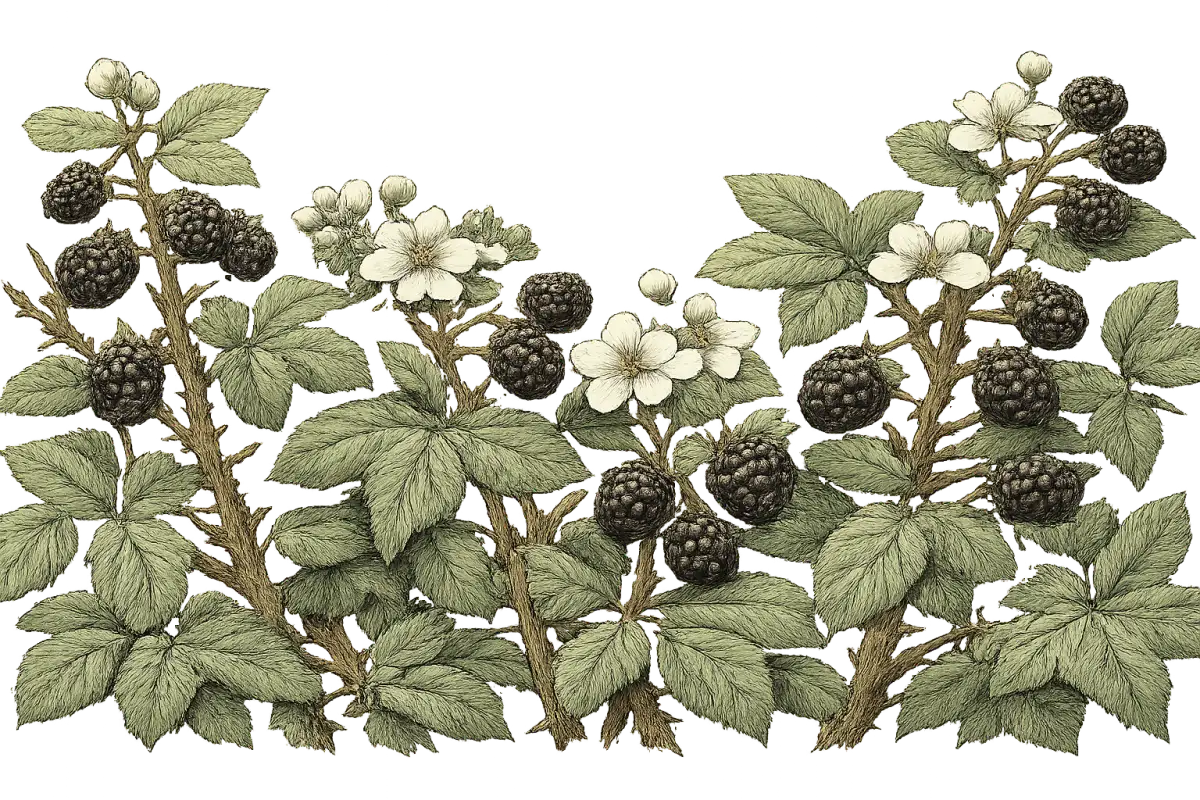
Before you look at zone-specific recommendations, orient yourself to the three growth habits, because they determine your management approach more than any other single factor.
Erect varieties have stiff, self-supporting canes that grow 5–8 feet tall. They spread by root suckers and are the easiest to manage without a trellis (though they still benefit from one). These are the workhorses of the home garden: Ouachita, Navaho, Kiowa, Apache.
Semi-erect varieties have arching canes that need trellis support, but they reward that effort with very large berries and high yields. Canes reach 5–8 feet and fan outward. Triple Crown, Chester, and Hull are the main players here.
Trailing varieties are a different animal: canes reach 15–20 feet, require full trellis support, and spread by tip rooting rather than root suckers. They produce some of the most flavorful berries of any blackberry type but are more cold-sensitive and more labor-intensive to manage. Marion, Boysen, Logan, and Olallie are the classic trailing types — beloved in the Pacific Northwest, risky in cold climates.
Cold Zones (5–6): Hardiness Is the First Filter
Zone 5 spans the upper Midwest, parts of the Northeast, and the mid-Atlantic mountains, with winter lows hitting -20°F to -10°F. That eliminates trailing types outright — Marion, Boysen, and Logan are not reliably hardy here. Erect and semi-erect types are your world, with a clear emphasis on proven cold hardiness.
Chester is our top recommendation for zone 5. It is considered the most cold-hardy thornless blackberry in commercial production, with consistent performance proven down to zone 5. It is a semi-erect type with a late-season harvest window that extends into August — valuable in climates where the growing season is compressed. Pair it with Triple Crown for outstanding flavor (the best of the thornless semi-erects), though note that Triple Crown performs best in zone 6 and warmer; in zone 5, shelter from desiccating winter winds helps.
For growers who want the reliability of primocane fruiting, Prime-Ark Freedom is the right call. It is thornless, erect, and delivers a fall crop that does not depend on overwintered canes surviving the winter. In 5a and colder, consider mowing it to the ground each late winter — the floricane summer crop may winterkill anyway, but the fall primocane crop is dependable. Prime-Ark 45 is the thorny equivalent if you are willing to work in gloves — extremely vigorous and productive.
If you want large berries and do not mind thorns, Kiowa is one of the hardiest erect types available and produces some of the biggest berries in the species. Worth considering if you have the management bandwidth.
Regardless of variety in zone 5: mulch canes heavily (6–8 inches) after the ground freezes to protect crowns and the lower cane buds. That crown protection is what allows regrowth the following spring even when upper canes suffer dieback.
Zone 6 opens up the full range of erect and semi-erect types. Ouachita is outstanding here — thornless, disease-resistant, with a long fruiting window that makes it an excellent producer across the mid-Atlantic and lower Midwest. Navaho gives you the firmest berry of the thornless erect types, with excellent shelf life if you plan to share or sell fruit. Triple Crown reaches its full potential in zone 6 — large berries, exceptional flavor, very high yields from a semi-erect form. Prime-Ark Traveler adds a thornless primocane option with berries firm enough to ship and share.
Warm Zones (7–8): Where Blackberries Hit Their Stride
Zone 7 is the heart of American blackberry country. The Southeast and mid-South have centuries of blackberry culture for good reason — the climate is nearly perfect. Nearly every variety performs here, which means your selection can be driven by flavor, fruit size, and harvest timing rather than survival.
Apache is the standout for zone 7 if berry size is a priority. Thornless, erect, with very large berries and excellent flavor — it is widely recommended by Southeastern extension services and shows good disease resistance. Ouachita is arguably the most reliable all-around performer in zone 7, with superior disease resistance to double blossom and anthracnose (both of which become more serious in the humid Southeast). If you can only plant one variety in zone 7 and want to minimize management, Ouachita is the answer.
Triple Crown thrives in zone 7 and will bury you in large, sweet berries if you trellis it properly. Navaho holds up beautifully in heat, maintains berry firmness through the hottest part of the season, and is a dependable mid-season producer. Choctaw is a thorny erect type that deserves mention — early season, popular in Oklahoma and Arkansas, and very productive.
If you want to extend your season into fall, Prime-Ark Freedom is capable of both a summer floricane crop and a fall primocane crop in zone 7 — two harvests from the same planting. That is a meaningful advantage if you want a long picking window.
Zone 8 covers the Deep South, Gulf Coast, and the Pacific Coast from central California south through Oregon. Heat and humidity become the primary challenges here, and disease pressure — especially double blossom and orange rust — rises significantly. Ouachita's disease resistance makes it the workhorse of zone 8. Apache handles heat well. Kiowa earns its place in zone 8 despite the thorns: enormous berries, solid yields from Oklahoma to Georgia.
For Pacific Northwest zone 8 coastal conditions, Marion enters the picture. This trailing type produces what many consider the definitive fresh blackberry flavor — intensely aromatic, complex, and rich — and it is the variety that built the Pacific Northwest's commercial blackberry industry. It requires full trellis support and careful cane management, but for flavor-first growers with the right conditions, there is nothing like it.
In zone 8, inspect plants every spring for orange rust (bright orange pustules on leaf undersides) and double blossom (distorted, thickened flower buds with no fruit). Catching either early is critical — more on that in the pests and diseases section.
Hot Zones (9): Chill Hours Are the Limiting Factor
Zone 9 includes Southern California, the Central Valley, southern Arizona, and the Gulf Coast. The challenge here is not cold — it is the absence of it. Most blackberries require 200–700 hours below 45°F to break dormancy and fruit properly, and zone 9 may not reliably deliver enough.
Brazos and Womack are the Texas-bred workhorses for zone 9 — both developed specifically for low-chill, high-heat conditions. They are thorny erect types, but they produce where others fail. These are not the best-flavored berries in the world, but they are reliable in climates that defeat most other varieties.
In coastal zone 9 with marine influence (much of coastal California), the situation is better than inland areas. Navaho performs acceptably with adequate winter chill. Olallie is the trailing type bred for Pacific Coast conditions — a classic California variety, good flavor, manageable chill requirement.
For inland zone 9, be honest with yourself about chilling hours before you plant. If your area receives fewer than 200–300 hours below 45°F, blackberries will underperform regardless of variety. Primocane-fruiting varieties are generally not a good fit for zone 9 — fall temperatures stay too warm for proper fruit development and flavor expression.
Quick Reference Table: Top Picks by Zone Group
| Zone Group | Top 3 Varieties | Type | Why |
|---|
| 5 | Chester, Prime-Ark Freedom, Kiowa | Semi-erect / Erect | Cold hardiness proven; primocane crop reliable when floricanes winterkill |
| 6 | Ouachita, Triple Crown, Navaho | Erect / Semi-erect | Full range opens up; disease resistance and flavor drive the decision |
| 7 | Apache, Ouachita, Triple Crown | Erect / Semi-erect | Peak blackberry climate; focus on size, flavor, disease resistance |
| 8 | Ouachita, Kiowa, Marion (coastal) | Erect / Trailing | Disease resistance critical in humidity; Marion for PNW coastal only |
| 9 | Brazos, Womack, Olallie (coastal) | Erect / Trailing | Low-chill development critical; coastal vs. inland distinction matters |
Soil Prep and Site Selection: Do This Before You Buy a Single Plant
A blackberry planting will be in the ground for 15–20 years. That is not a typo. The site work you do before the first plant goes in determines whether those two decades are productive or frustrating, and almost none of it can be redone once canes are established.
Get Your Soil Right First
Blackberries thrive in a soil pH of 5.5–6.5 — slightly acidic, more forgiving than blueberries but still specific enough that you cannot just plant and hope. Outside this range, nutrient availability drops. Below pH 5.0, aluminum and manganese toxicity damage roots. Above pH 7.0, iron and manganese become unavailable and you will see interveinal chlorosis on young leaves — yellow tissue between green veins, which most gardeners misread as a nutrient deficiency and try to correct with fertilizer. The nutrients are there. The plant cannot access them.
Test your soil first. A basic test from your state cooperative extension service costs $15–25 and tells you your current pH plus nutrient levels with region-specific amendment recommendations. Do this 6–12 months before planting — pH correction takes time.
To lower an alkaline pH, apply elemental sulfur. The rate depends on soil type: sandy soils need 0.5–1.0 pounds per 100 square feet to drop pH by one unit; loamy soils need 1.5–2.0 pounds; clay soils need 2.5–3.5 pounds. Do not apply more than these rates at once — excessive sulfur damages soil biology. Apply in fall for spring planting and retest before putting plants in.
To raise a pH that is too acidic (common in the Southeast and Pacific Northwest coastal areas, where starting pH can be below 5.0), apply agricultural lime or dolomitic lime. Sandy soils need 2–3 pounds per 100 square feet to raise pH by one unit; loamy soils 5–7 pounds; clay soils 8–10 pounds. Apply in fall; lime takes 3–6 months to fully react.
Before you plant, incorporate 3–4 inches of compost into the top 8–10 inches of soil. This is the only time you can work amendments deeply into the soil — once plants are established, you can only top-dress. Finished compost is best for immediate nutrient availability; aged wood chips build long-term organic matter; aged (never fresh) manure adds nitrogen.
Drainage and Site Selection
Blackberry roots are highly susceptible to crown rot and root rot in waterlogged conditions. Plants may establish and appear healthy for a season or two, then decline suddenly in year two or three when root rot takes hold. This is one of those problems you cannot fix after the fact.
Test drainage before planting: dig a 12-inch hole, fill it with water, and observe the rate. Water that drains within 1 hour is excellent. Drainage slower than 4–8 hours is marginal and requires raised rows (6–8 inches above grade). Standing water after 8 hours means you need raised beds — 12–18 inches tall, filled with a mix of 50% quality topsoil, 40% compost, and 10% coarse sand — or French drains. One thing drainage testing has taught us definitively: do not add sand alone to clay soil. In insufficient quantities, it creates a material that sets like concrete. Use organic matter instead, or build a raised bed.
Choose a site with 6–8 hours of direct sunlight daily. More sun means more fruit — this is not a guideline, it is a direct relationship. In zones 8–9, some afternoon shade during the hottest summer weeks can protect ripening berries from sunscald, but morning sun is always preferable for drying foliage and reducing disease pressure.
Avoid sites where tomatoes, peppers, eggplant, potatoes, or strawberries grew in the previous three years. These crops share Verticillium wilt, a soilborne fungus that persists for years and infects blackberry roots. There is no treatment once established. If no alternative site is available, build raised beds with fresh soil imported from outside the affected area. Also clear wild blackberry and raspberry from the area — ideally within 300 feet of your planting — because they serve as reservoirs for orange rust, double blossom, and Spotted Wing Drosophila.
Orient rows north–south if your site allows it. This maximizes sunlight interception on both sides of the row and improves air circulation, which reduces fungal disease pressure.
Planting, Spacing, and Trellising
Timing
Plant bare-root plants in early spring while still dormant — March through April in zones 5–7, February through March in zones 8–9. Container plants are more flexible but establish best with spring planting; avoid setting container plants out in midsummer heat unless you can water daily.
Spacing
Give plants room. Erect types: 3–4 feet in-row, rows 8–10 feet apart. Semi-erect types: 5–6 feet in-row, rows 10–12 feet apart. Trailing types: 5–8 feet in-row, rows 10–12 feet apart. This feels like a lot of space when you are planting small bare-root starts, but erect and semi-erect types fill in quickly via suckers and lateral growth. Crowding creates poor air circulation and sets up disease problems that are difficult to fix.
Planting Technique
For bare-root plants: soak roots in water for 1–2 hours before planting. Dig a hole wide enough to spread roots naturally without bending. Set the plant at the same depth it grew at the nursery — look for the soil line on the crown. Backfill, firm the soil, and cut canes back to 6–12 inches. This feels drastic but redirects energy to root establishment, which is exactly what you want in year one.
Mulch immediately after planting: 3–4 inches of wood chips, straw, or shredded bark, kept 2–3 inches away from the crown. Mulch conserves moisture during the critical first season, suppresses weeds, and moderates soil temperature. Replenish annually.
Trellising
All blackberry types benefit from a trellis, even erect varieties. Trellised plants have better air circulation, cleaner fruit, and are dramatically easier to harvest. The standard home garden setup is a T-trellis: 4×4 treated wood posts or metal T-posts set every 20–25 feet along the row, standing 6 feet above ground, with a 2-foot crossarm at the top. Run two wires: one at 3 feet and one at 5 feet. Canes are trained between the wires and tied as needed. Trailing types need denser wire spacing and considerably more tying effort.
Pruning: The Annual Schedule That Makes or Breaks Your Harvest
Now we can get specific. With the lifecycle in mind, here is exactly what to do each season for floricane-fruiting varieties — which covers the majority of what home gardeners grow.
Summer: Tip Your Primocanes
When new primocanes reach 42–48 inches tall — roughly 10 inches above the top trellis wire — clip off the soft growing tip. Just 3–4 inches. This is called tipping.
Why does it matter so much? An untipped cane produces one terminal fruiting cluster the following year. A properly tipped cane develops 8–15 lateral branches, each of which becomes a fruiting branch — 5–10 times more fruit from the same cane. Tipping is a five-minute task per row that multiplies next year's harvest significantly. Do it in June–July as canes reach height. Fast-growing erect types may need a second tipping later in the season.
Sanitize your pruning shears between plants — wipe blades with 70% isopropyl alcohol or a 10% bleach solution. Cane blight and anthracnose spread on pruning tools. This is not optional if disease pressure is present.
After Harvest: Remove Spent Floricanes Immediately
As soon as harvest is complete — typically July through August in zones 5–7, June through July in zones 8–9 — cut all spent floricanes at ground level. Every one of them, down to the soil.
These canes are already dead or dying. Leaving them standing is not neutral — it actively increases disease pressure. Dead cane tissue is a breeding ground for anthracnose, Botrytis, and cane blight. Floricane stubs harbor overwintering Spotted Wing Drosophila pupae and other pests. Spent canes also make it harder to identify and manage new primocanes, which is your next priority.
Remove all cut material from the planting. Do not leave it as mulch. Get it out of the patch.
Late Winter: Lateral Shortening and Cane Thinning
In late winter, before new growth begins (February–March in zones 5–7; January–February in zones 8–9):
Shorten all lateral branches on remaining canes to 12–18 inches. This removes weak lateral tips and concentrates fruiting energy into the stronger, thicker base of each lateral. Leave 12–15 laterals per cane for best fruit size; remove any laterals thinner than a pencil.
Thin to the strongest canes: 4–6 per plant for erect and semi-erect types, 8–12 for trailing types. "Strongest" means thick, firm, fully ripe-wood canes. Thin or damaged canes will produce fewer, smaller berries. Remove damaged, diseased, and crossing canes first; then select the best from what remains.
For primocane-fruiting varieties, the simplest approach is to mow every cane to the ground in late winter. The entire planting starts fresh each spring with new primocanes that grow through summer and fruit in late summer and fall. No two-cane juggling required. If you want both a summer and fall crop, leave second-year canes as floricanes, harvest them in summer, then remove them — letting primocanes carry the fall crop. More yield, more complexity.
 Where to Plant