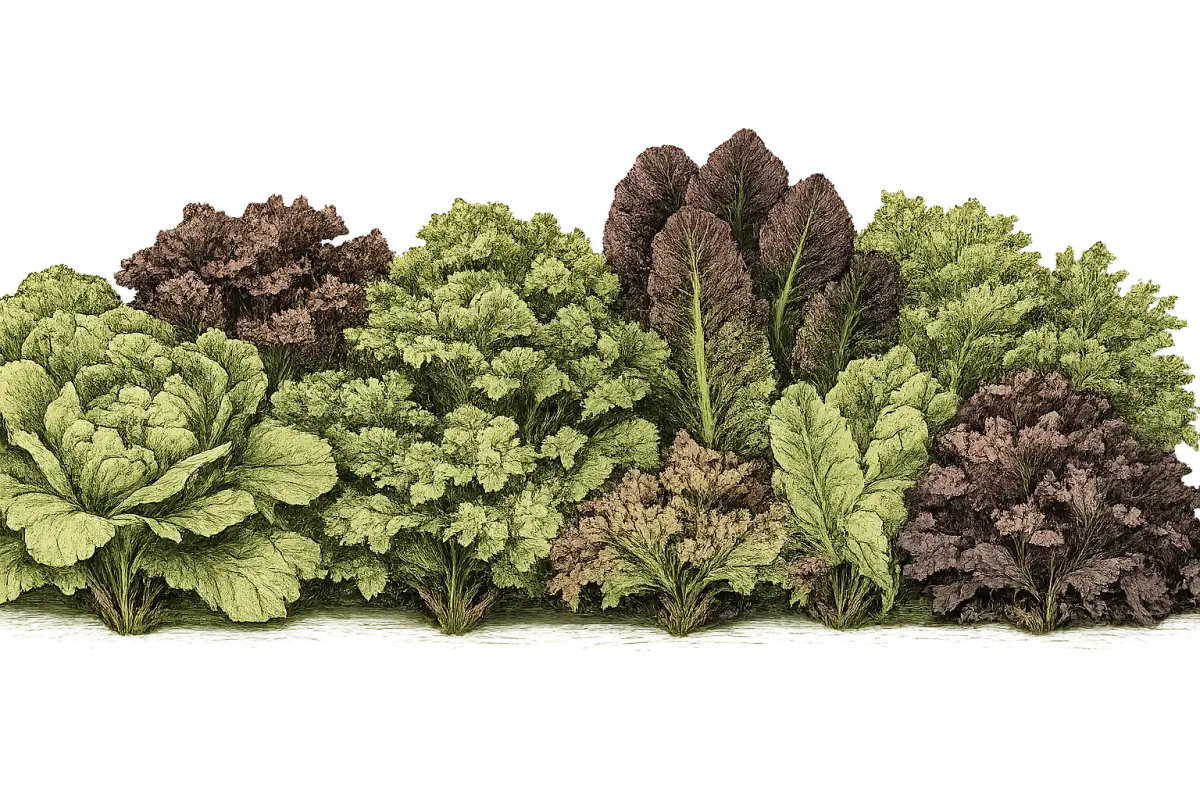
Before getting into zone-by-zone picks, understand the five lettuce types and where they fall on the heat tolerance spectrum, from most to least tolerant: Batavian/Summer Crisp (highest heat tolerance), Leaf/Loose-leaf, Butterhead, Romaine, and Crisphead/Iceberg (lowest). This ranking should drive every variety decision in warm climates. Crisphead iceberg needs 70 to 80 cool days to form heads and is the least heat-tolerant type -- it is nearly impossible in warm-climate home gardens. Batavian types were specifically bred to handle warmth and are the go-to for zones 7 and above.
Cold-Climate Zones (3-5): Where Summer Is Your Friend
Your challenge here is not heat -- it is the short season. You have an advantage most gardeners would trade for: a cool summer where nearly all lettuce types, including crisphead, actually work. Zones 3 and 4 can grow lettuce through summer without shade cloth because air temperatures rarely sustain the 80F+ threshold long enough to trigger bolting.
For lettuce in zones 3 and 4, Black Seeded Simpson (leaf, 50 days) is the most reliable cut-and-come-again producer in the catalog. Red Sails (leaf, 55 days) adds color and better bolt resistance than most leaf types. Buttercrunch (butterhead, 55 days) is the bolt-resistant standard for heading varieties. Ithaca (crisphead, 72 days) is one of the few crispheads genuinely viable in home gardens. Winter Density (romaine, 60 days) rounds it out with extreme cold hardiness that makes it valuable for late-fall extended harvests.
For the other greens in zones 3 and 4: Bloomsdale Long Standing is the spinach pick -- slow to bolt, deeply crinkled, and the hardiest salad green overall, capable of surviving below 20F with protection. Tyee is the bolt-resistant backup. For kale, Winterbor handles temperatures below 15F and Red Russian is tender, mild, and equally cold-hardy. Both should be planted in spring and again in late July for fall and winter harvest. Standard garden arugula works for spring; switch to Wild Arugula / Sylvetta for summer -- it is genuinely slower to bolt, a semi-perennial type that the standard cultivar cannot match for heat persistence. Fordhook Giant and Bright Lights Swiss chard are both vigorous choices that start two to three weeks before last frost.
Zone 5 adds meaningful options. Jericho (romaine, 60 days) becomes viable -- it was developed in Egypt and has standout bolt resistance for a romaine. Muir (Batavian, 55 days) opens the door to the heat-tolerant class for the warmer stretches. For spinach, Olympia (smooth-leaf, heat-tolerant) handles late spring plantings better than most alternatives. Lacinato/Dinosaur kale, with its milder and sweeter flavor, performs well here in consistent temperatures.
Zone 3 through 5 strategy in a sentence: get everything in the ground two to four weeks before last frost, run succession sowings through the cool summer, plant fall crops by early August, and use cold frames to extend into October and November.
Temperate Zones (6-8): Two Good Seasons and a Hot Gap in the Middle
Zones 6 through 8 have two prime windows -- spring and fall -- with a summer that ranges from challenging to nearly impossible for most greens. The variety picks reflect this: bolt-resistance and heat-tolerance become your primary filters for spring, and cold hardiness opens up in fall.
For zones 6 and 7, the reliable spring lettuce lineup: Coastal Star (romaine, 60 days) is bolt-resistant and dependable from spring into early summer. Buttercrunch (butterhead, 55 days) is the standard for heading types. Muir (Batavian, 55 days) is the most heat-tolerant class for pushing into warm weather. New Red Fire (leaf, 55 days) and Starfighter (leaf, 50 days) cover red and green cut-and-come-again, both with strong bolt resistance. Salad Bowl (leaf, 50 days) is the classic cutting variety that has earned its reputation.
Zone 8 requires a harder lean toward heat-adapted types. Muir, Nevada (Batavian, 60 days, sweet and crunchy), and Panisse (Batavian, 60 days, French-bred) are the core. Jericho (romaine, 60 days) is the best romaine option for warm conditions. Red Sails (leaf, 55 days) holds up reasonably well.
For the other greens in zones 6 through 8: spinach is spring-only in zones 7 and 8 -- it bolts faster than lettuce in heat and is not worth attempting in summer. Bloomsdale Long Standing or Tyee as early as the ground allows. Fall crops produce the best quality. Lacinato kale works well for spring and fall; Winterbor and Red Russian take over for late fall and winter. In zones 7 and 8, kale grows year-round with minimal protection and its flavor genuinely improves after frost as starches convert to sugar. Wild Arugula / Sylvetta for summer; standard arugula for spring and fall only, when cooling temperatures bring out its mildest flavor. Swiss chard -- Fordhook Giant, Bright Lights, or Ruby Chard -- is the summer bridge crop that holds when everything else fails. It handles heat far better than any lettuce and continues producing through fall with minimal intervention.
Hot-Climate Zones (9-10): Winter Is Your Growing Season
This requires a full mindset shift. In zones 9 and 10, you grow lettuce from October to March. That is your season. Summer greens outdoors are not a reasonable goal for most crops -- spinach bolts almost immediately in warmth, standard arugula lasts days, and most lettuce never establishes properly before the heat collapses it.
The variety selections reflect this reality. For lettuce in zones 9 and 10: Muir (Batavian, 55 days) and Panisse (Batavian, 60 days) extend the harvest into the warmth at the edge of the season. Nevada (Batavian, 60 days) is sweet and crunchy with genuine heat tolerance. Jericho (romaine, 60 days) and Anuenue (romaine, 65 days, Hawaiian-bred) are the romaine picks for warm climates. Rouxai (Batavian, 55 days) is a red Batavian with solid bolt resistance.
For the other greens: spinach is strictly an October-through-February crop -- avoid entirely March through September. Lacinato kale handles consistent temperatures best; sow in September, harvest fall through spring. Wild Arugula / Sylvetta is the only viable arugula option once temperatures begin rising in late spring. And Swiss chard -- the most forgiving green in hot zones -- can sustain outdoor production almost year-round with afternoon shade in summer. Lucullus is the most heat-tolerant chard variety for zones 9 and 10.
Quick Reference Table: Top Picks by Zone Group
| Zone Group | Top 3 Picks | Type | Why |
|---|
| 3-4 | Black Seeded Simpson, Buttercrunch, Bloomsdale Long Standing | Leaf, Butterhead, Spinach | Short season; all types work; cool summer advantage |
| 5-6 | Jericho, Muir, Starfighter | Romaine, Batavian, Leaf | Bolt resistance for spring; heat-tolerant class opens up |
| 7-8 | Muir, Coastal Star, Swiss Chard | Batavian, Romaine, Chard | Heat-tolerant varieties; chard bridges summer gap |
| 9-10 | Muir, Jericho, Swiss Chard | Batavian, Romaine, Chard | Winter-grown Batavian and romaine; chard for summer |
When and How to Plant (The Specifics That Actually Matter)
Timing by Zone
Spring planting: in zones 3 and 4, start lettuce and kale indoors in mid-February to early March; direct sow outdoors mid-April to early May. In zones 5 and 6, direct sow early to mid-April; transplant mid to late April. In zones 7 and 8, direct sow February through April -- no indoor starting needed. In zones 9 and 10, sow January through March.
Fall planting: zones 3 and 4, direct sow late July to early August. Zones 5 and 6, sow mid-August to early September. Zones 7 and 8, sow September through October. Zones 9 and 10, sow late September through December.
The fall dates are important. They feel counterintuitive -- you are starting seeds in summer for a fall harvest. But the greens germinate while it is still warm and do most of their vegetative development as temperatures cool into the ideal range. The result is plants that arrive at harvest size right as conditions are perfect for quality.
Sowing and Spacing
Direct sowing is the right call for almost all salad greens. Arugula grows so fast -- baby leaves in 21 days -- that indoor starting is genuinely pointless. Spinach handles transplant shock poorly enough that direct sowing is strongly preferred. For everything else, direct sowing keeps things simple.
Depth: lettuce at 1/4 to 3/8 inch; arugula at 1/4 inch; spinach at 1/2 inch; kale at 1/4 to 1/2 inch; Swiss chard at 1/2 to 1 inch. Lettuce germinates best with soil temperatures between 60 and 65F -- not too hot, not too cold. Arugula germinates well between 40 and 65F but struggles above 70F. Note on Swiss chard: each "seed" is actually a cluster of multiple seeds. Expect multiple seedlings per planting spot and plan to thin accordingly.
Target spacing after thinning: leaf lettuce at 4 to 6 inches; head lettuce at 8 to 10 inches; spinach at 3 to 6 inches; kale at 12 to 18 inches; arugula at 4 to 6 inches; Swiss chard at 8 to 12 inches. The thinnings are not waste -- eat them. Baby leaf thinnings are some of the best greens you will produce all season.
The exception to all this is cut-and-come-again baby greens production, where dense sowing is intentional. Sow seeds 1/2 to 1 inch apart in wide bands, 12 to 18 inches wide, and shear the whole bed at once rather than thinning individual plants. This is the highest-production-per-square-foot approach for home gardens.
Soil Preparation
Salad greens have shallow roots -- 4 to 6 inches for lettuce and arugula, 6 to 12 inches for spinach, 8 to 12 inches for chard, and 12 to 18 inches for kale. They depend on what is in the top layer. Before planting, work 2 to 4 inches of compost into the top 6 to 8 inches of soil. For heavy clay, amend with compost plus perlite or coarse sand. For sandy soil, add compost for moisture retention. Loose, well-draining, compost-rich soil solves most problems before they start.
Target pH: 6.0 to 7.0 for all greens, with lettuce preferring the slightly more acidic end (6.0 to 6.7). If growing a mixed bed, aim for 6.2 to 6.5. Spinach is the most pH-sensitive -- it struggles noticeably below 6.0. A soil test from your county extension office costs about $15 and removes all the guesswork. It is the most cost-effective thing you can do before planting.
Watering: Consistency Over Quantity
Inconsistent watering causes more problems with salad greens than almost any other single factor. The damage list: premature bolting, bitter leaves, tip burn, stunted growth, and increased disease vulnerability. All from dry-wet cycles that stressed roots trigger.
The target is not a specific quantity -- it is a consistent moisture level in the top 4 to 8 inches of soil. Check moisture by inserting a finger to 1 inch near the base of plants. If it is dry at 1 inch, water. For lettuce and arugula, check twice per week minimum. For kale, once a week is usually enough because kale roots reach 12 to 18 inches deep and buffer moisture better than shallow-rooted crops.
General requirements: lettuce needs 1 to 1.5 inches per week with roots at 4 to 6 inches, making it the most vulnerable to surface drying. Spinach needs 1 to 2 inches per week. Arugula needs about 1 inch but bolts fast under moisture stress. Kale and Swiss chard are the most forgiving, but quality still suffers without consistent water.
Why Drip Irrigation Changes Everything
Drip irrigation is the right tool for salad greens. It delivers water directly to the root zone while keeping foliage completely dry. That second part is critical: wet leaves are the primary driver of downy mildew, the most destructive lettuce disease. Drip also provides the consistent, measured supply that prevents the boom-bust moisture cycles that cause bitterness and bolting. Set up drip tape with emitters spaced 6 to 12 inches apart, run for 15 to 30 minutes daily or every other day, and put it on a timer. The consistency alone will improve your harvest quality.
Overhead sprinklers are the worst irrigation method for salad greens. They wet foliage, splash soilborne pathogens onto leaves, and create conditions perfect for disease. If overhead watering is your only option, do it early morning only, never evening. Leaves must dry before dark.
Mulch as a Watering Tool
A 2 to 3 inch layer of straw mulch reduces evaporation by 25 to 50%. It also keeps soil temperature 10 to 15F cooler than unmulched soil -- which directly delays bolting. Apply after seedlings reach 3 to 4 inches tall, keeping mulch 1 inch away from stems. Maintain 2 to 3 inch depth through the season. In winter, this changes: 4 to 6 inches of mulch over dormant kale or spinach protects crowns through hard freezes.
One caveat: during slug season, mulch provides habitat. Reduce mulch near seedlings and increase it once plants are established.
Container Watering
Container greens dry out faster than in-ground plantings because the soil volume is smaller and there is more surface exposure. Check daily by inserting a finger 1 inch into the soil. In spring and fall, once-daily watering may be enough. In summer heat, twice daily is sometimes necessary. Self-watering containers -- which draw from a bottom reservoir -- are genuinely excellent for greens and remove most of the guesswork.
Never use garden soil in containers. It compacts, drains poorly, and suffocates shallow roots. Use quality potting mix with a peat or coir base, perlite, vermiculite, and compost. Add 25 to 30% compost to commercial potting mix for greens.
The Winter Overwatering Trap
Cold-frame and tunnel-grown greens die more often from overwatering than from cold. Growth slows dramatically below 40F and when daylight drops below 10 hours. Plants in this near-dormant state use almost no water. Water only when the soil surface is dry, during the warmest part of the day, never in the evening. Vent cold frames daily on sunny days to reduce trapped humidity, which also contributes to disease.
Feeding: Know Which Greens Are Light and Which Are Heavy
Not all salad greens need the same feeding. This is one of the most common over-generalized mistakes.
Lettuce and arugula are light feeders. Compost alone is often sufficient for a lettuce bed. If you feed at all, use half-strength liquid fertilizer every two to three weeks. Over-fertilizing lettuce causes soft, floppy leaves that attract aphids and are more susceptible to disease. It also contributes to tip burn by interfering with calcium uptake. Less is more with lettuce.
Over-fertilizing arugula has an additional cost: the peppery flavor that makes it worth growing in the first place gets diluted. Feed it sparingly and the flavor concentrates.
Spinach and Swiss chard are heavy feeders. Spinach responds dramatically to nitrogen and rewards generous feeding with increased leaf production. At thinning time or about four weeks after transplanting, side-dress with 1/4 cup of ammonium sulfate (21-0-0) per 10-foot row, then repeat every two to three weeks. Fish emulsion or blood meal work as organic alternatives. Chard that is not fed regularly produces smaller, tougher leaves -- fertilize with nitrogen every four to six weeks.
Kale is moderate to heavy. Feed with balanced fertilizer (10-10-10) at planting and side-dress with nitrogen every four to six weeks during active growth. But stop nitrogen applications four to six weeks before your first expected hard freeze if you are growing kale through winter. Late-season nitrogen reduces cold hardiness, which undermines the whole point of kale as a winter crop.
Organic nitrogen sources worth knowing: fish emulsion (5-1-1) is a gentle liquid feed good for ongoing applications. Blood meal (12-0-0) is a high-nitrogen organic option for quick response. Compost (~1-1-1) builds soil structure while providing slow background fertility. Soy meal (7-1-2) provides slow-release nitrogen over the season.
Tip burn, that browning at the inner leaf edges of lettuce, is not a disease and does not spread. It is a physiological disorder caused by calcium transport failure -- calcium cannot move fast enough to keep up with rapid leaf growth. The triggers: inconsistent watering, temperature spikes, acidic soil below pH 6.0, and excess nitrogen. The fixes in order of impact: water consistently, maintain pH above 6.0, and reduce synthetic nitrogen fertilizer. Affected portions can be cut off; the rest of the leaf is still edible.
Harvesting: Three Methods, Months of Production
How you harvest determines whether you get one meal or months of production. There are three approaches, and the best choice depends on what you planted and what you want.
Cut-and-Come-Again: The Highest Yield Per Square Foot
This is the most productive method. Sow seeds densely in wide bands, let plants reach 4 to 5 inches, then use sharp scissors to shear everything 1 to 2 inches above the soil. The plant regrows from the crown. Water well immediately after cutting. Apply diluted liquid fertilizer -- fish emulsion or compost tea -- after every harvest. Plants regrow in two to three weeks.
Critical detail: do not cut below 1 inch. Cutting below the growing point kills the plant. The first cut is the most vigorous; quality declines slightly with each subsequent harvest. Expect three to four total cuts before replacing the planting with a fresh sowing.
Best greens for this method: leaf lettuce (three to four cuts, two to three week regrowth), arugula (two to three cuts, two weeks), Swiss chard (four or more cuts, the most productive for repeat harvest), baby kale (three to four cuts, three weeks), and spinach (two to three cuts, works but bolts sooner than other methods). This method does not work for heading types -- crisphead, romaine heads, butterhead heads. These produce one harvest and don't regenerate.
Outer-Leaf Picking: Best for Kale and Chard
Pick the two or three outermost leaves when they reach the appropriate size, leaving the central rosette and growing point intact. The plant continues producing from the center. This extends the harvest from a single planting for weeks or months.
Kale is the champion for this method. Pick outer leaves when 8 to 10 inches long, never removing more than one-third of leaves at once. A single kale plant can produce continuously well into winter. Swiss chard can be harvested this way for the entire growing season -- outer leaves at 8 to 10 inches for cooking, 3 inches for raw use.
Harvest Timing Details
Baby arugula is ready in 21 to 28 days -- one of the fastest vegetables in the garden. Baby lettuce and spinach are ready in 25 to 30 days. Full leaf lettuce at 50 to 60 days. Heads at 55 to 80 days depending on type. Kale at 55 to 75 days for mature leaves; frost genuinely improves the flavor as starch converts to sugar, so late harvests in cold zones are worth waiting for.
When you see stem elongation on lettuce, that is the bolting signal. Harvest immediately -- leaves are still edible early in the process but become increasingly bitter. Consider letting a few plants flower; lettuce flowers attract beneficial pollinators, and arugula flowers are edible with a mild spicy flavor. Save seeds from any non-hybrid varieties that bolt.
Storage
Harvest in the morning for the crispest leaves that last longest in storage. Refrigerate at 32 to 34F. Crisphead lettuce stores two to three weeks; romaine and butterhead one to two weeks; leaf lettuce about one week; spinach one to two weeks; kale one to two weeks; arugula three to five days (it is the most perishable green in the group); Swiss chard one to two weeks.
A 10-foot row of spinach produces approximately 4 to 6 pounds. A 4x4 foot cut-and-come-again bed provides regular salads for a family of four, with each planting cycling through three to four harvests over six to twelve weeks.
Succession Planting: How You Go from One Salad to Months of Salads
One planting of lettuce produces one wave of harvest. Maybe two to three weeks of production, then it bolts or runs out. Succession planting -- sowing new seeds at regular intervals -- is what converts a single good week into continuous supply.
The intervals: every seven to ten days in spring and early summer, when plants mature faster in warmth and older plantings bolt sooner. Every ten to fourteen days in late summer and fall, when growth slows with cooling temperatures. Every two to three weeks in winter under cold frames, when growth slows to a near-crawl.
 Where to Plant