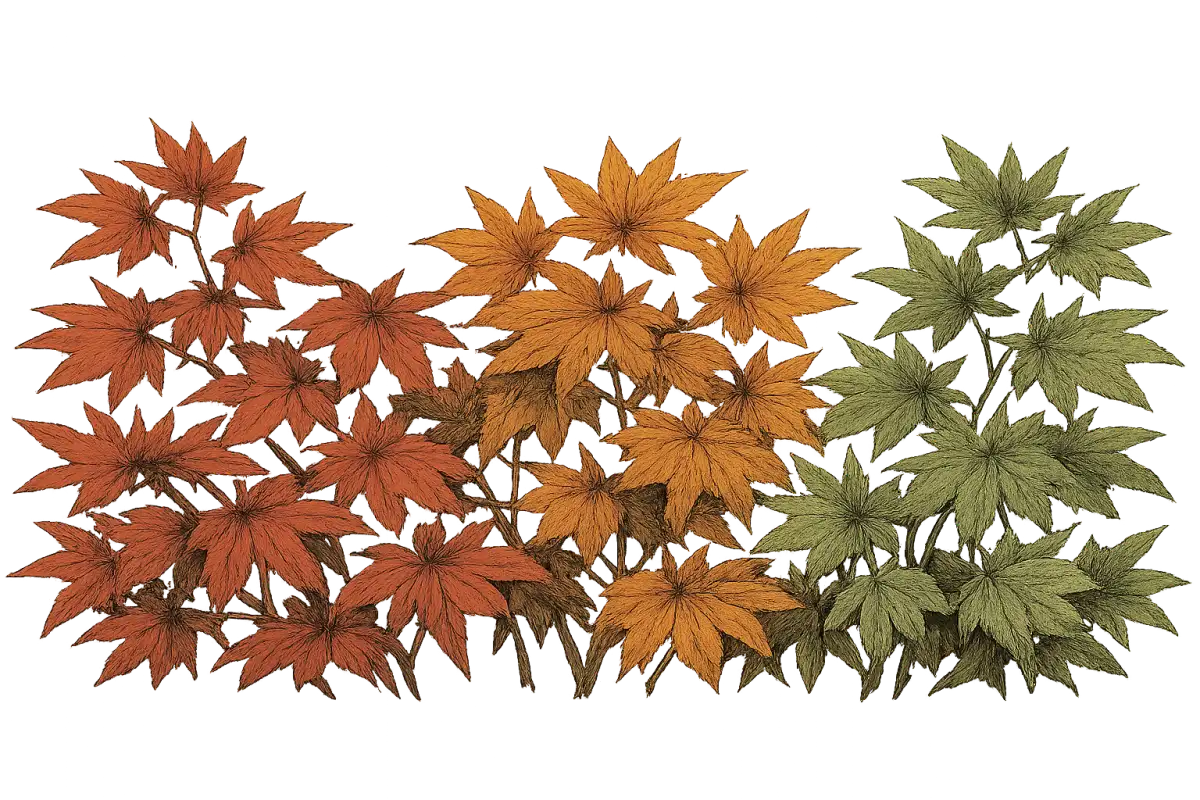
Cold Zones (5): Where Winter Sets the Rules
Zone 5 covers the upper Midwest, northern New England, and parts of the Mountain West, with winter lows between -20F and -10F. Japanese maples are at the cold edge of their range here, and cultivar selection is not optional -- it is the difference between a tree that survives and one that dies back to the ground every March.
The central challenge in zone 5 is threefold: late spring frosts that damage emerging leaves, cold drying winds that kill branch tips over winter, and rapid freeze-thaw cycles that split bark. The right cultivar addresses all three. The wrong one will have you nursing frost-blackened foliage every spring for the life of the tree.
Emperor I is the single best choice for red foliage in zone 5 and the one I would recommend without hesitation. Its cold hardiness is excellent, but the more important trait is its late leafing habit -- it pushes leaves two to three weeks later than Bloodgood, which means it is typically still dormant when the late frosts that devastate early-leafing varieties sweep through. That timing advantage has saved countless trees across zone 5 plantings.
Twombly's Red Sentinel is worth knowing for tight spaces. Its columnar form -- reaching 15 to 20 feet tall but only about 8 feet wide -- reduces its exposure to wind damage that broader canopy trees suffer. The narrow silhouette also means it can fit in locations where an upright spreading form would eventually crowd out everything around it.
Sango-kaku, the coral bark maple, has proven zone 5 survivability and offers something no other Japanese maple does: winter interest. The bark on young stems turns vivid coral-red in cold weather. Against snow, it is genuinely striking. Its summer foliage is yellow-green and turns gold in fall -- not the drama of a red cultivar, but the coral bark in January earns it a place.
For laceleaf types in zone 5, Waterfall is the appropriate choice. It is hardier than the red dissectum types and produces graceful green foliage that turns gold in fall. Any zone 5 gardener wanting a red laceleaf should be aware that those types are less cold-tolerant and will need more careful winter protection.
Zone 5 strategy: Wrap trunks with burlap for the first three to five winters. Mulch the root zone four to six inches deep before the first hard freeze. Site trees on south or east-facing slopes with protection from north and northwest winds. An established, well-sited Japanese maple in zone 5 is a tough tree. A newly planted one in an exposed spot is not.
The Sweet Spot (Zones 6-7): Maximum Cultivar Choice
Zones 6 and 7 together represent the ideal climate range for Japanese maples, and it shows in how readily they grow here. Winter cold is reliable enough to provide good dormancy without causing chronic dieback. Summers are warm but not brutal. The cultivar selection is essentially unlimited.
In zone 6, nearly every Japanese maple cultivar performs well with appropriate siting. Bloodgood is the most widely planted cultivar for good reason -- it holds its deep red-maroon color through summer better than most, handles a range of exposures, and is reliably vigorous. If you want a red upright Japanese maple in zone 6 and you are not sure which one to choose, Bloodgood is a sound, proven answer.
Crimson Queen is the premier red laceleaf choice for zones 6 and 7. The cascading form, deep red foliage, and reliable performance make it one of the most requested Japanese maple cultivars at nurseries. Like all laceleaf types, it wants afternoon shade and protection from drying wind. Give it the right site and it will be the focal point of the garden for decades.
Tamukeyama is worth serious attention. The foliage color is darker than Crimson Queen -- a deep purple-red that approaches burgundy-black -- and it is more vigorous for a laceleaf type. It also has somewhat better heat tolerance, which matters if you are in the warmer end of zone 7. A mature Tamukeyama has a sculptural quality that few other small trees can match.
Sango-kaku works well through zones 6 and 7. The coral bark color is most vivid in zones 5 and 6 where winters are colder; it begins to fade somewhat in the milder winters of zone 7, but the tree itself remains healthy and ornamental.
For zone 7, two additional laceleaf cultivars deserve mention. Inaba Shidare produces rich purple-red foliage and holds its color reasonably well in moderate summer heat. Orangeola is a distinctive choice: spring foliage emerges in orange-red tones before transitioning, and fall color is exceptional. If you want something less commonly planted than Crimson Queen with equally strong performance, Orangeola is worth seeking out.
Zone 6 and 7 strategy: Young trees in zone 6 benefit from trunk wrapping in the first two to three winters. Beyond that, the primary care concerns are siting (morning sun, afternoon shade), consistent summer watering, and mulch maintenance. These zones are forgiving enough that a well-chosen cultivar in a reasonable site will largely take care of itself.
Hot Zone (8): Shade Is Now Required
Zone 8 covers the Deep South, Gulf Coast inland areas, Pacific Northwest lowlands, and parts of Texas. Hot summers, mild winters. The dynamics shift meaningfully here -- afternoon shade moves from strongly preferred to required, and cultivar selection narrows.
The primary concern in zone 8 is afternoon sun and reflected heat. A Japanese maple planted on the south or west side of a structure in zone 8 will struggle every summer regardless of cultivar. The tree will survive, but it will look burned from July onward and never reach its ornamental potential. Getting the site right in zone 8 is more important than in any cooler zone because the consequences of a marginal site are both more severe and more visible.
Bloodgood is the top choice for zone 8. Among all commonly available cultivars, it has the best heat tolerance and the best sun tolerance, which gives you a bit more flexibility on siting when a perfect east-facing spot is not available. It should still have afternoon shade, but it can handle a somewhat more challenging exposure than laceleaf types.
Tamukeyama is the best laceleaf choice for zone 8. Among the dissectum types, it has the best heat tolerance. It will still need full afternoon shade protection, but it succeeds in zone 8 with consistent deep watering and thick mulch in a way that other laceleaf cultivars often do not.
Emperor I performs well in zone 8 and is a good alternative to Bloodgood for upright red foliage. Sango-kaku can handle zone 8 heat, though its bark color is less vivid in mild winters and the ornamental impact that makes it so compelling in colder zones is diminished. For those who want a green laceleaf, Viridis handles heat somewhat better than red dissectum types -- the physiology of green foliage is slightly more heat-resilient.
Zone 8 strategy: Plant on the east or northeast side of buildings, under the canopy of tall deciduous trees, or in any other configuration that guarantees shade by 1 PM. Water deeply two to three times per week in summer. Maintain four inches of mulch consistently -- do not let it thin out through the summer. At the first sign of brown leaf edges, increase watering frequency before the scorch progresses.
Survival Mode (Zone 9): Only the Toughest Survive
Zone 9 -- the Gulf Coast, Florida Panhandle, Southern California inland valleys, parts of Arizona -- is where Japanese maples are genuinely at their limit. Long, hot summers with intense sun are exactly the opposite of what these woodland trees prefer. Success is possible, but it requires real commitment to the conditions that make it work.
My honest advice for zone 9 gardeners who are determined to grow a Japanese maple: Bloodgood in a spot where it gets no direct sun after noon. That is the reliable formula. Everything else is a harder road.
Tamukeyama is the only laceleaf I would recommend in zone 9, and only with significant shade protection -- under the canopy of tall deciduous trees, on the north or east side of a building, or in a courtyard setting where reflected heat is blocked. Zone 9 gardeners experimenting with other laceleaf cultivars typically find themselves disappointed.
Container growing is worth serious consideration in zone 9. Moving a tree into shade during extreme heat events, or situating it so it gets maximum benefit from a shaded patio or courtyard, gives you a level of control that in-ground planting does not. The tradeoff is the daily watering commitment containers require in hot weather.
Zone 9 strategy: Afternoon shade is not a preference -- it is the difference between a tree that survives and one that does not. Water three times per week minimum in summer and check daily during heat waves. Mulch four to six inches deep. Protect from hot, dry wind from any direction. Do not plant near pavement or south-facing walls.
Quick Reference: Top Cultivars by Zone
| Zone Group | Top Cultivars | Form | Why They Work |
|---|
| Zone 5 | Emperor I, Twombly's Red Sentinel, Sango-kaku | Upright | Cold hardiness and late-leafing habit dodge spring frosts |
| Zone 6 | Bloodgood, Crimson Queen, Sango-kaku | Upright / Laceleaf | Wide cultivar selection; balanced climate for all forms |
| Zone 7 | Bloodgood, Tamukeyama, Orangeola | Upright / Laceleaf | Heat-tolerant cultivars with reliable performance |
| Zone 8 | Bloodgood, Tamukeyama, Emperor I | Upright / Laceleaf | Best heat tolerance; afternoon shade required |
| Zone 9 | Bloodgood, Tamukeyama | Upright / Laceleaf | Only the most heat-tolerant survive; shade mandatory |
Soil: What Japanese Maples Actually Need Underground
Most gardeners think about Japanese maples from the trunk up -- the form, the color, the fall display. Spend equal time thinking from the trunk down. The soil situation determines whether the tree thrives or merely survives.
Japanese maples evolved in the understory of temperate forests where soils are rich in decomposed leaf litter, moist, and slightly acidic. The target soil conditions for a cultivated tree try to replicate that environment: a pH of 5.5 to 6.5, good drainage, and meaningful organic matter content.
The pH Question
The 5.5 to 6.5 pH range is not arbitrary. Within that range, essential nutrients -- particularly iron, manganese, and phosphorus -- remain chemically available to the tree's roots. When pH climbs above 7.0, those nutrients become locked in the soil. The tree cannot access them even if they are present in abundance, and the result is interveinal chlorosis: leaves turn yellow between the veins while the veins themselves stay green. The tree looks sick. It is not sick -- it is starving in a full pantry because the pH is wrong.
Test your soil pH before you plant. A home test kit gives you a rough answer. Sending a sample to your county extension service ($10 to $15) gives you a precise one, plus amendment recommendations. If your pH is above 6.5, amend with elemental sulfur before planting. Sulfur reacts with soil bacteria to lower pH over three to six months, so plan ahead if you can.
For gardeners in the Midwest, Southwest, and anywhere with limestone bedrock or alkaline irrigation water, this is a step you cannot skip. Prairie soils frequently run pH 7.0 to 8.0. Desert soils in zones 8 and 9 often measure pH 7.5 to 8.5. In both cases, fighting the native soil chemistry with ongoing sulfur amendment is possible but requires commitment. In severe situations -- soil above pH 8.0 -- container growing with a controlled acidic mix is a more practical path than spending years trying to acidify ground that constantly wants to drift back.
Amendment rates to lower pH by approximately one point, per 100 square feet: one pound of elemental sulfur in sandy soil, 1.5 pounds in loam, two pounds in clay. These are starting points -- test after three to six months and adjust.
Drainage: The Non-Negotiable
Japanese maples will not tolerate persistently soggy roots. Phytophthora root rot -- a water mold that attacks roots in waterlogged soil -- is often lethal, and it develops in conditions that look like nothing more than "a little low and wet." Do a simple percolation test before planting: dig a hole twelve inches deep, fill it with water, let it drain, fill it again, and time the drainage. Ideal is one to two inches per hour. Still holding water after twelve hours means you have a serious drainage problem that no amount of soil amendment in the planting hole will fix.
If your soil is heavy clay, amend broadly -- not just the planting hole, but the surrounding area -- with three to four inches of compost worked into the top twelve inches across an area three times wider than the root ball. Consider planting in a broad, gentle raised mound six to eight inches above grade to move roots above the drainage problem. Do not add gravel to the bottom of the planting hole. This creates a perched water table that makes drainage worse, not better.
Low spots that collect runoff from surrounding terrain are simply not appropriate sites for Japanese maples. Choose a different spot.
Mulch Is Not Optional
Mulch does four things for Japanese maples that nothing else can replicate: it retains soil moisture, moderates soil temperature, suppresses weeds, and breaks down over time into the organic matter that replicates the forest floor conditions these trees evolved in.
Apply three to four inches of shredded hardwood bark, pine bark, shredded leaves, or wood chips from just outside the trunk outward to the drip line or beyond. Keep six inches of clearance around the trunk -- mulch piled against bark traps moisture and invites rot, fungal disease, and rodent activity under the mound. This is the "mulch volcano" that you see everywhere in American landscaping and that quietly damages millions of trees every year. The mulch ring should look like a donut, not a cone.
Refresh mulch annually. Pull back any existing layer that has built up beyond four to six inches total depth before adding new material. In zones 5 and 6, increase depth to six inches before the first hard freeze for root zone insulation.
Planting: The Steps That Actually Matter
Timing
In zones 5 and 6, plant in spring (April through May) after the last frost. The tree gets a full growing season to establish before facing its first winter.
In zones 7 and 8, fall planting (October through November) is preferred. Mild winters allow root establishment without heat stress, and the tree arrives at its first summer already anchored.
In zone 9, plant in fall (November through December). This gives the tree maximum time to establish before the heat arrives.
Planting Depth: The Mistake That Kills Trees Slowly
Plant at exactly the same depth the tree was growing in its nursery container. The root flare -- where the trunk widens at the base and the first major roots emerge -- should be visible at the soil surface or slightly above it.
Burying the trunk even two or three inches below grade is the mistake that causes slow, mysterious decline over two to five years. Bark covered by soil stays constantly moist, inviting fungal infection. The root flare cannot breathe. Growth slows. Leaves get smaller. Branches die back. The tree eventually fails and the owner never figures out why, because it looks fine from a distance until it suddenly does not.
After planting, check that the root flare is exposed. Check again a few months later -- settling can gradually bury the crown in soil that was correctly placed at planting.
The Planting Process
1. Dig the hole two to three times wider than the root ball but no deeper. Width matters more than depth -- roots spread outward, not downward.
2. Do not amend the bottom of the hole. Plant into native soil at the bottom so the tree sits on firm, stable ground.
3. Amend the backfill by mixing the removed soil with twenty-five to thirty percent compost. This improves the soil the roots will grow into without creating a dramatic contrast between the planting zone and the surrounding soil that can trap water or discourage roots from expanding outward.
4. Set the tree at the correct depth. Check the root flare position before backfilling.
5. Water thoroughly to settle the soil and eliminate air pockets. A slow, deep soaking -- not a quick spray.
6. Mulch immediately. Three to four inches, six inches clear of the trunk.
7. Do not stake unless the site is extremely windy. Trees that flex naturally develop stronger trunks than staked ones.
Watering: Deep, Infrequent, and Consistent
The principle behind watering Japanese maples is simple and counterintuitive for new tree growers: deep and infrequent is always better than shallow and frequent. A deep soak encourages roots to grow downward into cooler, more consistently moist soil. Shallow daily watering keeps roots near the surface where they are vulnerable to heat, drought, and temperature extremes.
A proper deep watering means the soil is moist to a depth of eight to twelve inches. Run a hose at a slow trickle at the base of the tree for twenty to thirty minutes, or a soaker hose encircling the drip line for thirty to forty-five minutes. To verify you have watered deeply enough, push a screwdriver or soil probe into the ground -- it should slide easily to at least eight inches.
Zone-Based Frequency
In zones 5 and 6, water once per week during summer, increasing to twice weekly during heat waves above 85F or dry spells lasting more than five days. In fall, taper off as temperatures cool, but give a thorough deep soak before the ground freezes. This pre-winter soak is one of the most effective winter protection measures available -- trees entering winter with well-hydrated roots suffer significantly less desiccation damage from cold, dry winter winds.
In zone 7, twice weekly is standard through summer. Adjust based on rainfall and heat.
In zone 8, plan on two to three times per week through the summer months, which stretch longer than in cooler zones. Monitoring soil moisture directly -- rather than following a fixed schedule -- is the most reliable approach in any zone, but particularly here where conditions change quickly.
In zone 9, three times per week is the minimum during the long, hot summer. During extreme heat events above 95F, check daily. Container-grown trees in zones 8 and 9 should be checked every day without exception.
Reading the Tree
Learn the two failure modes and their symptoms, because they look different:
Underwatering announces itself progressively. First, leaves curl inward to reduce surface area and slow water loss. Then the margins turn brown and crispy -- the classic leaf scorch. Then the tree drops leaves prematurely as a survival mechanism. Then branches begin dying back at the tips. Each stage is a warning. The earlier you respond, the less damage accumulates.
Overwatering is subtler and more dangerous. Yellowing leaves that are not fall color. General loss of vigor. And the telling sign that most gardeners miss: a tree that wilts even though the soil is wet. Roots damaged by root rot cannot absorb water. The gardener sees wilting, adds more water, worsens the root environment, and accelerates the decline. If your tree is wilting, check the soil moisture before you water. Push your finger three to four inches into the soil near the trunk. If it is already moist, the problem is not drought.
Overhead sprinklers are not the right tool for watering Japanese maples. Wet foliage promotes fungal diseases including anthracnose. Water the root zone, not the canopy.
 Where to Plant