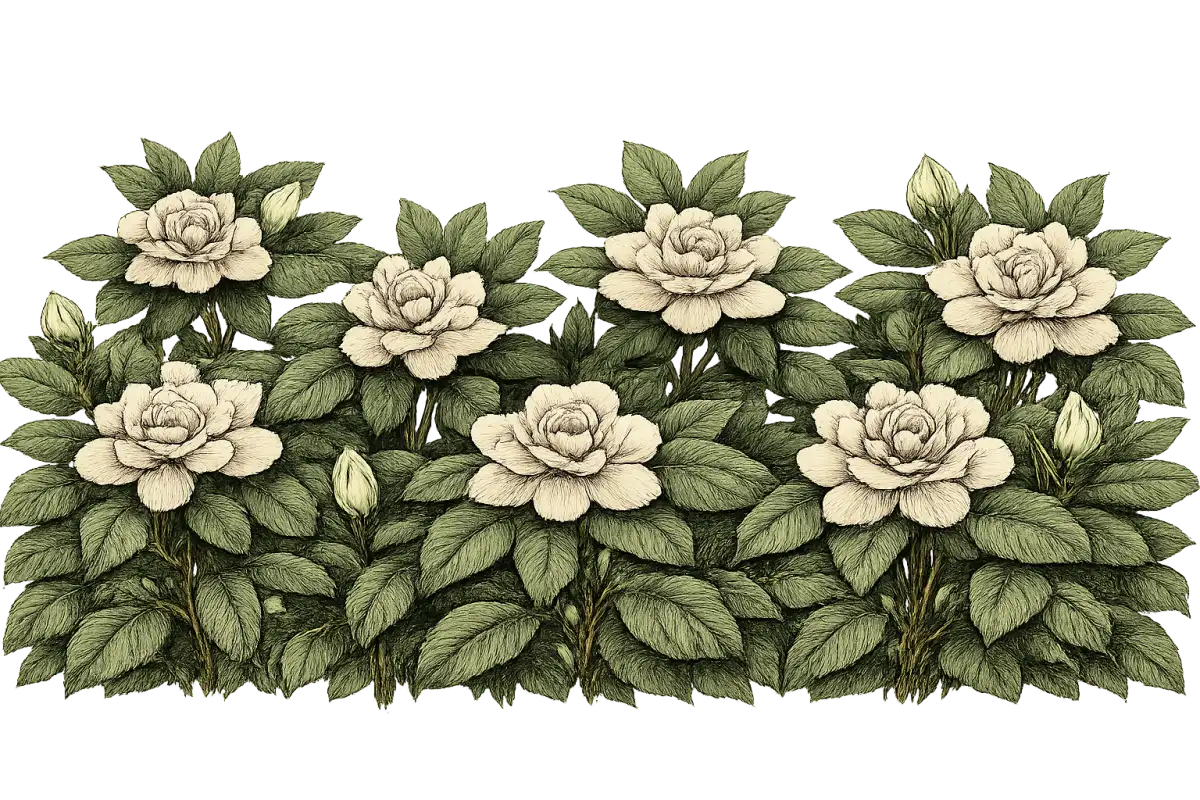
Cold-Zone Varieties (6b-7): Pushing the Northern Boundary
Gardenias are fundamentally warm-climate plants, and zones 6b and 7 represent the northern edge of where they can survive in the ground. Only a handful of varieties have been bred or selected for this tolerance, and choosing from outside this group is an expensive experiment with predictable results.
Chuck Hayes is the one I recommend without hesitation for the coldest gardenia zones. Its hardiness rating of zones 6b through 10 makes it the most cold-tolerant gardenia widely available. It grows to about 4 feet in a compact habit, produces double white flowers with good fragrance in spring, and reliably reblooms in fall — a trait that most gardenias simply do not have. In zone 7, that fall rebloom is a particular pleasure because you get a second wave of fragrance just as the season winds down. If you are in zone 7 and someone at the nursery tries to sell you a different variety, ask specifically whether it matches Chuck Hayes for cold hardiness. Usually it does not.
Frost Proof is the second strong option for zone 7 landscapes. It grows 3 to 5 feet tall, carries double white flowers with strong fragrance, and blooms heavily from spring through summer. It tolerates cold better than most gardenias, though its name is somewhat aspirational — it is not truly frost-proof and will sustain damage in hard freezes below 15°F. Plant it on the south or east side of buildings where it gets wind protection, and mulch heavily before winter.
Jubilation, from the Southern Living Plant Collection, earns its place in zone 7 through an exceptional bloom season — May through November in warm zones. At 3 to 4 feet with a compact habit, it fits well into smaller gardens and foundation plantings. It has good disease resistance and performs well across zones 7 through 10.
Zone 7 strategy, regardless of variety: mulch 3 to 4 inches deep before the first hard freeze, plant on the sheltered south or east side of structures, avoid low-lying frost pockets where cold air pools, and in zone 7a, seriously consider container growing so you can move plants under cover during the coldest snaps. Even the hardiest varieties can suffer bud damage when a late spring frost hits during the bloom period.
The Sweet Spot (Zones 8-10): Where Gardenias Belong
Zones 8 through 10 — the American South, Gulf Coast, and Florida — are where gardenias thrive without apology. Warm summers, mild winters, and naturally acidic soils across much of the Southeast remove many of the obstacles that make gardenias difficult elsewhere. Your biggest decisions here are about size and bloom season, not survival.
August Beauty is the default recommendation, and it earns that status. It grows 4 to 6 feet tall and wide, produces double white flowers with heavy fragrance, and blooms from spring through fall — the longest bloom season of any standard gardenia variety. It is the most popular gardenia in the United States, and it is popular for the reason things become popular: it works. If you are in zones 7 through 10 and want one variety that will not give you grief, this is it.
First Love (also sold as Aimee) is for gardeners who want to make a statement. It grows 5 to 8 feet tall, has an upright, vigorous habit, and produces the largest flowers of any gardenia — 4 to 5 inches across, which is remarkable for the genus. The fragrance is intense. The bloom season runs from spring into early summer. It needs more space than other varieties and is best in zones 8b and warmer due to lower cold tolerance than August Beauty, but in the right spot it is genuinely spectacular.
In zones 9 and 10, a note on sun and pest pressure: full sun is appropriate in zone 8, but in zones 9 and 10 where summer temperatures regularly exceed 95°F, afternoon shade is not optional — it is protective. Gardenias in full sun in extreme heat will drop buds and scorch leaves. Morning sun with afternoon shade is the correct exposure. Also be aware that the warm, humid conditions of zones 9 and 10 favor whiteflies and scale insects year-round. Regular inspection of leaf undersides during the growing season is just part of gardenia ownership in these zones.
Compact and Dwarf Varieties: Small Spaces, Same Fragrance
Not every gardenia spot calls for a 5-foot shrub. These varieties work across all zones within the gardenia range and are particularly well-suited to containers, borders, and small gardens.
Radicans — sometimes called Prostrate Gardenia — is the only true ground-cover gardenia. It grows just 6 to 12 inches tall with a spread of 2 to 3 feet, produces small but fragrant double flowers, and creates a dense, low carpet that works at the front of borders, along low walls, or as a tidy edging plant. It is also excellent in tabletop containers. The form is completely different from every other gardenia, and it fills a design role that no other variety can.
Kleim's Hardy is the unusual one in the lineup: it produces single, star-shaped flowers rather than the classic double blooms every other gardenia carries. If you want something elegant and different rather than the traditional gardenia look, this is the variety. It grows 2 to 3 feet in a compact habit, works well in mixed borders and containers, and is hardy in zones 7 through 10.
Container and Indoor Varieties: Growing Where Gardenias Technically Should Not
For gardeners in zones 6 and below, containers are the only realistic path to growing gardenias. The plant comes inside for winter and goes back out after last frost.
Veitchii is the classic indoor gardenia, and it has a meaningful advantage over other varieties for this purpose: it blooms in winter. When grown as an indoor plant, you get flowers during the months you most appreciate them — not during summer when the plant could be outside anyway. It is compact enough to manage in a container and is the variety most commonly found in garden centers as a houseplant.
Radicans works well in tabletop containers indoors, both because of its small size and because it is less demanding of space than larger varieties.
A direct word about indoor gardenias: they are genuinely challenging, and the challenge is not the variety — it is the environment. Most homes in winter run at 30 to 40% humidity. Gardenias need 50% or more. Without a humidifier, indoor gardenias will drop buds, develop brown leaf edges, and eventually succumb to spider mite infestations, which thrive in exactly the dry air conditions that stress the plant. A humidifier is not a luxury for indoor gardenias. It is effectively mandatory.
Quick Reference Table: Top Picks by Zone
| Zone Group | Top Varieties | Type | Why |
|---|
| 6b-7 | Chuck Hayes, Frost Proof, Jubilation | Cold-hardy | Selected for northern tolerance; winter survival |
| 8-10 | August Beauty, First Love | Standard | Proven performers across the South; longest bloom |
| All zones | Radicans, Kleim's Hardy | Dwarf/compact | Small spaces, containers, borders |
| Containers/indoor | Veitchii, Radicans | Container | Winter bloom; manageable size |
When and How to Plant
Timing by Zone
In zones 7 and 8, plant in early spring after the last frost date, or in early fall to give roots time to establish before winter. Spring planting is generally safer in zone 7, where fall-planted gardenias may not harden off sufficiently before cold arrives.
In zones 9 and 10, fall through early winter planting is ideal. The mild winters allow root establishment, and the plant enters its first hot season with an established root system rather than trying to establish one in the heat.
Site Selection
Light requirements depend on where you live. In zones 7 and 8, full sun improves flowering — gardenias need the energy from direct light to produce their heavy bloom load. In zones 9 and 10, morning sun with afternoon shade protects the plant from heat stress and bud drop during the hottest months.
Avoid low-lying spots where water collects after rain. Gardenias will not tolerate standing water, and a single season in a poorly draining location can establish root rot before you realize there is a problem. If you are unsure about drainage, do the test: dig a hole 12 to 18 inches deep, fill it with water, and time how long it takes to drain. Good drainage means the hole empties within 5 to 6 hours. If water is still sitting there after 12 hours, do not plant a gardenia there without building a raised bed.
Keep gardenias away from concrete foundations, sidewalks, and retaining walls. Lime leaches from concrete over time and steadily pushes soil pH in the wrong direction. A few feet of distance is not enough — give yourself a meaningful buffer.
Site gardenias near a patio, walkway, or window. The fragrance is the point. A gardenia planted where no one passes is a missed opportunity.
The Planting Process
Step 1: Test and amend. Test soil pH. If above 6.5, work in peat moss, composted pine bark, and elemental sulfur, and plan to wait 3 to 6 months for sulfur to fully lower pH. If planting immediately, at least amend with peat moss and pine bark, which lower pH and improve drainage immediately, and supplement with chelated iron while the sulfur works.
Step 2: Dig the hole. Make it 2 to 3 times wider than the root ball and the same depth. Wide holes matter more than deep ones — gardenia roots spread laterally.
Step 3: Amend the backfill. Mix the removed soil with equal parts peat moss and composted pine bark. This is the soil the roots will grow into, and it needs to be right.
Step 4: Plant at the correct depth. Set the plant so it sits at the same depth it was growing in the nursery container. Do not bury the crown. Burying the crown invites rot.
Step 5: Backfill and water. Fill in with your amended mix and water deeply to settle the soil and eliminate air pockets.
Step 6: Mulch immediately. Apply 2 to 3 inches of pine bark, pine needles, or oak leaves. Keep mulch 2 to 3 inches away from the trunk — piled mulch against the crown causes rot. Extend the mulch ring at least to the drip line of the plant. This is not decorative; it is moisture management, temperature regulation, and slow pH maintenance all at once.
Step 7: Water regularly through the first season. Gardenias spend their first year establishing roots, and consistent moisture during this period determines how well they perform in every subsequent year. Do not let them dry out, and do not let them sit in water. Find that middle ground and maintain it.
Watering: The Narrow Line Between Wet and Waterlogged
The core principle of gardenia watering is deceptively simple: keep the soil evenly moist. Not wet. Not dry. Moist, like a wrung-out sponge.
The reason this is harder than it sounds is that gardenias respond badly to both extremes and to the fluctuation between them. Too dry and they drop buds, wilt, and shed leaves. Too wet and the roots suffocate in anaerobic soil, root rot fungi take hold, and the plant wilts from root damage — a wilting that looks exactly like drought stress and will be fatally misdiagnosed by anyone who does not check the soil first. Wet-dry cycles — forgetting to water, then soaking the pot — may be the worst of the three, because the plant endures repeated stress events that compound over time.
Outdoor Watering
Outdoor gardenias need a minimum of 1 inch of water per week from rain and irrigation combined. In hot weather above 90°F, increase to 1.5 to 2 inches per week. Sandy soils drain quickly and may need more frequent watering; clay soils drain slowly and need careful monitoring to avoid waterlogging.
Water at the base of the plant, not overhead. Overhead watering promotes leaf spot diseases and can damage or spot flower buds. Early morning is the best time — foliage dries quickly in morning sun, reducing disease pressure.
Drip irrigation is the ideal delivery method for gardenias. It delivers water slowly and directly to the root zone, keeps foliage dry, and provides the consistent, measured moisture that gardenias prefer over irregular deep soakings.
Mulch is not optional. Two to 3 inches of acidic organic mulch buffers the soil against moisture fluctuations, keeps roots cool in summer heat, and slowly acidifies the soil as it decomposes. A gardenia without mulch on a hot August afternoon is fighting the weather with no protection.
Container and Indoor Watering
Container gardenias need a different approach because the limited soil volume dries out faster and is simultaneously more prone to waterlogging than in-ground soil.
Before every watering, check the soil with the finger test: insert a finger 1 to 2 inches into the soil. If it feels moist, wait. If it feels dry at that depth, water. Follow a fixed schedule at your peril — pot size, pot material, indoor temperature, humidity, and season all affect how fast the soil dries. A rigid once-a-week schedule will overwater in winter and underwater in summer.
When you do water, water thoroughly. Water until it flows freely from the drainage holes. Then let the pot drain completely. Never let a pot sit in a saucer of standing water for more than 30 minutes — that saucer becomes a reservoir of saturation against the drainage holes, and root rot follows.
Use room-temperature water. Cold water shocks roots that are adapted to warm soil temperatures.
The Overwatering Trap
Root rot from overwatering is the most serious disease gardenias face, and it is almost always fatal once it is established. The maddening thing about it is that the symptoms look like drought: the plant wilts, leaves droop, the gardener adds water, the rot accelerates. By the time mushy brown roots are visible, the plant is usually beyond recovery.
Prevention is the only reliable strategy. If you suspect root rot — the plant is wilting despite wet soil, the leaves are soft and yellowing rather than crispy, there is a foul smell from the root zone — stop watering immediately and unpot the plant to check the roots. White, firm roots are healthy. Brown, mushy roots confirm the diagnosis. At that point, remove affected roots, repot in fresh acidic mix with excellent drainage, and cut back watering severely. Plants caught early sometimes recover. Plants with widespread root decay usually do not.
Watering and Iron Availability
There is a secondary effect of overwatering that most gardeners never connect: waterlogged soil becomes anaerobic, and in anaerobic conditions, iron is converted to a chemical form that roots cannot absorb. This causes iron chlorosis — yellow leaves, green veins — even when the soil pH is perfectly correct. If your gardenia shows chlorosis and your pH tests fine, check your drainage and watering habits before adding more iron treatments. Fix the watering first. Then reassess the chlorosis.
Fertilizing: Getting the Micronutrients Right
Gardenias are moderate-to-heavy feeders during the growing season, but the type of fertilizer matters as much as the amount. Generic balanced fertilizers — the 10-10-10 or similar formulations found on every garden center shelf — are wrong for gardenias. Many contain lime as a filler or are formulated without the micronutrients that gardenias specifically require. Use a fertilizer formulated for acid-loving plants: products labeled for azaleas, rhododendrons, or gardenias will carry the right nutrient profile, including chelated iron, manganese, and zinc.
Cottonseed meal is an excellent organic alternative — it releases nutrients slowly, is naturally acidifying, and fits well into an organic gardening program.
Feeding Schedule
In spring, resume regular feeding as new growth appears, applying every 2 to 4 weeks through summer. Pull back in early fall and stop entirely by early October for outdoor plants in colder zones. Late fertilizing stimulates tender new growth that will not harden off before frost, making it vulnerable to cold damage.
For indoor plants, feed monthly with acid-forming fertilizer through spring and summer. Reduce to every 6 to 8 weeks in fall and winter, at half strength during the coldest months when the plant is in semi-dormancy.
Avoid high-nitrogen formulas without phosphorus and potassium — excess nitrogen pushes the plant into foliage growth at the expense of flowers. Avoid over-fertilizing in general. Salt buildup from fertilizer residue damages roots; flush containers with plain water every 2 to 3 months to prevent this accumulation.
Pruning: The Timing Window Most Gardeners Miss
Gardenias need less pruning than most landscape shrubs. They have naturally attractive, symmetrical form, and heavy-handed pruning does more harm than good. But there is one pruning rule that, if you get it wrong, will cost you an entire year of flowers — and it is the rule most people get wrong.
Gardenias set their flower buds for the next season in late summer and fall. Pruning after midsummer removes those buds. The plant does not flower the following spring. The gardener cannot understand why, because the shrub looks healthy and full. The answer is that the flowers were cut off in August.
The only safe window for pruning is immediately after flowering finishes — for most varieties, that is late spring to early summer, after the main bloom flush. Dead and diseased wood can be removed at any time, because dead branches are not carrying flower buds. But any shaping, thinning, or height reduction must happen in that post-bloom window, and it must be finished by midsummer.
For repeat-blooming varieties like August Beauty, Chuck Hayes, and Jubilation, prune after the first major spring flush and before fall rebloom buds begin to set. Enjoy the fall bloom, then wait again until the following spring bloom finishes before pruning.
Shaping and Thinning
When you do prune, be conservative. Remove branches that break the natural silhouette. Cut back to a lateral branch or leaf node, leaving no stubs — stubs die back and invite disease. Prefer thinning cuts (removing entire branches at their origin) over heading cuts (shortening branches midway). Take no more than one-third of the plant's total volume in a single season.
Opening up the interior of the plant with thinning cuts improves air circulation, which reduces fungal disease pressure. Crossing branches that rub against each other create wounds that become entry points for stem canker and other diseases; remove the weaker of the two.
Rejuvenation for Overgrown Plants
Older gardenias that have become leggy or sparse can be brought back, but it takes patience. The gradual approach: remove one-third of the oldest, woodiest stems at ground level immediately after flowering. Repeat for the next two years. By the third year, the plant is fully renewed with vigorous new growth from the base. This method keeps the plant in flower through the process and carries much less risk than cutting everything back at once.
Hard rejuvenation — cutting the entire plant to 6 to 12 inches — eliminates at least one full season of flowers and risks killing older, stressed plants that cannot recover from the shock. Use it only when gradual renovation is impractical.
The Pruning Calendar in Plain Terms
Do not touch a gardenia with pruning shears from August through March, except to remove dead or clearly diseased wood. April and May: enjoy the flowers and deadhead spent blooms. Late May through early July: your window. Shape, thin, and clean up the plant. After early July: put the pruners away until next summer.
Pests and Diseases: What to Watch For
 Where to Plant