Vines

Clematis: What Nobody Tells You Before You Plant the Queen of the Climbers

Tom Bridger

Tom Bridger

Tree & Shrub Specialist · Updated April 2026

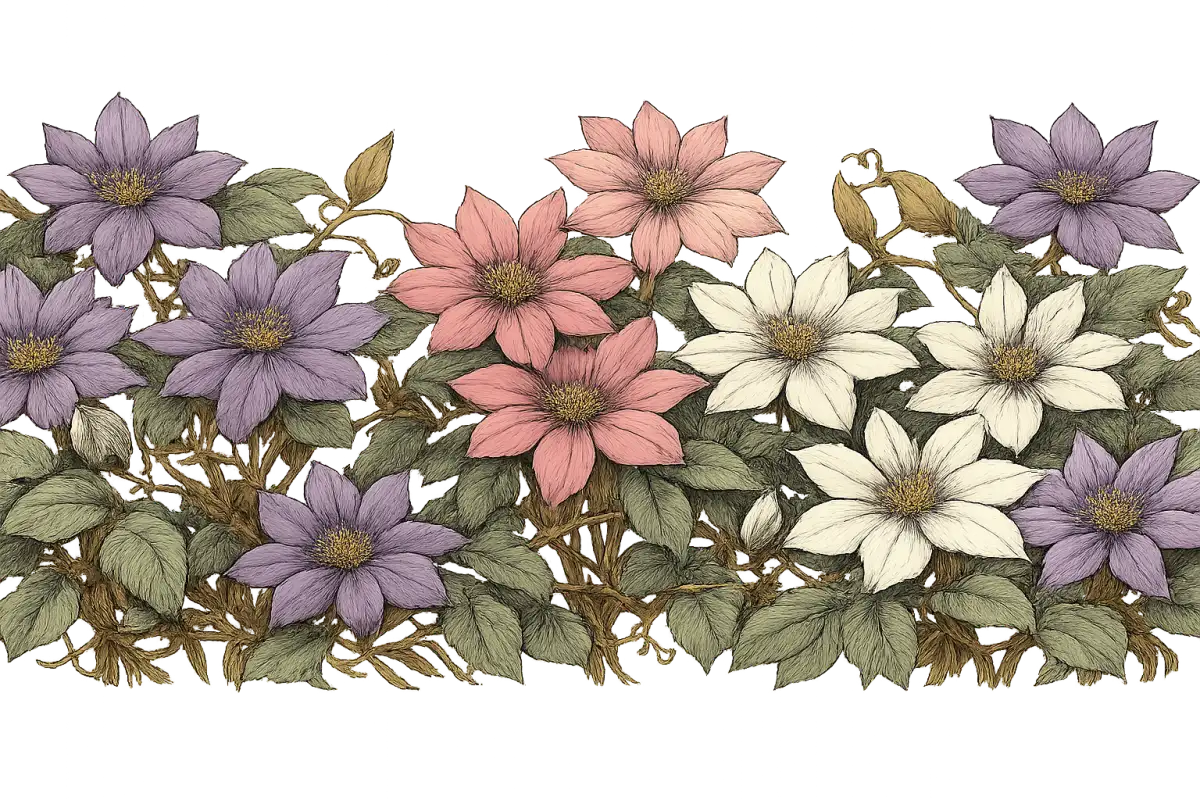
How to grow clematis — vintage botanical illustration showing the plant in detail

Clematis at a Glance

Sun

Sun

6+ hours of direct sun

Soil pH

Soil pH

6.0-7.0

Water

Water

1 inch per week during the growing season

Spacing

Spacing

24-36"

Height

Height

6-30 feet depending on variety

Soil type

Soil

Well-drained soil amended with compost

Lifespan

Lifespan

perennial

Get your personalized growing data

Enter your zip code for frost dates, growing season, and soil type.

I have watched a lot of gardeners fall in love with clematis at the garden center and walk away with a plant they will kill within eighteen months. Not because clematis is difficult -- it genuinely is not -- but because there are two or three things about it that run completely against every other planting instinct you have developed. Get those things right, and clematis rewards you with decades of some of the most spectacular flowering you will see on a vertical surface. Get them wrong, and you will spend years wondering why the vine never quite works.

The plant earned its nickname. Over 300 species, thousands of cultivars, flowers ranging from nodding bells the size of a thimble to flat-faced dinner plates measuring eight inches across. Purple, red, pink, white, yellow. Blooming from April through October depending on what you plant and how you plan the succession. Climbing through roses, swallowing garden walls, threading up through old trees. There is a clematis for nearly every garden situation in the country.

But here is the thing that separates the gardeners who have thriving clematis from the ones who have given up: they know that clematis must be planted deeper than it sat in the nursery pot. They know that there are three distinct pruning groups and that confusing them costs you a full year of flowers. And they know that the vine cannot climb a fat wooden post without help.

This guide is built around those realities. We will get the variety selection right for your zone first, then walk through planting, support, pruning, watering, and the mistakes that derail most beginners. If you put in the time to read this carefully before you plant, your clematis will still be flowering twenty years from now.


Quick Answer: Clematis Growing at a Glance

USDA Zones: 3 through 9 (with the right variety)

Sun: Minimum 6 hours of direct sun for most varieties; some tolerate 4 hours

Root zone: Must be cool and shaded -- mulch, low companion plants, or flat stones

Soil pH: 6.0-7.0 (slightly acidic to neutral; tolerates 5.5-7.5)

Drainage: Non-negotiable. Roots rot in standing water

Planting depth: 2-3 inches deeper than nursery pot level, with 2-3 leaf nodes buried

Watering: 1 inch per week during the growing season; never let roots dry out completely

Fertilizer: Balanced 10-10-10 in spring; bloom-booster 5-10-5 as buds form

Pruning: Depends entirely on pruning group (Group 1, 2, or 3) -- know yours before you cut anything

Support: Thin wire, mesh, or lattice -- petioles cannot grip thick posts or flat walls

Mature size: 6 feet (compact alpinas) to 30 feet (vigorous montana types)

First serious bloom: Year 2-3 for most varieties


The Deep-Planting Rule (And Why It Changes Everything)

Before we talk varieties, zones, or pruning groups, we need to talk about the one technique that determines whether your clematis survives its worst day in the garden.

Every other plant you grow goes into the ground at nursery depth. Tomatoes are an exception -- you can bury their stems to encourage extra roots -- but as a general rule, you match the soil line in the pot to the soil line in the ground. Clematis is a different story entirely. It must be planted 2-3 inches deeper than nursery level, with 2-3 leaf nodes buried below the soil surface.

This feels wrong. It goes against instinct. And the tag on the plant almost never explains why.

The reason is clematis wilt -- a fungal disease caused by Phoma clematidina that enters through stem wounds or natural openings, blocks the vascular system, and can collapse an entire vine seemingly overnight. One day the plant looks fine. The next morning, stems are hanging limp and black. It is one of the more alarming things you will see in a garden, and the first time it happens to a Group 2 large-flowered hybrid you have been nursing through its first season, it feels like a catastrophe.

Without deep planting, it often is. The fungus has no competition -- if it kills everything above ground, there are no dormant buds underground to push new growth. The plant is gone.

With deep planting, wilt becomes a recoverable event. You cut the affected stems to the ground, dispose of the infected material, disinfect your pruning shears, and wait. New stems emerge from the buried nodes within four to eight weeks. An established plant -- three years or older with a robust underground bud system -- almost always comes back completely. I have seen plants hit by wilt in May blooming again by July.

The planting technique itself is straightforward: dig the hole 18-24 inches wide and 18-24 inches deep -- deeper than you think you need. Mix the excavated soil 50/50 with compost. Position the plant so the top of the root ball sits 2-3 inches below the final soil surface, with at least 2-3 leaf nodes buried. Backfill, firm gently, water deeply to settle the soil, and mulch to 2-3 inches, keeping mulch a few inches back from the stem itself.

One more detail that trips up a surprising number of gardeners: plant 12-18 inches away from the base of any wall or fence. The soil immediately against a wall sits in a rain shadow -- precipitation hits the wall and runs down the outside, leaving the adjacent soil chronically dry. Wall foundations can also leach lime and raise the pH. Angle the root ball slightly toward the wall, run a guide wire to the trellis, and let the vine grow toward its support rather than starting at it.


Best Clematis Varieties by Zone

Choosing a clematis that matches your climate is what separates a twenty-year vine from a two-year disappointment. The range is remarkable -- alpine species bred for zone 3 winters right through to evergreen armandii types that thrive in zone 9 heat. But the wrong plant in the wrong zone, no matter how well tended, will struggle.

Before the zone-by-zone breakdown, a quick word on pruning groups, because they appear throughout every variety recommendation and you need the framework to make sense of the choices. Every clematis belongs to one of three groups:

Group 1 blooms on old wood in early spring. Prune lightly, only right after flowering. Never cut these back hard in late winter -- you will remove an entire season's flower buds.

Group 2 blooms on old wood in late spring, then often reblooms on new growth in late summer. Light pruning in late winter, cutting only to the first pair of healthy, swelling buds.

Group 3 blooms entirely on new growth in mid-to-late summer. Cut everything to 12-18 inches above the ground each late winter. No old wood, no worry about timing.

What zone are you in?

Enter your zip code for frost dates, growing season, and soil type.

Cold Zones (3-4): Where Alpine Species Earn Their Reputation

The upper Midwest, northern Great Plains, northern New England. Winter lows between -40F and -20F. Growing seasons of 90-150 days. The challenge is not heat management or disease pressure -- it is pure survival.

Your two tools here are Group 1 alpine species, which evolved in mountain conditions and genuinely do not mind extreme cold, and Group 3 varieties, which are cut to the ground each spring anyway, making the question of what survives above ground largely irrelevant.

For early spring bloom, start with Pamela Jackman (C. alpina). It is compact at 6-8 feet, reliable in zone 3, and produces deep blue nodding bell-shaped flowers that arrive when the rest of the garden is still waking up. Blue Bird (C. alpina) is similarly compact at 6-10 feet and equally cold-tolerant, a solid choice for small spaces and containers. Markham's Pink (C. macropetala) brings semi-double pink bells and attractive seedheads after bloom, topping out at 6-10 feet -- manageable in tight spaces, bulletproof in cold.

For summer and fall display from Group 3, Jackmanii is the entry point. Deep purple, 5-6 inch flowers, 10-12 feet of vigorous growth. It has been reliably performing in zone 4+ for so long that it has become almost invisible -- every garden catalog lists it, which leads some gardeners to dismiss it as ordinary. It is not ordinary. It is the standard by which other purple clematis are measured. Pair it with Polish Spirit for sheer volume -- this viticella-type produces masses of rich purple 3-4 inch flowers on 10-15 feet of vine and is naturally wilt-resistant. Etoile Violette, another viticella type, delivers deep violet-purple and the same excellent wilt resistance.

The zone 3-4 strategy is simple: alpine Group 1 types for April-May bloom, Group 3 types for July onward. Heavy mulch over the crown after the fall hard prune on Group 3 is worth doing, particularly in the most exposed sites.

Moderate Zones (5-6): The Widest Possible Menu

Zones 5-6 -- the Mid-Atlantic, Ohio Valley, Pacific Northwest interior, central Great Plains -- are where all three pruning groups thrive without exceptional accommodation. This is the clematis sweet spot, and the opportunity it presents is succession planting: three well-chosen varieties on a single fence or wall blooming from April through October.

For the spring show from Group 1, Elizabeth (C. montana) is the choice when you have space. Pale pink, fragrant, 20-30 feet of vigorous coverage, and a spring display that stops people on the sidewalk. Mayleen is equally vigorous and even more intensely pink. If you lack the wall for a montana, the zone 3-compatible Blue Bird alpina works here too, compact enough for small gardens.

The Group 2 large-flowered hybrids are the stars of late spring. The President -- deep purple-blue, 7-inch flowers, reliable and vigorous -- is the workhorse of this group. Plant it where you want a dependable anchor. Nelly Moser, pink with its classic dark center stripe, is stunning but fades badly in full afternoon sun; give it morning sun with some shade and it is magnificent. Niobe is the dark red option, compact at 6-8 feet, outstanding in containers. Henryi, white with dark stamens and flowers up to 8 inches across, is the right choice for brightening a north-facing or partly shaded wall.

For summer through fall, Jackmanii from Group 3 is again the reliable anchor. Add Ville de Lyon for carmine red that holds its color better than most reds, and Hagley Hybrid if you need something compact -- shell pink, 6-8 feet, well-behaved in smaller spaces. Sweet Autumn Clematis (C. terniflora) closes the season in September-October with masses of small, fragrant white flowers -- note that it can self-seed aggressively, so manage it accordingly.

The zone 5-6 three-group combination on a single fence is one of the most satisfying things you can build in a garden. It requires some organization -- labeled stakes at the base of each plant until you know which is which -- but the result is six months of continuous bloom.

Warm Zones (7-8): Heat Tolerance Becomes the Priority

Mild winters but hot, humid summers. The challenge shifts from cold hardiness to heat tolerance and increased fungal disease pressure -- which means Group 2 large-flowered hybrids deserve more caution here, and the viticella types become especially valuable.

In zone 7-8, Group 1 opens up to include C. armandii, the evergreen clematis. White, intensely fragrant flowers in early spring on glossy evergreen foliage, growing 15-20 feet. This is a genuinely different plant from the deciduous clematis most gardeners are familiar with, and in zones 7-9 it provides structure and greenery year-round. Apple Blossom, an armandii selection with pink-flushed flowers, is a lovely alternative. Note that C. montana types, which perform so well in zones 5-6, tend to struggle in the heat of zone 8. Keep expectations modest if you try them.

For Group 2 in these zones, provide afternoon shade for all large-flowered hybrids. The President holds up reasonably well in heat. Anna Louise -- purple with a red bar -- has good color retention in warm conditions. Nelly Moser in particular will bleach badly in full summer sun; afternoon shade is not optional if you want the flower to look like anything.

The real recommendation for zones 7-8 is to lean heavily on Group 3 viticella types, which are both heat-tolerant and naturally resistant to the clematis wilt that hot, humid conditions encourage. Madame Julia Correvon is wine-red and outstanding -- the best heat-tolerant red I know of. Royal Velours brings dark, velvety purple on 10-12 feet of vine. Etoile Violette produces masses of deep violet flowers and laughs at both heat and wilt. Polish Spirit is as vigorous and purple here as it is in zone 4.

Deep planting is especially important in these zones. Wilt pressure is higher in heat and humidity, and the deep-planted dormant buds are your insurance policy.

Hot Zones (9): The Short List That Actually Works

Zone 9 -- the deep South, Gulf Coast, southern California, central Florida -- is the hardest zone for clematis, not because nothing grows but because the short list of what grows well is genuinely short. Most Group 2 large-flowered hybrids will struggle in sustained heat. What thrives here is a specific and non-negotiable roster.

C. armandii is the top recommendation for zone 9. Evergreen, fragrant, white-flowered in late winter through early spring, structural all year. It needs a sheltered position but delivers something no other clematis can in this zone: year-round presence and a winter bloom that arrives before nearly anything else in the garden.

Sweet Autumn Clematis (C. terniflora) is practically a weed in zone 9 -- which is both its selling point and its warning label. It loves heat, produces enormous quantities of small fragrant white flowers in September, and self-seeds aggressively. Manage its offspring or you will find it everywhere.

Madame Julia Correvon and Arabella (a blue-purple non-climbing sprawler, excellent in containers) round out the practical Group 3 options. Provide afternoon shade for everything. Mulch heavily -- the root zone must stay cool, and in zone 9 that is a genuine challenge. Water deeply and consistently through summer.

Quick Reference Table: Top Picks by Zone Group

Zone GroupTop 3 VarietiesType/GroupWhy
3-4Pamela Jackman, Jackmanii, Polish SpiritAlpina (G1), Large hybrid (G3), Viticella (G3)Cold-proof; G3 cut back annually so winterkill is irrelevant
5-6The President, Elizabeth, JackmaniiLarge hybrid (G2), Montana (G1), Large hybrid (G3)Full three-group succession; all thrive here
7-8Madame Julia Correvon, Etoile Violette, C. armandiiViticella (G3), Viticella (G3), Evergreen (G1)Heat-tolerant; wilt-resistant; evergreen structure
9C. armandii, Sweet Autumn, ArabellaEvergreen (G1), Species (G3), Non-climbing (G3)The short list that actually performs in sustained heat

The Pruning Groups, Explained Without Confusion

Pruning is the single care task most often done wrong with clematis, and the consequences are swift and obvious: a healthy, vigorous vine that produces zero flowers for an entire year. The reason pruning trips people up is that generic garden advice -- "prune clematis in spring" -- is not just incomplete, it is actively dangerous if you are growing Group 1 or Group 2 varieties.

The system is based on a simple biological fact: different clematis bloom on different types of wood.

Group 1 blooms entirely on old wood -- stems from previous seasons that developed flower buds during fall and winter. If you cut those stems down in late winter, you have removed every flower bud on the plant. The vine will grow back vigorously. It will produce no flowers until it rebuilds its framework the following year. The rule for Group 1 is the same every year: prune right after flowering finishes, and lightly. Remove dead and damaged stems, do some light shaping, leave the main framework intact. Never cut Group 1 to the ground.

Group 2 is the most complex because it blooms twice. The main spring display comes on old wood from the previous year. The summer rebloom comes on new growth from the current season. This means you want to preserve old wood for the spring show while still allowing new growth for the summer flush. The rule: late winter, light prune only. Examine each stem from the top downward. Find the first pair of large, healthy, swelling buds. Cut just above them. Remove dead and weak stems entirely. Leave the strong framework. After the first flush finishes in early-to-mid summer, lightly trim spent flower stems to encourage the rebloom.

If you accidentally hard-prune a Group 2 in late winter -- and it happens to everyone at least once -- do not panic. You have lost the spring bloom, but the vine will push vigorous new growth and you will get a late summer display. It will return to normal the following year with correct pruning.

Group 3 is the easiest. It blooms entirely on new growth produced in the current season. Last year's stems will not produce a single flower. The rule: late winter, cut everything to 12-18 inches above the ground. Leave 2-3 pairs of healthy buds on each stub. That is the entire procedure. New growth emerges in spring and covers the support by midsummer.

If you do not know which group a plant belongs to, the answer is simple: do not prune it hard until you do know. Watch it for a full season. Early spring bloom means Group 1. Late spring bloom with possible late-summer rebloom means Group 2. Mid-to-late summer bloom means Group 3. The following year you will know exactly what to do.

A memory aid that actually works: think of traffic lights. Red for Group 1 -- stop, do not prune hard. Yellow for Group 2 -- caution, light prune only. Green for Group 3 -- go, prune hard with confidence.

One more note on pruning tools: use bypass pruners, not anvil type, and disinfect between plants with rubbing alcohol or a 10% bleach solution. Clematis wilt can travel on contaminated blades from an infected plant to a healthy one. Sharp blades matter too -- ragged cuts create more wound surface area for fungal entry.


Support, Training, and the Fan Principle

Clematis climbs in a way that surprises most first-time growers. Unlike ivy, which adheres via aerial roots, or wisteria, which twines its entire stem around a support, clematis climbs by wrapping its leaf stem petioles -- the short connection between the main stem and the leaf blade -- around thin objects. Those petioles need something roughly pencil-thickness to grip. A fat wooden post, a smooth metal pipe, or a flat masonry wall gives them nothing to work with.

This is why you see newly planted clematis sitting in a dejected heap at the base of what should be its support, making no progress upward. The plant is not sick and it is not slow. It simply has nothing to climb.

The fix is straightforward: add thin supports that petioles can grip. Wire mesh or chicken wire wrapped around a thick post works. Horizontal and vertical wires attached to a wall with eye bolts, spaced 12-18 inches apart, are clean and unobtrusive. Thin lattice with 4-6 inch openings mounted 3-4 inches from the wall provides climbing surface and -- importantly -- the air circulation gap that helps foliage dry quickly and resist disease. String or twine works for young plants while they establish.

Equally important is how you train the stems once they start climbing. Vertical stems grow straight to the top of the support and flower only there, leaving bare, flowerless lower stems that look thin and disappointing. Horizontal or fanned-out stems produce lateral branches along their full length, and each lateral produces flowers. The difference between a clematis that flowers only at the top of a trellis and one that flowers from bottom to top is almost entirely a training decision.

From the first season, gently tie stems outward in a fan pattern. The more horizontal you can coax a stem, the more side shoots it will produce. This is exactly the same principle used in espalier fruit trees. For Group 1 and Group 2 types, you are building a permanent framework of fanned stems that carries flowers year after year. For Group 3 types, you restart this process each spring as new growth emerges -- train it outward early, before it decides its own direction.


Watering and Soil: The Balance That Keeps Roots Happy

The golden rule of clematis -- "head in sun, feet in shade" -- is not just a charming phrase. It describes a real requirement. The top growth needs a minimum of 6 hours of direct sun for good flowering. The root zone needs to stay cool, consistently moist, and protected from the summer heat that stresses the plant and invites disease.

These two requirements occasionally push in different directions. A south-facing wall gets maximum sun, which the vine loves, but the soil at its base can bake in summer heat, which the roots hate. The practical solutions are mulch, low companion planting, or flat stones placed at the base to shade and cool the soil.

Mulch is the most reliable tool. Apply 2-3 inches of shredded bark, bark chips, or leaf mold over the root zone each spring. Keep it a few inches back from the stem to avoid rot. In zones 3-6, add 3-4 inches of additional mulch after the first hard frost in fall to protect the crown through winter. Refresh annually as it decomposes. Mulch reduces evaporation significantly, which means less supplemental watering and more consistent moisture -- the exact condition clematis thrives in.

The watering baseline is 1 inch per week during the growing season. In zones 7-8 in the height of summer, that increases to 1.5-2 inches as heat and evaporation rates climb. Sandy soils need more frequent watering in smaller amounts; clay soils need less frequent but deeper watering, with careful attention to drainage. Drip irrigation or a soaker hose is ideal -- it delivers water slowly to the root zone without wetting foliage, which reduces powdery mildew and other fungal problems.

Never let roots dry out completely. Clematis is not drought-tolerant, unlike many other vines. Drought stress leads to poor growth, reduced flowering, and susceptibility to disease. On the other hand, roots sitting in waterlogged soil will rot, and a wilting plant in consistently wet soil is not thirsty -- it has root damage and needs better drainage, not more water.

On soil preparation: clematis prefers a pH of 6.0-7.0 -- slightly acidic to neutral. This is far less demanding than many other ornamentals; you are essentially looking for average garden soil in the right range. The target is entirely achievable without elaborate amendment. Strongly acidic soil below pH 5.5 benefits from garden lime; alkaline soil above 7.5 benefits from elemental sulfur and acidic organic matter. But the bigger concern is almost always drainage, not pH. Do the drainage test before you plant: dig a hole 12 inches deep, fill it with water, and time how long it drains. Under 30 minutes is fast-draining sandy soil that needs more organic matter. 30-60 minutes is ideal. 1-4 hours is slow clay that needs heavy amendment. More than 4 hours means you need a different site, a raised bed, or installed drainage.

For fertilizing, the approach is straightforward. In spring, as buds begin to swell, apply a balanced fertilizer -- 10-10-10 or equivalent. As flower buds form in early summer, switch to a bloom-booster with higher phosphorus -- 5-10-5 or 4-8-4. Phosphorus is the nutrient most directly linked to flowering; high-nitrogen fertilizers produce lush foliage at the expense of blooms, which is the common mistake. Stop all fertilizing after mid-August in zones 3-6 (early September in zones 7-9). Late feeding encourages soft new growth that will not harden before frost.

What zone are you in?

Enter your zip code for frost dates, growing season, and soil type.


Pests and Diseases: What Actually Threatens Your Vine

Clematis is generally a healthy plant. The disease and pest pressure that makes other ornamentals a constant battle is largely absent here. But clematis wilt -- which we have already discussed in the context of deep planting -- deserves a fuller treatment, because understanding it changes how you respond when it happens.

Clematis Wilt: The Full Picture

Phoma clematidina enters through wounds or natural stem openings, blocks the vascular system, and cuts off water to everything above the infection point. The collapse is fast and dramatic -- you will notice it in hours, not days. Stems go limp and black from a point downward. Leaves wilt and hang but stay attached. Often only one or two stems are affected while others remain healthy; this partial collapse is actually what distinguishes wilt from drought stress, which affects the entire plant uniformly.

Susceptibility follows a clear pattern. Group 2 large-flowered hybrids are the most vulnerable -- the bigger and more hybridized the flower, the greater the wilt risk. Viticella types (Etoile Violette, Royal Velours, Madame Julia Correvon, Polish Spirit) are virtually immune. Species clematis (C. alpina, C. montana, C. macropetala) are also very resistant. Sweet Autumn Clematis has excellent wilt resistance. If wilt has been a recurring problem in your garden, the practical solution is to switch away from Group 2 large-flowered hybrids entirely and grow viticella types or species clematis instead.

When wilt strikes: cut affected stems to ground level immediately, cutting below any blackened tissue into clean growth -- in practice, all the way to the ground is safest. Bag all infected material and discard with the trash; do not compost it. Disinfect your pruning shears after every cut. Water the plant if the soil is dry -- the healthy root system still needs moisture. Then wait. If the plant was deep-planted with 2-3 nodes below the soil surface, new stems will emerge within weeks. Established plants of three years or older almost always recover. Young plants in their first or second year have less developed underground bud systems and are more vulnerable to permanent loss -- another reason deep planting from day one matters so much.

Powdery Mildew

White, powdery coating on leaves, typically arriving in late summer. Mostly cosmetic -- it rarely affects the plant's health or next year's flowering. It is promoted by poor air circulation and overcrowded growth. The practical response is to improve air circulation (mount trellises 3-4 inches from the wall, thin overcrowded stems), avoid overhead watering, and largely leave it alone. The season is nearly over when it appears. If it is cosmetically unacceptable, neem oil or a potassium bicarbonate fungicide spray addresses it.

Slugs

In early spring, slugs eat new shoots before they reach the trellis. For Group 3 clematis -- cut to 12-18 inches each spring and regenerating all above-ground growth from scratch -- this is especially damaging. Slugs can set the plant back weeks. Apply iron phosphate slug bait (Sluggo) around the base in early spring before new growth emerges. Be proactive; by the time you see slug damage, you have already lost time.

Aphids and Earwigs

Aphids cluster on new growth and shoot tips in spring, sucking sap and leaving honeydew that attracts sooty mold. A strong blast of water from a hose dislodges them; insecticidal soap spray is effective on persistent colonies. Populations typically crash naturally by midsummer as ladybugs and lacewings move in. Earwigs chew irregular holes in flowers and leaves overnight, most noticeably on newly opened blooms. Rolled newspaper or inverted flower pot traps near the base of the plant, checked each morning, control them. Diatomaceous earth around the base also works.


The Mistakes That Cost You the Most

I want to rank these for you clearly, because not all mistakes are equal. Some cost you a few flowers. Others cost you the plant.

The most dangerous mistake: not deep-planting. This is the one you cannot fix after the fact. Once the plant is in the ground at nursery depth, it is in the ground at nursery depth. If wilt hits that plant, it has no underground bud system to regenerate from. The only fix is to dig it up and replant it correctly, which is traumatic for an established vine. Do it right the first time -- 2-3 inches below nursery level, 2-3 nodes buried. This single technique converts a potentially fatal disease into a recoverable setback.

Second most costly: wrong pruning group at the wrong time. Hard-pruning a Group 1 or Group 2 in late winter removes every flower bud on the plant. The vine grows back vigorously and produces nothing but leaves for an entire growing season. The fix is knowing your pruning group before you cut anything. If you do not know the group, do not prune hard. Wait a full season, watch when it blooms, and identify the group before you touch it.

Third: the wrong support. Petioles cannot grip thick posts, smooth pipes, or flat walls. If you plant clematis at the base of a 4x4 wooden post and walk away, it will not climb. Add wire mesh, thin lattice, or horizontal wires attached with eye bolts. This is a fixable problem -- but it is far easier to set up the right support before planting than to retrofit it around an established vine.

Roots drying out is the fourth entry, and it kills more plants than most gardeners realize because the connection between an inconsistent watering schedule and a declining clematis is not always obvious. Clematis is not drought-tolerant. It will limp along in dry conditions and look only moderately unhappy before disease susceptibility climbs and growth stalls. Consistent moisture plus mulch is the practical answer.

Not shading the root zone amplifies every other stress. Hot, exposed roots push the plant toward drought stress even when you are watering adequately. Mulch 2-3 inches deep, plant low companions (hardy geraniums, heuchera, ajuga), or lay flat stones at the base. Any of these works. Doing nothing leaves a stress point that compounds over summer.

Planting against the wall rather than 12-18 inches out creates a chronic rain shadow problem that is genuinely difficult to fix after the fact. Supplemental watering helps, but the plant will always be fighting for moisture in a way it should not have to. This is an easy error to prevent and a frustrating one to manage after the fact.

Letting stems grow straight up rather than fanning them out produces a vine that flowers only at the very top, which is both anticlimactic and avoidable. Fan stems outward from the first season. The payoff is flowers from bottom to top instead of a bare stem with a floriferous cap.

Ignoring spring slug damage on Group 3 plants is a quiet setback that compounds across years if unaddressed. Proactive baiting with iron phosphate before new growth emerges is simple and inexpensive.

Buying without knowing the pruning group seems minor but cascades directly into the wrong pruning mistake. Check the plant tag, look up the variety by name, or ask nursery staff before you buy. If no one can tell you which group a plant belongs to, that is useful information about where you are shopping.


Companion Planting: Solving Two Problems at Once

The best companion plants for clematis solve the root-shading problem while adding their own seasonal interest. Low-growing perennials planted at the base of the vine keep soil cool and moist, reducing heat stress and watering demands, while the clematis climbs above them into sun.

Hardy geraniums (cranesbill) are the classic choice -- 12-18 inches tall, sun to part-shade tolerant, spreading enough to cover the root zone thoroughly. Heuchera works beautifully in shadier positions and provides evergreen foliage in dozens of colors. Ajuga spreads to form a living mulch in part-shade conditions. Creeping thyme is excellent in full-sun situations where you want something that stays very low and handles drought. All of these serve the "feet in shade" requirement while adding genuine ornamental value at ground level.

The classic English garden combination -- clematis threaded through roses -- works beautifully when you match the partners thoughtfully. Blue or purple clematis against pink roses is the traditional pairing, and it earns its reputation. Group 3 clematis is the easiest choice for this combination: you cut it back each late winter without disturbing the rose's framework, and the two plants essentially manage themselves on the same support.

For a fence or large wall, planting all three pruning groups together creates continuous bloom across the season. Group 1 alpinas or montanas open in April or May. Group 2 large-flowered hybrids peak in late spring with a rebloom in late summer. Group 3 types carry the display from midsummer through frost. Three well-chosen clematis on a single wall can give you six months of flowers -- which is one of the most ambitious seasonal displays in any garden, and entirely achievable if you plan the succession deliberately.


Container Growing: What Changes and What Stays the Same

Clematis grows well in containers with the right setup. The principles are the same -- cool roots, consistent moisture, appropriate support -- but the scale of management changes. Containers dry out faster, need more frequent feeding, and require winter protection in cold zones.

Use a pot at minimum 18 inches wide and 18 inches deep. Drainage holes are not optional. Fill with a mix of 2 parts quality potting soil, 1 part compost, and 1 part perlite for drainage. Mix in slow-release granular fertilizer at planting. Provide an obelisk, tripod, or bamboo tepee in the pot -- or position the container near a wall or fence and guide stems to the support.

The best container varieties are compact Group 3 types -- Picardy, Arabella, Hagley Hybrid -- because the annual hard prune prevents the root-bound tangles that develop when large vines spend years in the same pot. For truly small spaces, Bijou is a dwarf Group 2 that tops out at 3 feet and does not need a trellis. The Boulevard series was bred specifically for container performance. Alpina types from Group 1 are charming in pots and extremely cold-hardy.

Container clematis needs water more frequently than in-ground plants -- daily in hot weather in summer. Feed with liquid fertilizer every two weeks during the growing season: balanced formula early, switch to bloom-booster as buds form. Stop feeding in late summer. In cold zones (3-5), insulate the pot with bubble wrap, move it to a sheltered location, or bury it in the ground for winter. The root zone in a container has no soil mass surrounding it to moderate temperature extremes; unprotected containers in zone 4 winters can freeze solid and kill even cold-hardy roots.

What zone are you in?

Enter your zip code for frost dates, growing season, and soil type.


Frequently Asked Questions

My clematis grew vigorously but produced no flowers. What is happening?

Three things cause this, in rough order of likelihood. First: wrong pruning. If you hard-pruned a Group 1 or Group 2 in late winter, you removed the flower buds. The plant will not bloom until it rebuilds its framework. Identify the pruning group and prune correctly next year. Second: too much nitrogen. If you have been feeding with a lawn fertilizer or high-nitrogen all-purpose product, you are pushing foliage at the expense of flowers. Switch to a bloom-boosting 5-10-5 fertilizer as buds form. Third: too much shade. Clematis needs a minimum of 6 hours of direct sun for good flowering. Below that threshold, growth continues but flowering drops off sharply.

How do I know which pruning group my clematis belongs to?

The most reliable method is observation. Watch the vine for a full season and note when it blooms. Early spring bloom (before June in most zones) means Group 1. Late spring to early summer bloom, with a possible second flush in late summer, means Group 2. Mid-to-late summer bloom (July onward) means Group 3. The plant tag often lists the group; so do most catalog descriptions. You can also look up the variety name -- the pruning group is well-documented for virtually every named cultivar.

My clematis suddenly collapsed overnight. The stems are black. Is the plant dead?

Almost certainly not, provided the plant was deep-planted correctly. This is classic clematis wilt (Phoma clematidina). Cut affected stems to the ground immediately, bag all cut material for the trash, disinfect your pruning shears, and water the plant if the soil is dry. If 2-3 leaf nodes were buried below the soil surface at planting, new stems will emerge from those dormant underground buds within weeks. Established plants of three or more years almost always recover fully. Do not dig the plant up. Patience is the correct response.

Can I grow clematis in a container on my patio?

Yes, with the right variety and setup. Use a pot at least 18 inches wide and deep with good drainage. Fill with a compost-enriched potting mix amended with perlite. Choose compact varieties: Bijou, Arabella, Picardy, Hagley Hybrid, or the Boulevard series. Group 3 types are easiest because the annual hard prune prevents root-bound tangles. Water daily in summer heat, feed with liquid fertilizer every two weeks during the growing season, and insulate or shelter the pot in winter if you are in zones 3-5.

How far apart do I need to plant clematis from a wall?

At least 12-18 inches. The soil immediately against a wall or fence sits in a rain shadow -- precipitation runs down the wall face and the base stays far drier than surrounding ground. Additionally, mortar and foundations can leach lime into adjacent soil, raising pH. Plant 12-18 inches out, angle the root ball slightly toward the wall, and guide young stems to the support with wire or string. They will cover the wall; they just need to start with their roots in soil that actually receives rainfall.

What is the difference between a viticella clematis and a standard Group 3?

Viticella types are a specific subgroup within Group 3, descended from Clematis viticella, a southern European species. They are pruned the same way as other Group 3 varieties -- hard cut to 12-18 inches in late winter -- but they bring two notable advantages: excellent heat tolerance for warm climates, and very strong resistance to clematis wilt. If you have had wilt problems with Group 2 large-flowered hybrids, switching to viticella types is the practical fix. Etoile Violette, Royal Velours, Madame Julia Correvon, and Polish Spirit are the most commonly available and all are outstanding performers.


The Long View

Clematis rewards patient, informed growers. Plant correctly -- deep enough, far enough from the wall, with the right support waiting -- and you are giving this plant the foundation for a very long life. Get the pruning group right, and you will have flowers every year without the frustration of watching a healthy vine produce nothing. Keep the root zone cool and consistently moist, and the vine will handle more adversity than most gardeners expect.

The Queen of the Climbers is an apt title. But queens are not high-maintenance in the demanding, exhausting sense -- they are particular about a small number of things that matter very much. Two inches of extra planting depth. The right pruning at the right time. A thin support instead of a thick post. Consistent moisture at the roots. Get those four things right, and clematis will give you decades of vertical display that almost nothing else in the garden can match.

Start with the deep planting. Know your group before you pick up the pruners. Everything else follows from there.

Source material for this guide was synthesized from articles on clematis cultivation, pruning group management, wilt disease biology, support and training techniques, variety selection by zone, soil preparation, companion planting, and container growing.

Where Clematis Grows Best

Clematis thrives in USDA Zones 4, 5, 6, 7. Explore each zone's complete guide for growing tips, companion plants, and seasonal advice.

Also possible in: Zone 3, Zone 8 (challenging but possible with the right conditions).

Not sure of your zone? Look it up by zip code →