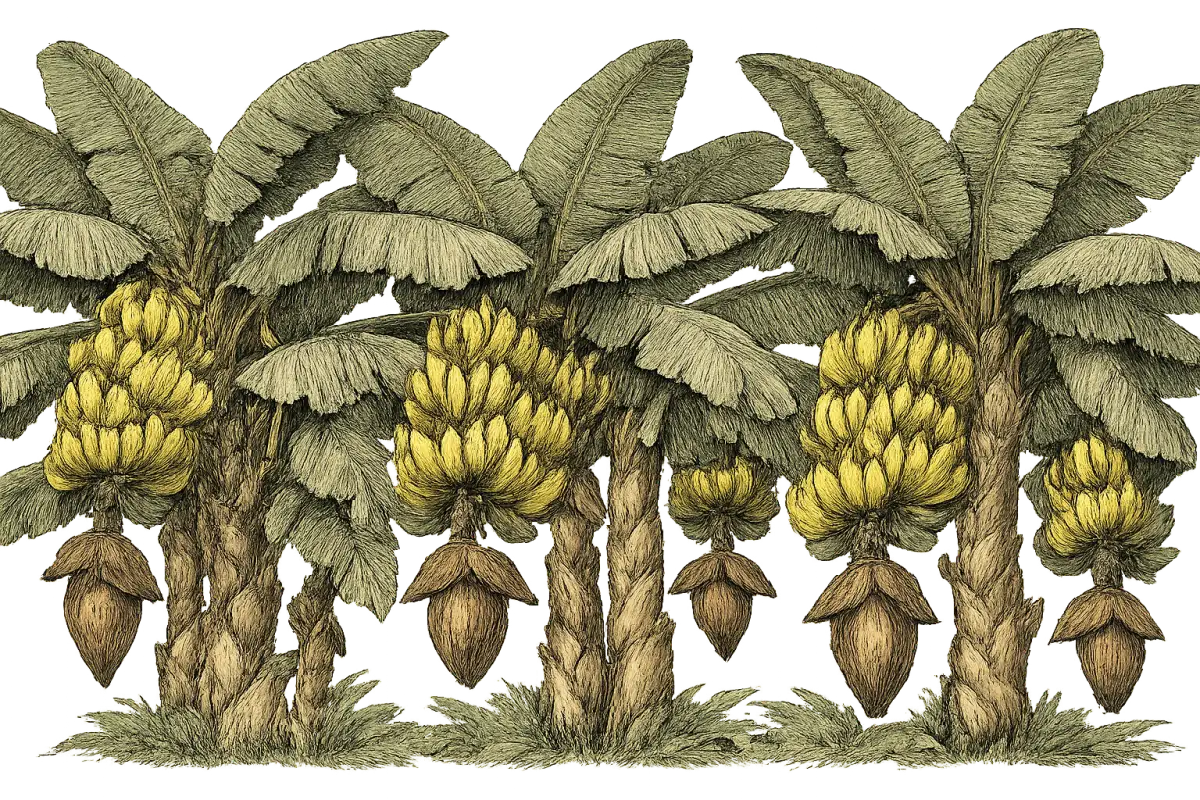
Warm Zones (9-11): Any Banana You Want
If you live in South Florida, Hawaii, the Gulf Coast, or coastal Southern California, you are in banana country. Zones 10-11 support year-round outdoor growing of essentially any banana variety, with fruiting 9-15 months from planting and continuous production once the colony is established.
Grand Nain is the actual variety sold as Chiquita and Dole — 6-8 feet tall, producing 40-60 lb bunches, and the commercial standard worldwide. Dwarf Cavendish is the most popular home variety in the US: 6-7 feet (up to 10 feet in South Florida), standard yellow dessert fruit, and fruit forms after 10-15 frost-free months.
For something more interesting than the grocery store standard, consider Ice Cream / Blue Java — silvery-blue peel when unripe, creamy white flesh with a genuine vanilla custard flavor. One important warning from Bananapups.com, which runs the most detailed banana field trial data we have found: "90% out there are fakes." Buy Ice Cream from reputable specialized tropical nurseries only, or you will be disappointed. Lady Finger (also called Pisang Ceylon or Sugar Banana) produces small, slender, intensely sweet fruit on 12-25 foot plants and is more disease-resistant than Cavendish. Red Banana is worth growing for beauty alone — burgundy-red pseudostem and leaves, creamy pinkish-white flesh with raspberry overtones, and nutritionally superior to yellow varieties (more beta-carotene and vitamin C). It takes 15-18 months to fruit versus 9-12 for Cavendish, but premium US grocery stores price it 2-3x higher than Cavendish for good reason.
In zone 9, occasional cold protection makes sense. A severe freeze below 25°F can damage Cavendish-type rhizomes. Frost cloth on cold nights and heavy mulch around the base handles most zone 9 winter events.
Zone 8: The Borderline That Rewards the Right Variety
Zone 8 is the most interesting zone for banana growing, because it sits exactly at the threshold of what is possible. Fruiting is achievable — but only with the right variety and the right winter protection strategy (more on that in the winter section).
The key metric here is the fruiting success rate by subzone. Zone 8b (Southeast US, parts of Pacific NW, North Texas) achieves fruiting 60-80% of years with proper management. Zone 8a drops to 40-60%. Those numbers are honest. Some years the weather wins.
Dwarf Orinoco is the unambiguous top choice for zone 8 fruiting. Bananapups.com, after years of cold-zone field trials, calls it flatly: "Can't be beat! Nothing comes close" for cold-hardy fruiting. The standard Orinoco has been growing along the US Gulf Coast for over a century and commonly produces fruit clusters even in zone 7 with pseudostem protection. The dwarf version tops out at 6-8 feet, making pseudostem caging practical. The superior clones to seek out are Cali Gold and Dwarf Chamaluco.
Monthan is your best friend if you are racing the season. Most bananas need 3-6 months from flower to ripe fruit. Monthan goes from flower to yellow fruit in 50-60 days. If you can get the pseudostem to flower by early June, you have ripe fruit by August — a window that zone 8 can reliably provide. It is both cold-hardy and uniquely short-cycle, which is a rare combination.
Blue Java / Ice Cream ranks third in cold-hardy fruiting trials. It comes up early in spring — a meaningful advantage in short-season zones — and the vanilla custard flavor makes every effort worthwhile. Dwarf Namwah (Pisang Awak) is another strong performer: the dwarf form survived 8°F without mulch at Plant Delights Nursery. Rajapuri flowers quickly but needs 3-4 months to fill its fruit, which can be tight in zone 8a.
For ornamental die-back in zone 8 (where you love the look but are not chasing fruit), Musa sikkimensis is spectacular — up to 14 feet with dazzling cinnamon-red leaf backs — and it survived 9°F without mulch since 2007 at Plant Delights. Musella lasiocarpa, the Golden Lotus Banana, produces what one grower described as "large bizarrely beautiful yellow flowers that look like giant golden artichokes" and has survived over a decade without mulch at Plant Delights.
Zone 7: Tropical Drama Without the Fruit (Mostly)
Zone 7 — the Mid-Atlantic, Tennessee Valley, Oklahoma, and Pacific Northwest pockets — is ornamental banana territory, with fruiting treated as a lucky bonus rather than a plan.
Musa basjoo is the undisputed champion here. Its rhizomes are hardy to -10°F with heavy mulch, making it the only banana that grows reliably outdoors across the full zone 7 range. It reaches 8-14 feet in a single season from the rhizome, produces nothing edible (small yellow 2-inch ornamental fruit), but delivers a tropical garden effect that is genuinely unmatched by any other hardy plant. Plant it, mulch it in winter, and watch it emerge bigger than the year before, season after season, as the rhizome expands.
Musa velutina (Pink Velvet Banana) is the delightful exception in zone 7: it is the only banana species that reliably flowers and fruits after dying to the ground. The fruit is small, pink, seed-filled, and technically self-peeling — it is not edible in the dessert sense, but it is charming and it comes back every year. Zones 7b-10. Musella lasiocarpa works in zone 7 as well.
Fruiting the Orinoco in zone 7 is possible — it has been done, with wire cage pseudostem protection — but the success rate is 10-30% of years. Monthan, with its 50-60 day flower-to-fruit window, gives the best odds of any edible variety. We would not plan your summer banana bread around either of them. But we would definitely try.
Zone 6: Commit to the Container, or Go All-In on Basjoo
Zone 6 (Midwest, Northeast, Mountain West) gives you two legitimate paths. Path one: grow Musa basjoo in the ground, mulch it heavily (12+ inches over the root zone), and enjoy the dramatic die-back-and-regrow cycle. The plants will not fruit, but they will grow to impressive size and the rhizome gets larger and more vigorous every year. Path two: grow dwarf fruiting varieties in containers and bring them indoors before temperatures drop below 57°F.
Dwarf Cavendish and Dwarf Namwah are the best container candidates for zone 6. They stay manageable in size, fruit reliably given enough light and warmth, and tolerate the seasonal indoor-outdoor transition. The container strategy is not a consolation prize — it is a genuine system that works well. We will cover it in detail later.
Zone 5: Musa basjoo Outdoors, Containers for Everything Else
Zone 5 is the northern limit for outdoor banana growing, and there is exactly one variety that belongs there: Musa basjoo. Its rhizomes survive -10°F with heavy mulch — a cold tolerance that no edible banana comes close to matching. The plants will be smaller than in warmer zones (6-10 feet versus 14-20 feet in zone 8), but they will come back. Cut the pseudostem to 2 feet in fall, bury the root zone under 12+ inches of mulch, and wait for June.
All edible fruiting varieties in zone 5 belong in containers, brought outdoors from May through September and overwintered indoors. Super Dwarf Cavendish, at 2-3 feet, is the most practical option.
Quick Reference Table: Top Picks by Zone Group
| Zone Group | Top Varieties | Type | Why |
|---|
| 10-11 | Grand Nain, Lady Finger, Red Banana | Cavendish / Specialty | Any variety thrives; choose for flavor |
| 9 | Dwarf Cavendish, Ice Cream, Rajapuri | Cavendish / ABB | Reliable fruiting; occasional cold protection |
| 8 | Dwarf Orinoco, Monthan, Blue Java | Cold-hardy fruiting | Wire cage method enables fruiting most years |
| 7 | Musa basjoo, Musa velutina, Musella lasiocarpa | Ornamental / Cold-hardy | Die-back-and-regrow; fruiting rare |
| 5-6 | Musa basjoo (outdoor), Dwarf Cavendish (container) | Ornamental / Container | Basjoo survives -10°F; containers for fruit |
| 3-4 | Super Dwarf Cavendish, Dwarf Namwah | Container only | Outdoors May-September; indoors otherwise |
Site Selection: Wind Is the Threat You Did Not See Coming
Most gardeners think about sun when they choose a planting spot. For bananas, wind deserves equal billing. Banana leaves are enormous — up to 6 feet long on mature plants — and they catch wind like sails. The plant has no wood. It is held upright entirely by water pressure in its cells, with a shallow root system spread through the top 12-18 inches of soil.
The damage thresholds are specific. At 25 mph, leaves begin to tear and shred along parallel veins. At 40 mph, the whole plant may topple. At 60 mph, it can blow completely over. Shredded leaves still photosynthesize — the strips stay attached to the central midrib — but severe shredding reduces the plant's ability to fuel the growth and fruit development you are working toward.
The most effective wind protection strategy is not a fence or a wall, though those help. It is block planting — growing bananas in groups of 3-5 or more. The plants at the center of a group are protected by those at the perimeter, humidity is elevated between them, and the whole colony supports itself. In commercial plantations, the western outside rows always look worse than the interior. Plant your bananas in a group whenever you can.
For individual specimens, a south-facing wall is the gold standard location. You get maximum solar warmth reflected off the wall surface, wind protection from the north and west, and a microclimate that runs meaningfully warmer than the surrounding garden — sometimes enough to push effective fruiting one half-zone warmer than your USDA designation suggests.
Avoid hilltops, open fields, and the wind tunnels that form between buildings. In terms of sun, aim for 6-8 hours of direct sunlight minimum. More is better for both growth rate and fruiting. The one exception: in zones 10-11 with extreme afternoon heat, light shade in the hottest part of the day can prevent leaf scorch. Variegated varieties like Musa 'Ae Ae' (the Royal Banana, with stunning green-and-white variegated leaves and edible variegated fruit) need partial shade specifically — their variegated tissue burns in full sun.
Planting: Heavy Soil Prep Pays Off for a Decade
Bananas reward upfront soil investment more than almost any other fruit plant. A mature fruiting plant removes roughly 15-20 pounds of potassium, 3-5 pounds of nitrogen, and 1-2 pounds of phosphorus from the soil per year. The root system is shallow (most of it in the top 12-18 inches) but spreads 10-15 feet laterally. Rich, deep, well-draining loam is the ideal, with a pH of 5.5 to 7.0.
Step 1: Prepare the soil. Dig a hole 2-3 times wider than the root ball. Mix the removed soil generously with compost and aged manure. Add wood ash for extra potassium. If your soil is heavy clay, amend heavily with sand and organic matter — or build raised beds. Drainage is non-negotiable. Bananas need consistently moist soil, but standing water causes root rot. Sandy soils (common in Florida) will need more frequent fertilization throughout the plant's life.
Step 2: Timing. Plant 3-4 weeks after your average last frost date, once soil temperatures are reliably above 57°F. Cold shock at planting sets growth back significantly. Spring planting gives the maximum growing season for reaching fruiting size.
Step 3: Select your starting material. For the fastest path to fruit, start with a sword sucker — a pup with narrow, pointed leaves that is well-attached to the mother rhizome. Sword suckers are vigorous and root-connected. Avoid water suckers (broad-leaved, weakly attached) — they look similar but underperform significantly. At 2-4 feet tall, a sword sucker is ready to transplant. Plant it at the same depth it was growing. Do not bury the crown deeper.
Step 4: Mulch immediately. Apply 2-4 inches of organic mulch over the root zone. Old banana leaves, shredded leaves, straw, compost, and wood chips are all good choices. Keep the mulch 4 inches away from the pseudostem base to prevent rot. The root zone must stay consistently moist, and mulch is your best tool for achieving that.
Step 5: Space appropriately. Standard varieties need 8-12 feet between plants; dwarfs need 6-8 feet. For block plantings, you can tighten that spacing within the group. Allow room for 3-4 stalks of different ages per planting spot.
Feeding: The Most Demanding Plant in Your Garden
We want to be direct about this: bananas are the heaviest feeders of any common garden plant. Their growth rate — one new leaf per week during peak season, entire pseudostems reaching 8-14 feet in a single growing season — demands nutrition on a scale that surprises first-time growers. Monthly fertilization is not optional. It is maintenance.
The most critical nutrient is potassium. A mature plant consumes 15-20 pounds of potassium per year. Potassium drives water uptake, sugar synthesis, and fruit quality — insufficient potassium is the most common nutrient deficiency in bananas, and the symptoms are ugly: yellowing and browning at the leaf margins, crumpling leaves, and fruit that is small and flavorless. During flowering and fruit development, switch to a high-potassium formula (15-5-30 or similar, or the 6-2-12 formulation commonly recommended for Florida conditions where soils are already high in phosphorus).
During vegetative growth, a balanced formula (8-10-10 or 10-8-10 or 15-15-15) is appropriate. The transition point is when the flower bell emerges — that is when you shift to the high-K formula and stay there through harvest.
The feeding schedule by plant age:
- Young plants (first 6 months): Every 2-4 weeks, starting with a few ounces and gradually building to 1/4 to 1/2 pound per application.
- Established plants (6+ months, pre-flowering): Monthly, 1.5 to 2 pounds of granular fertilizer per application.
- Flowering and fruiting: Monthly, high-potassium formula. Continue through fruit development.
- Fall/winter: Stop when growth slows. Resume when new growth appears in spring.
Apply granular fertilizer by broadcasting it around the drip line — the outer edge of the canopy. Never pile it directly against the pseudostem, which can burn the tissue. Water thoroughly after every application.
Organic options work well as supplements. Chicken manure is the traditional banana fertilizer in tropical growing regions and is excellent. Wood ash is a superior potassium source and easy to source if you have a fireplace or fire pit. Fish emulsion gives fast-acting nitrogen when growth stalls. Banana peels are popular but contribute trivially compared to actual needs — nice as an addition, not as a strategy.
One thing that genuinely changes the math on feeding and watering: drip irrigation combined with heavy mulching has been documented to produce 58% water savings and 23-32% yield increases compared to surface irrigation. For a plant that needs 1-2 inches of water per week and 78-98 inches annually for optimal production, that efficiency is worth building in from the start.
Watering: Thirsty Does Not Begin to Cover It
The pseudostem is 95% water. The most common cause of banana death — more common than cold, more common than disease — is insufficient water. Leaf edges turning brown and crispy, leaves curling inward to reduce surface area, slow growth, delayed or absent fruiting: these are drought stress symptoms, and they appear faster than on almost any other garden plant.
In-ground plants in zones 9-11 need deep watering 2-3 times per week, with daily watering in extreme heat. Check the soil 2-3 inches down — if it is dry, water immediately. The goal is evenly moist soil that never fully dries out and never puddles.
Overwatering is also real, particularly in containers or clay soils. Yellowing lower leaves, a soft mushy pseudostem base, and root rot are overwatering signs. The solution is not to water less everywhere — it is to ensure drainage and adjust for your specific conditions. In clay soils, amend heavily or use raised beds. In containers, drainage holes must be clear and saucers must be emptied within 30 minutes of watering.
The water savings from drip irrigation are substantial enough that we recommend it for any planting of more than a few plants. Soaker hoses work adequately for small home gardens. The least efficient method is overhead irrigation, which wets leaves (increasing disease pressure from Black Sigatoka) and loses water to evaporation.
Winter Protection: Four Methods, One Goal
For anyone in zones 5-8, overwintering strategy determines whether you are growing bananas for real or just for fun. These are your four options, ranked by protection level and effort.
Method 1: Mulch-and-Forget (Zones 7-8, Ornamental)
After frost kills the leaves, cut the pseudostem to 4-6 inches above ground level with a sloping cut (to prevent moisture pooling). Pile 12+ inches of shredded leaves, straw, or bark mulch over the stump and root zone, extending 2-3 feet in all directions. An optional tarp keeps the pile dry, which improves insulation. In spring, remove mulch gradually as temperatures warm above 50°F.
This is the simplest method. The pseudostem dies — you get no fruit — but the rhizome survives, and the plant emerges next spring. Best for ornamental varieties like Musa basjoo where fruiting is not the point.
Method 2: Wire Cage Method (Zones 7-8, Gold Standard)
This is the approach recommended by Plant Delights Nursery for gardeners who want to preserve the pseudostem and give themselves a shot at fruiting. After the first freeze, cut the top of the pseudostem, leaving 3-4 feet of stem with the brown dead leaves still attached (they add insulation). Drive rebar stakes in a circle 2 feet out from the outermost pseudostem. Wrap concrete reinforcing wire (remesh) around the rebar to form a cage. Fill the cage completely with shredded leaves, packed tightly.
Critical material note: use shredded leaves only — they allow air circulation. Do NOT use pine straw, hay, or grass clippings. These pack too tightly, trap moisture, and cause rot. The difference between shredded leaves and grass clippings can be the difference between a live pseudostem in April and a rotted one.
In spring, remove the cage and leaves when growth emerges. A surviving pseudostem picks up where it left off and can fruit that same season. This is how zone 8 gardeners get fruit 60-80% of years.
Method 3: Trunk Wrapping (Zones 7-8)
Cut the pseudostem back to 2-4 feet, wrap with burlap, bubble wrap, or horticultural fleece in multiple layers, secure with garden twine, and pile 6-10 inches of bark mulch around the base. Faster than the cage method, but less insulating and higher rot risk if moisture gets trapped. A plastic cap over the top of the wrapped stem helps prevent rain entry.
Method 4: Dig and Store (Zones 5-6, Valuable Varieties)
After frost kills foliage, cut the pseudostem to 6-12 inches, dig up the entire rhizome with a garden fork, let it dry 1-2 days in a shaded area, wrap in newspaper and loosely in plastic bags (not sealed — it needs some airflow), and store somewhere cool and dark. A garage, basement, or crawl space with temperatures around 45°F is ideal; the mid-30s°F is the lower limit. Check monthly and provide a tiny amount of water if the rhizome feels completely desiccated.
Replant 3-4 weeks after last frost in spring. The plant starts from ground level, but it is alive.
 Where to Plant