Trees

Dogwood Trees: What Nobody Tells You Before You Plant One

Tom Bridger

Tom Bridger

Tree & Shrub Specialist · Updated April 2026

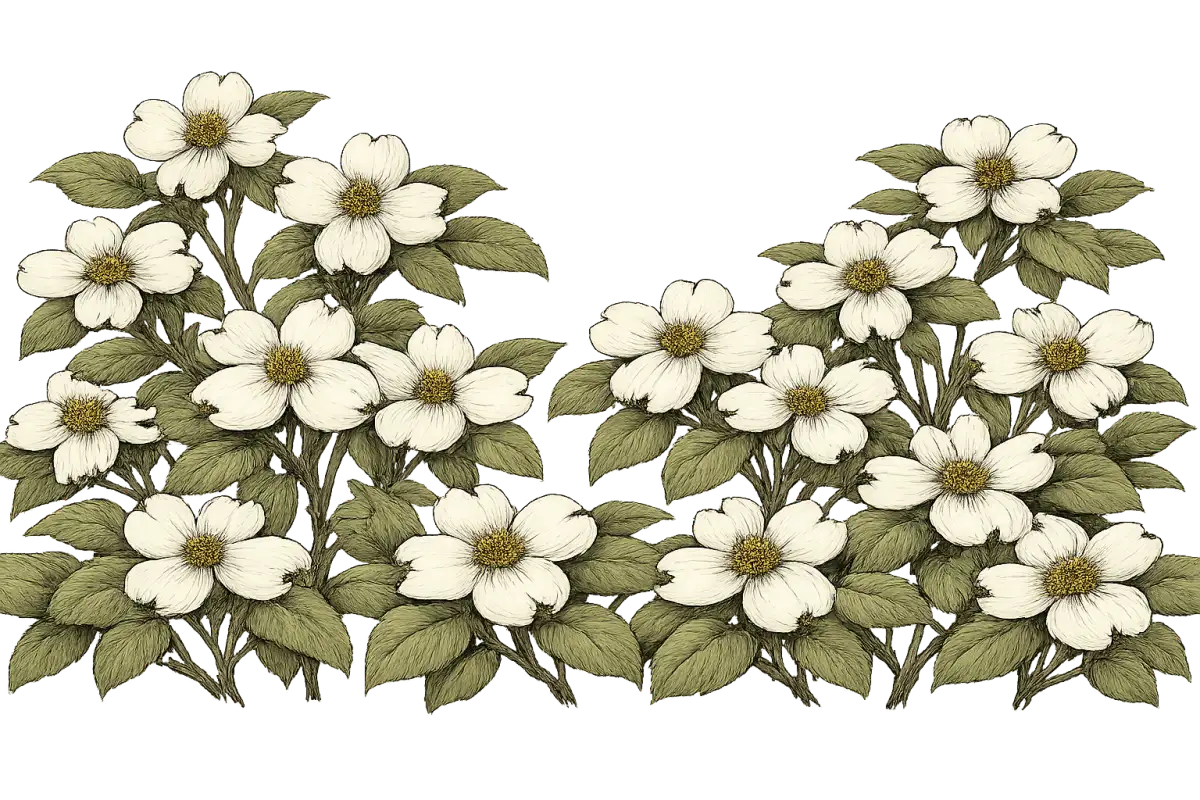
How to grow dogwood — vintage botanical illustration showing the plant in detail

Dogwood at a Glance

Sun

Sun

Morning sun with afternoon shade

Soil pH

Soil pH

5.5-6.5

Water

Water

1 inch per week during growing season

Spacing

Spacing

15-25 ft

Height

Height

Allow 15-20 ft from structures for mature spread

Soil type

Soil

Acidic

Lifespan

Lifespan

perennial

Get your personalized growing data

Enter your zip code for frost dates, growing season, and soil type.

There is a house in my neighborhood with a dogwood that has been declining for the better part of a decade. Every spring it struggles out a few pale blooms. Every fall the foliage turns a sickly yellow instead of the brilliant red-purple it should be. The owners have fertilized it, sprayed it, pruned it. What they have never done is fix the two problems that were baked in from day one: it is planted on the south side of the house, full western sun, and there is mulch piled a foot high against the trunk like a little mountain.

That tree is not going to make it. And the painful part is that it never had a chance.

I tell that story not to be grim, but because it captures exactly what goes wrong with dogwoods in American landscapes. The problems are almost never mysterious. They trace back to decisions made before the tree went in the ground -- which side of the house, how deep to plant it, whether to choose a susceptible variety in a high-risk area. Get those decisions right and a dogwood will reward you for forty years: four seasons of genuine beauty, spring flowers that stop people on the street, fall color that rivals any maple, berries that fuel songbirds through migration, and winter architecture that is elegant even after every leaf has dropped.

Get the decisions wrong and you will spend years wondering why your tree never thrives. This guide is about getting them right the first time.


Quick Answer: Dogwood Growing at a Glance

USDA Zones: 5 through 9 (species-dependent; zones 5-8 are the sweet spot)

Light: Morning sun with afternoon shade in most zones; partial shade to full sun acceptable in zones 5-6

Soil pH: 5.5-6.5 (acidic; test before planting)

Drainage: Well-drained and non-negotiable -- dogwoods do not tolerate standing water

Watering: 1 inch per week during growing season; 2-3 times per week for first two years

Irrigation method: Drip irrigation strongly preferred; overhead watering increases disease risk

Mulch: 2-4 inches of organic mulch; maintain a 3-4 inch gap from the trunk

Mature size: 15-30 feet tall depending on species and cultivar

Key disease threat: Dogwood anthracnose (Discula destructiva) -- manageable with proper placement and variety selection

Key pest threat: Dogwood borer -- almost entirely preventable with mulch and no bark damage

Best placement: East or northeast side of buildings or larger trees; woodland edge


Placement Is Everything (And Most People Get It Wrong)

Dogwoods are natural understory trees. In the wild, they grow beneath oaks, maples, and pines in dappled or filtered light -- not in the open middle of a sunny lawn, and not in the dense shadow of a building's north face. Every instinct a dogwood has evolved over millennia is tuned to that in-between world of partial shade and protected conditions. When you honor that, the tree responds. When you ignore it, it struggles in ways that no amount of fertilizer or pruning will fix.

The single most important placement rule: morning sun, afternoon shade. In zones 5 and 6 where summer heat is moderate, full sun is acceptable provided the soil stays consistently moist. But move into zone 7 and full sun becomes a problem -- leaves scorch along the margins in late summer, vigor drops, and a stressed tree is a vulnerable tree. By zone 8, significant afternoon shade is not a preference but a requirement, and in zone 9, dogwoods want to be in actual understory conditions beneath larger trees.

The east or northeast side of a house or large deciduous tree is ideal for most landscapes. The tree gets morning light -- enough to set flower buds generously and keep foliage drying quickly after rain -- but is sheltered from the beating of a western afternoon sun. This positioning also nails one of the subtler benefits of the understory timing: in early spring, before the canopy trees above have leafed out, your dogwood sits in near full sun and blooms its heart out. Then as the season warms, the emerging canopy provides natural afternoon protection.

What to avoid is equally specific. South-facing walls are disqualifying in most zones -- reflected heat causes severe, chronic stress. Deep dense shade is equally bad, and for a reason that goes beyond aesthetics: shade is the single biggest environmental risk factor for dogwood anthracnose. The fungus Discula destructiva needs cool, humid conditions to thrive, and deep shade creates exactly that microclimate. A tree in dense shade that never gets its canopy dried by sun and air movement is an anthracnose invitation. Low-lying frost pockets damage emerging flower buds in spring. Compacted soils, common around driveways and construction areas, block the shallow root system from spreading.

Low-lying areas where water collects after rain are also off the table. Dogwoods will not tolerate waterlogged roots, and a wet site that looks fine in a dry summer will reveal itself in a rainy spring.

When you find the right spot -- that east-facing edge of a bed, the gap in the shrub border that gets morning light, the corner near the patio where you want something that rewards you from every window -- plant your dogwood there and do not second-guess it. Placement done right is worth more than every other care decision combined.


Best Dogwood Varieties by Zone

There are three main groups of dogwood you need to know, and the differences between them matter far more than most gardeners realize.

Cornus florida -- the native flowering dogwood of eastern North America -- is the one most people picture. It blooms in early spring before the leaves emerge, produces the classic large rounded white or pink bracts, bears high-fat red berries that feed over 35 bird species through fall migration, and turns brilliant red-purple in autumn. It is a keystone native species in every meaningful sense. It is also susceptible to dogwood anthracnose, and that susceptibility is the one fact that has to drive your decision-making.

Cornus kousa -- the Japanese or Korean dogwood -- blooms later, in late May to June after its leaves have emerged. Its bracts are pointed and star-shaped rather than rounded, giving it a distinctly different look. It bears edible, raspberry-like pink fruits in fall. It has excellent anthracnose resistance. It handles zones 5-8 well, though it does not extend into zone 9 the way florida can.

Stellar hybrids, bred at Rutgers University by crossing florida and kousa, fall in between: bloom timing is mid-spring, appearance is intermediate, and disease resistance is good to excellent. They cover zones 5-8.

One practical payoff of growing all three: pair a florida with a kousa and you get nearly two months of dogwood bloom, from April through June.

What zone are you in?

Enter your zip code for frost dates, growing season, and soil type.

Cold Zones (5-6): Maximum Flexibility

Zones 5 and 6 are genuine dogwood country. All three groups perform well here, the widest range of cultivars is available, and summer heat is not the constraining factor it becomes further south. In zone 5, dogwoods can tolerate full sun if the soil stays consistently moist.

For a classic native florida in zone 5 where anthracnose pressure is low, Cherokee Princess is the benchmark white-bract cultivar -- heavy blooming, reliable, and a known quantity for decades. Where disease is a concern in cool, wet areas of this zone, Appalachian Spring is the answer. It is the only anthracnose-resistant C. florida selection in existence, found as a wild survivor in heavily infected Appalachian populations. If you want a native dogwood in a high-risk area, this is the only responsible choice.

On the kousa side, Milky Way is the heavy bloomer to know -- it produces an exceptional flower load and carries the strong disease resistance that makes kousa worth growing. Satomi delivers vivid deep pink to red bracts that make a dramatic statement. Wolf Eyes is the choice for tight spaces: a compact kousa with white-edged variegated foliage that makes it interesting even when it is not in bloom.

Among the Stellar hybrids, Aurora and Constellation are the Rutgers selections most worth knowing. Aurora is a heavy bloomer with white bracts and excellent resistance. Constellation has a narrower, more upright form -- useful in landscapes where spread is a constraint.

Zone 6 is where the variety palette opens widest. The Cherokee series from C. florida all perform here: Cherokee Princess for white, Cherokee Brave for deep pink bracts with a white center, Cherokee Chief for red bracts with red-tinged new growth, and Cherokee Sunset for variegated pink-yellow foliage that makes it a showpiece plant even outside bloom season. Any of these will perform beautifully in a well-placed zone 6 landscape. If disease history is a factor, pivot to Appalachian Spring or the kousa side of the palette: Summer Gold adds gold-variegated foliage to the kousa's natural disease resistance. The Stellar hybrids Stellar Pink and Ruth Ellen round out the zone 6 options with proven vigor and graceful form.

Warm Zones (7-8): Shade and Selection Both Matter

Zone 7 changes the calculus. Afternoon shade goes from recommended to essential for C. florida, and variety selection becomes more consequential. The same heat that makes zone 7 summers uncomfortable for people puts real stress on dogwood foliage -- leaf scorch is a common summer complaint in this zone, and a scorched, stressed tree is more vulnerable to everything else that can go wrong.

Cloud Nine is the C. florida selection best suited to zone 7's heat. It was specifically noted for heat tolerance and delivers a heavy bloom load even under the warmer conditions of this zone. Appalachian Spring works in zone 7 and carries the added benefit of disease resistance, which matters because cool, wet zone 7 springs can still create anthracnose pressure even when hot summers suppress it. On the kousa side, Milky Way and Rosy Teacups both perform well -- kousa as a species handles zone 7 heat better than florida, making it a strong choice for gardeners who want to plant on the sunnier exposures of a zone 7 yard. The Stellar hybrid Stellar Pink continues to perform vigorously in zone 7 and is a reliable middle-ground between the florida look and kousa disease resistance.

Zone 8 is where the options narrow significantly. Cornus kousa reaches its southern limit here and typically does not perform well in the hottest parts of this zone -- the kousa that thrives in a Maryland summer will struggle in a Mississippi one. In zone 8, stay with C. florida and lean hard on Cloud Nine. Cherokee Brave is possible with aggressive afternoon shade. Appalachian Spring and the soft pink of Rubra fill out the zone 8 palette. Provide drip irrigation, maintain 3-4 inches of mulch, and protect from reflected heat off walls or pavement.

Hot Zone (9): Manage Expectations

Zone 9 is marginal dogwood territory, and I will not pretend otherwise. Cornus kousa and the Stellar hybrids are not recommended here. The only C. florida variety with a reasonable chance of success is Cloud Nine, planted in genuine understory conditions beneath larger trees, kept consistently moist with drip irrigation and heavy mulch, and treated as the challenging project it is. Bloom quality and vigor will be reduced compared to what zone 5 or 6 growers achieve. Many zone 9 gardeners find better results exploring alternatives, but if you are committed to the dogwood form in zone 9, Cloud Nine under a canopy is your path.

Quick Reference: Top Picks by Zone Group

Zone GroupTop VarietiesTypeWhy
5-6 (low disease risk)Cherokee Princess, Milky Way, AuroraFlorida / Kousa / HybridClassic beauty, widest palette, proven performance
5-6 (disease concern)Appalachian Spring, Wolf Eyes, ConstellationResistant Florida / Kousa / HybridDisease resistance without sacrificing ornamental value
7Cloud Nine, Stellar Pink, Milky WayFlorida / Hybrid / KousaHeat tolerance + disease resistance
8Cloud Nine, Appalachian Spring, RubraFloridaNarrow palette; heat tolerance is the filter
9Cloud NineFloridaMarginal; understory planting only

Soil, Drainage, and the pH Question

Dogwoods evolved in the acidic, organic-matter-rich soils of eastern North American woodlands. Decades of decomposing leaf litter create a soil that is mildly acidic, well-drained, loose, and biologically active. When you plant a dogwood in your yard, you are trying to recreate those conditions. The further your existing soil is from that profile, the more work you need to do before planting day.

Soil pH is the foundation. Dogwoods require pH 5.5-6.5. Within that range, nutrients are available and root function is normal. Above pH 6.5, iron and manganese begin locking up. Above pH 7.0, you will see interveinal chlorosis -- yellow leaves with green veins -- and progressive decline. The tree is not sick; it is starving in soil that is chemically preventing it from accessing what it needs.

Test before you plant. Your local cooperative extension office can analyze a soil sample for $10-20 and give you far more reliable results than a home kit. In the Southeastern US, soils are often naturally acidic and may already be in range. Midwestern prairie-derived soils tend toward neutral or slightly alkaline and typically need amendment. In the Western US, alkaline soils make dogwood growing genuinely difficult without ongoing pH management.

If your pH is above 6.5, apply elemental sulfur -- at a general rate of 1-2 pounds per 100 square feet to lower pH by approximately one unit in loamy soil -- ideally 6-12 months before planting. Sulfur works through soil bacteria converting it to sulfuric acid, and that reaction takes time. Sandy soils require less; clay requires more. Retest annually, because pH drifts upward over time from irrigation water chemistry and natural soil buffering.

Drainage is equally non-negotiable. Test it before committing to a site: dig a hole 12 inches deep, fill it with water, let it drain, fill it again, and time the second drain. If the water is gone within four hours, you are fine. If it is still sitting there after four hours, do not plant a dogwood there. Standing water even briefly around dogwood roots causes rapid root rot.

For marginal drainage, the fix is planting high -- setting the root crown 2-3 inches above the surrounding grade and mounding amended soil outward in a gradual slope -- rather than trying to dig your way out of the problem. Never try to improve drainage by digging a deep hole and filling it with amended soil. You will create a bathtub: water from surrounding clay flows into the improved pocket and has nowhere to go, and your carefully amended hole becomes a death trap.

Sandy loam and loam are ideal soil textures for dogwoods. Heavy clay is marginal but workable if you plant high, amend the broad area rather than just the planting hole, and mulch heavily. The one condition that cannot be fixed: a site with a seasonally high water table. Move the tree somewhere else.

On organic matter: in the woodland floor where dogwoods evolved, the top several inches of soil are rich in decomposed leaves and bark. At planting, incorporate 2-3 inches of compost into the broad planting area. Then let your mulch do ongoing work -- as it decomposes, it feeds the soil exactly as the forest floor does naturally.


Planting Day: The Decisions That Lock In the Future

Everything you do on planting day either sets the tree up to thrive or bakes in problems that will take years to manifest and decades to regret. There are four things that cannot be undone after the fact.

Plant at the right depth. The root crown -- where trunk meets roots -- should sit at or slightly above the surrounding soil level. Never below it. Burying the crown even a few inches kills bark through rot, suffocates shallow roots in oxygen-poor soil, and triggers a slow decline that may not show symptoms for two or three years. By the time you see a sparse canopy or branch dieback, the root damage is already substantial. Dig the hole only as deep as the root ball. Firm the soil at the bottom of the hole before setting the tree so it does not settle lower after planting. If you are not sure, plant an inch or two high and let the soil settle to grade.

Dig wide, not deep. Dogwoods develop a shallow, spreading root system -- not a deep taproot. Dig the hole 2-3 times wider than the root ball to give those lateral roots easy passage into surrounding soil. Width matters more than depth.

Backfill with native soil. Do not amend the planting hole with peat moss or compost. The "bathtub effect" is real: water pools in a heavily amended pocket that is surrounded by less absorbent native soil. If your soil needs improvement, amend broadly -- the wide area around the planting zone, not just the hole itself.

Mulch correctly, immediately. Apply 2-4 inches of organic mulch -- shredded bark, wood chips, or leaf mulch -- in a wide ring extending to the dripline or beyond. Then pull it back from the trunk. The gap between mulch and bark should be 3-4 inches in all directions. You should be able to see the root flare at the soil surface. Mulch piled against bark -- the "volcano mulch" effect you see in parking lot plantings all over the country -- creates persistent moisture that softens and rots bark, provides habitat for voles that girdle trunks, and invites fungal disease into the most vulnerable point of the tree. Get this right on day one. Replenish annually as the mulch decomposes.

After planting, water thoroughly to soak the root ball and eliminate air pockets. Then water 2-3 times per week through the first two growing seasons. The tree's root system is entirely confined to the original root ball for many months -- it is dependent on moisture in that immediate area, and it cannot reach beyond it for a long time.

What zone are you in?

Enter your zip code for frost dates, growing season, and soil type.


Watering: The Shallow Root Problem

Dogwoods have a shallow, fibrous root system that spreads widely near the soil surface. This is not a flaw; it is the adapted strategy of an understory tree that evolved in organically rich forest topsoil. But it creates a practical challenge in the landscape: those roots dry out faster than deep-rooted trees, and they sit in the zone most affected by standing water and poor drainage.

The result is a tree that needs consistently moderate moisture -- not wet, not dry -- and that has limited tolerance for the extremes in either direction.

For newly planted trees, water 2-3 times per week through the first two full growing seasons. In the first two weeks, daily soaking of the root ball is appropriate. After that, a deep soaking every 2-3 days for the first couple of months, then back to the 2-3 times per week pattern. Water slowly -- a 20-30 minute trickle penetrates the root ball far more effectively than a quick blast that runs off the surface. Always check soil moisture before watering: push a finger 2-3 inches into the soil near the root ball. If it feels moist, skip the watering.

For established trees (two or more years in the ground), the target is 1 inch of water per week during the growing season, combining rainfall and supplemental irrigation. During heat waves above 90°F, water more frequently -- shallow roots dry out rapidly in hot soil. Provide a deep soaking in late fall in zones 5 and 6 before the ground freezes; winter desiccation can damage a tree that enters dormancy with dry soil.

Use drip irrigation. This is not just a watering efficiency recommendation -- for dogwoods, it is a disease management strategy. Wet foliage is the primary mechanism through which anthracnose spreads. The fungus Discula destructiva requires moist leaf surfaces for spore germination, and overhead irrigation that regularly wets the canopy creates exactly the conditions the disease needs. Drip delivers water to the root zone and keeps leaves, bark, and branches dry. If your dogwood is in a lawn area with overhead sprinklers, either adjust the heads away from the canopy or consider relocating the tree outside the spray zone.

If overhead watering is unavoidable, do it in the early morning -- before 8 AM -- so foliage dries quickly in morning sun. Never water in the evening. Leaves that stay wet overnight are at highest risk for disease.

The wilting trap is worth knowing about. Both underwatering and overwatering cause wilting -- the symptoms look identical. The instinctive response to a wilting tree is to water it, but if the cause is overwatering and root rot, more water accelerates the death spiral. Before you water a wilting dogwood, push a screwdriver or finger 3-4 inches into the soil. If the soil is moist or wet, do not add water. Investigate drainage instead.


The Two Threats That Kill Dogwoods (And How to Stop Both)

Every other pest and disease issue in the dogwood world is secondary to these two. Understand them and you have the knowledge to protect your tree. Ignore them and you will eventually be calling an arborist to deliver bad news.

Dogwood Anthracnose: The Disease That Has Devastated Forests

Dogwood anthracnose is caused by the fungus Discula destructiva, first identified in the late 1970s. In some areas of the Appalachian Mountains, it has killed an estimated 33-95% of wild flowering dogwoods. This is not a minor nuisance disease. It can kill a mature tree within 2-5 years of severe infection.

The disease moves in stages. In Stage 1, you see small tan or brown spots on leaves, often with purple margins, starting on lower branches where ground humidity is highest. In Stage 2, those spots spread into leaf blight, large brown dead areas appear, premature leaf drop begins, and cankers -- sunken patches of dead bark -- form on twigs. The tree may begin sending out epicormic sprouts from the trunk, a stress response as it tries to replace lost canopy. Stage 3 is branch dieback progressing from the bottom of the tree upward, main trunk cankers, and eventual death.

The environmental risk factors are well understood. Dense shade is the biggest single driver -- it maintains the cool, humid microclimate the fungus requires. Overhead irrigation that wets foliage, poor air circulation, and prolonged cool wet springs all increase risk. A vigorous, well-placed tree in partial sun with good air movement and drip irrigation is fundamentally harder to infect than a shaded, irrigated-from-above tree that never fully dries out.

Prevention is the only reliable strategy. Remove and destroy fallen leaves in autumn -- they harbor spores through winter and reinfect the tree the following spring. Bag them; do not compost them. Prune infected branches promptly, cutting at least 6 inches below any visible symptoms and sterilizing tools between cuts with 70% rubbing alcohol or a 10% bleach solution. Destroy all removed material.

In high-risk areas -- cool, moist climates, shaded locations, landscapes where neighboring trees have had the disease -- choose resistant varieties. Cornus kousa cultivars offer the most reliable anthracnose resistance. The Stellar hybrids (Aurora, Constellation, Stellar Pink, Ruth Ellen) bred at Rutgers University combine good to excellent resistance with C. florida's ornamental character. And Appalachian Spring -- discovered as a wild C. florida survivor in heavily infected Appalachian populations -- is the only anthracnose-resistant true native selection. If you want the classic native dogwood in a high-risk landscape, it is your only responsible option.

Dogwood Borer: Almost Entirely a Man-Made Problem

The dogwood borer (Synanthedon scitula) is a clearwing moth whose larvae bore under bark and feed on the cambium layer, disrupting water and nutrient transport. Heavy infestations can girdle and kill branches or entire trees. Extension services consistently identify this as the most serious insect pest of dogwoods.

Here is the fact that puts the borer in proper perspective: borers almost always enter through existing bark wounds. Female moths preferentially lay eggs at wound sites. Without wounds, there is very little entry opportunity. The primary source of those wounds, year after year, in yard after yard? Lawn mowers striking the trunk base, and string trimmers repeatedly wounding bark at ground level.

This means that the primary prevention measure is also one of the simplest: mulch the base of the tree in a 3-4 foot circle. Mulch eliminates the need to mow or trim anywhere near the trunk. There is no bark to wound if no equipment ever gets close. Keep the mulch 3-4 inches away from the bark itself -- mulch pressed against bark is its own problem -- but get that ring established and train everyone who touches your lawn equipment to respect it. This one practice eliminates the vast majority of borer risk.

Avoid unnecessary pruning for the same reason. Every cut is a potential borer entry point. Each pruning wound on a dogwood should be considered a deliberate invitation, which is why dogwood pruning philosophy is so firmly in the "less is more" camp.

Signs of active borer infestation include sawdust-like frass at bark wounds, bark sloughing or peeling from trunk or branches, branch dieback starting with individual limbs, and small round exit holes in the bark. Treatment of established infestations is difficult and often unsuccessful. Prevention is the only strategy that reliably works.


Pruning: The Minimum-Intervention Approach

Dogwoods have one of the most beautiful natural forms of any landscape tree -- elegant horizontal layered branching that develops without any human help. The goal of dogwood pruning is to preserve that form, not to fight it. Everything else follows from that principle.

Prune in late winter while the tree is fully dormant. This timing is not arbitrary. Without leaves, you can see the branch structure clearly and distinguish dead wood from living. Anthracnose spores are dormant in winter, so fresh wounds are less immediately vulnerable to fungal entry. And dogwood borer moths are not active in winter, so new cuts do not immediately become egg-laying sites.

What to remove: dead branches (identifiable by absent buds, brittle texture, and dark or peeling bark), diseased branches showing anthracnose cankers or borer damage, crossing or rubbing branches that wear away bark at the contact point, and suckers or water sprouts that disrupt the natural form.

What to leave alone: the central leader, major scaffold branches that define the tree's character, and branch tips. Never top a dogwood. Never remove more than 25% of the canopy in a single season. Dogwoods do not have the vigorous resprouting ability of, say, crape myrtles. Heavy cuts create wounds that heal slowly, and while they are open, they are invitations for borers and disease.

Use thinning cuts -- removing an entire branch back to its point of origin -- rather than heading cuts that leave a stub. Stubs die back, invite decay, and produce dense bushy regrowth that looks wrong on a dogwood. For branches over an inch in diameter, use the three-cut method: an undercut 12-18 inches from the branch collar to prevent bark tearing, a top cut farther out to drop the branch cleanly, and a final cut just outside the branch collar to remove the stub.

Do not apply wound sealant. Research has overturned the old advice. Sealants trap moisture against the wound, promote decay, and interfere with the tree's natural compartmentalization process. Leave wounds exposed; a properly made cut heals on its own.

When pruning diseased wood, sterilize tools between every cut. 70% rubbing alcohol is the fastest and most practical option. Bag and dispose of any diseased prunings -- do not chip, compost, or leave material on the ground.

For newly planted trees in years one through three, prune nothing except dead or damaged branches from nursery handling. The tree needs every leaf to establish its root system. Leave it alone and let the natural form develop.


The Mistakes That Cut Dogwood Lives Short

I have seen these mistakes often enough to rank them by how frequently they are ultimately responsible for tree death.

Wrong light exposure is the top killer. A C. florida planted in deep shade will bloom poorly, grow weakly, and sit in the ideal microclimate for anthracnose to establish. A dogwood planted in full southern exposure in zone 7 or 8 will scorch, stress, and slowly decline. Neither recovers without relocating the tree, which is rarely practical once a tree is established.

Mower and trimmer damage is the primary entry vector for dogwood borers and is responsible for more borer-related deaths than any other factor. A mulch ring is not optional landscaping -- it is borer prevention.

Volcano mulching is the third most visible killer in residential landscapes, and it is everywhere. Mulch piled against the trunk rots bark, breeds disease, provides vole habitat, and can girdle a tree while appearing to take care of it. The mulch ring that is supposed to protect your tree becomes the thing that kills it. Pull back any volcano mulch that exists around your dogwoods now, before it does further damage.

Planting too deep is insidious because it takes 1-3 years for symptoms to appear. By the time you see sparse canopy and branch dieback, significant root damage has already occurred. Dig to the right depth from the start, and verify the root flare is visible at the soil surface after planting.

Ignoring soil pH shows up as a slow, mysterious decline. Yellow leaves, poor growth, sparse flowering -- all symptoms that mimic other problems, so gardeners spend years treating the wrong thing. Test the soil. Do it before planting, and retest every year.

Choosing the wrong species for your disease risk profile is a mistake with a multi-year time delay. You plant a standard Cherokee Princess in a cool, moist, shaded location and it looks fine for a couple of years. Then anthracnose arrives and over the next five years the tree slowly dies. If you had planted Appalachian Spring or a kousa from the start, you would have a healthy tree.

Overhead irrigation deserves its own call-out because it actively works against you on two fronts: it wets foliage and promotes anthracnose, and if done in the evening, leaves stay wet overnight in exactly the conditions the fungus needs. Move your drip lines. Adjust your sprinkler heads. This one change can dramatically shift disease outcomes.

What zone are you in?

Enter your zip code for frost dates, growing season, and soil type.


Companion Planting: Building the Right Community

Dogwoods share their natural habitat with a well-defined community of plants, and the best companions in the landscape are the ones that share the same requirements: acidic soil, consistent moisture, and partial shade. Growing them together creates a self-reinforcing system where mulch, soil amendments, and watering serve everyone at once.

Azaleas and rhododendrons are the most natural companions -- they prefer pH 5.0-6.0, thrive in the same dappled conditions, and their bloom timing complements dogwood beautifully. Native ferns fill the ground layer with texture without competing aggressively for surface moisture. Hostas are reliable shade lovers that soften the bed beneath the canopy. Hellebores bloom in late winter and early spring, before the dogwood, extending the season of interest from late February onward. Spring bulbs -- daffodils, crocus, snowdrops -- naturalize beneath dogwoods and bloom in the full sun of early spring before the canopy fills in, then fade away as the leaves emerge.

For a genuinely naturalistic planting, trillium, Virginia bluebells, and woodland phlox create the forest floor effect that puts the dogwood in its proper context. These native wildflowers thrive in exactly the conditions a well-placed dogwood creates.

The companion planting rules are straightforward: plant companions outside the immediate root zone to avoid disturbing dogwood's shallow roots; choose plants that do not require overhead irrigation; avoid aggressive groundcovers that will spread and compete with the tree for surface moisture. The worst companions are exactly what you might expect -- invasive runners and thirsty, vigorous plants that turn the mulch ring into a competition zone.

One structural tip: the 4-season value of a dogwood is highest when it can be viewed from indoors. Place it where you will see the early spring bloom from a kitchen window or living room, where the fall color reads against a plain backdrop, and where the winter silhouette catches low winter light. Dogwoods give you something to look at in every month of the year -- the placement should honor that.


Frequently Asked Questions

My dogwood has yellow leaves with green veins. What is wrong?

This is almost certainly a pH problem. The symptom -- interveinal chlorosis, where leaf tissue turns yellow while veins stay green -- is a classic sign of iron unavailability caused by soil pH above 6.5. Test your soil pH before adding any fertilizer or amendment. If pH is confirmed too high, apply elemental sulfur to bring it down toward 5.5-6.5. Note that sulfur takes time to react -- it works through soil bacteria and may take weeks to months to show results. While you wait, using an acidifying fertilizer formulated for azaleas and rhododendrons can help maintain the tree.

Can I plant a dogwood in full shade?

You can, but you should not. Deep, dense shade dramatically reduces flowering -- dogwoods need adequate light to set flower buds -- produces leggy, weak branch structure, and most critically, creates the cool, humid microclimate that is the single biggest risk factor for dogwood anthracnose. Partial shade to morning sun with afternoon shade is the target. If your only available spot is deep shade, consider whether a different species is more appropriate.

How big will my dogwood get?

All three main species groups -- C. florida, C. kousa, and the Stellar hybrids -- reach 15-30 feet in height at maturity. Give them room. Plant at least 15-20 feet from structures to allow for mature spread. Dogwoods develop their horizontal layered branching character as they age, and they need space for that form to express itself. The compact kousa cultivar Wolf Eyes and the upright hybrid Constellation are worth considering in tighter spaces.

Should I fertilize my dogwood?

Dogwoods are light feeders, and over-fertilization causes more problems than under-fertilization. In woodland settings with natural leaf litter, additional fertilization is often unnecessary. If needed, apply a balanced fertilizer (10-10-10 or one formulated for acid-loving plants like azaleas) in early spring before new growth begins. Avoid excessive nitrogen -- it promotes rapid, soft growth that is more susceptible to disease and insect damage. Do not fertilize newly planted trees in their first year; let them establish roots before pushing top growth.

Do I need to spray my dogwood for disease?

In most well-placed dogwoods with proper cultural practices, regular spraying is not necessary or advisable. The goal is prevention through placement, variety selection, and maintenance -- not reactive chemical treatment. If anthracnose is present and spreading, fungicide applications can slow the disease, but they cannot cure an established infection and they cannot substitute for fixing underlying cultural problems. If borers are present, chemical treatments are largely ineffective once larvae are under the bark. Encourage beneficial insects and birds by avoiding broad-spectrum insecticides; these predators and parasites naturally control pest populations.

How do I know if my dogwood has borers?

Look for sawdust-like frass -- the excrement and wood debris the larvae produce -- at bark wounds or the base of the trunk. Bark that is sloughing or peeling away from the wood beneath is another indicator. Branch dieback that starts with individual limbs rather than the whole tree, exit holes about the diameter of a pencil lead in the bark, and a reduced, sparse canopy are all signs of advancing borer damage. If you find evidence of borers, consult a certified arborist. Prune clearly affected branches well below any visible damage and destroy the removed material.


The Long View

A well-placed dogwood, planted at the right depth, in the right soil, with a proper mulch ring and no bark wounds, can live for forty years or more. It will stop flowering for no one. It will feed birds every October with no effort from you. It will turn color in November in a way that earns it the right to be called one of the best fall trees in the eastern United States.

The investment of getting it right at the start -- testing the soil, choosing the right variety for your disease risk and zone, picking the east side of the house instead of the south, pulling back the mulch from the bark -- pays compounded returns for decades.

What I see most often when a dogwood fails is not disease, not pests, not drought. It is a decision made before the tree ever went in the ground, coming due years later. The borer that found the wound the mower left. The anthracnose that took hold in the shade that seemed like such a sheltered, pretty spot. The slow rot where the mulch was piled too high for too long.

Get the placement right. Match the variety to your situation. Protect the trunk. Then let the tree be a dogwood.

Research for this guide was synthesized from university extension resources and horticultural literature including Rutgers University (Stellar hybrid breeding program), Virginia Cooperative Extension, North Carolina State Extension, Pennsylvania State Extension, and USDA Forest Service research on Discula destructiva and dogwood anthracnose impact in Appalachian forest ecosystems.

Where Dogwood Grows Best

Dogwood thrives in USDA Zones 5, 6, 7. Explore each zone's complete guide for growing tips, companion plants, and seasonal advice.

Also possible in: Zone 8 (challenging but possible with the right conditions).

Not sure of your zone? Look it up by zip code →