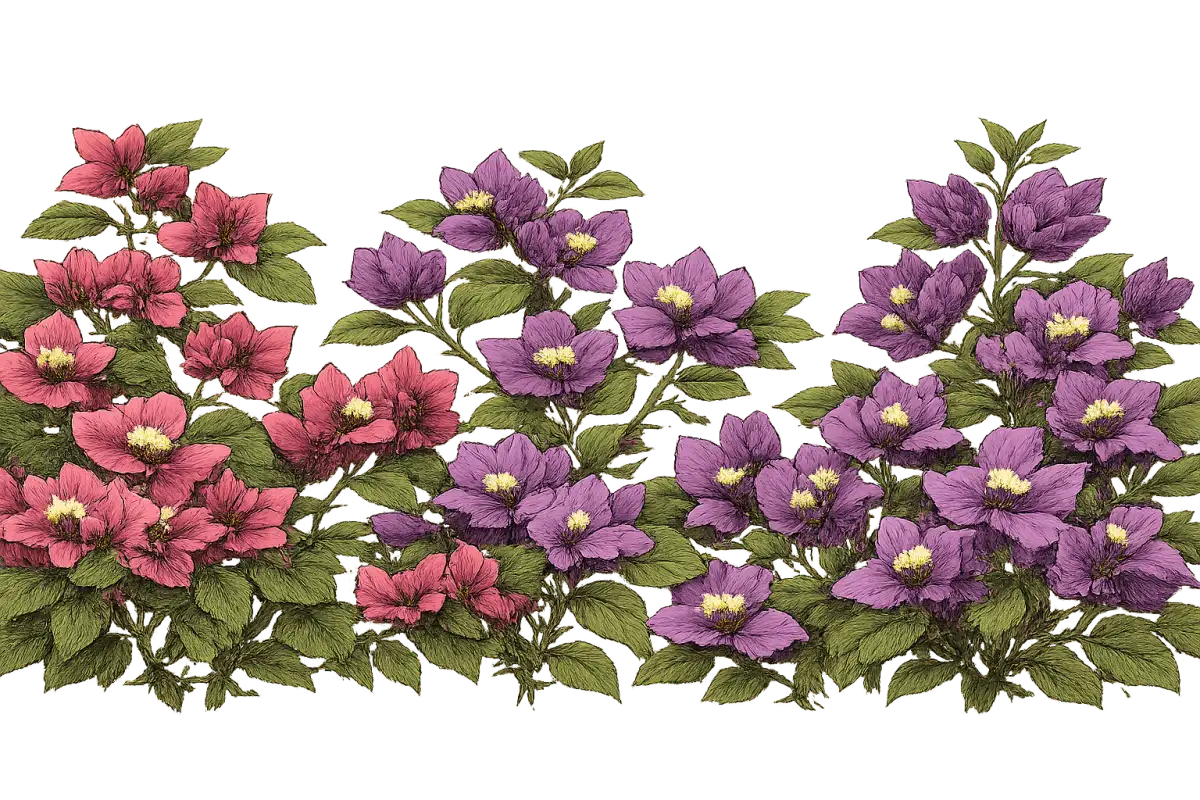
Marginal In-Ground Zones (9a-9b): Hardiness First, Color Second
Southern Texas, inland Southern California, parts of Arizona, coastal northern Florida -- these are the zones where bougainvillea is possible in-ground but requires careful variety selection and smart siting. The plant may take frost damage in a hard winter, and recovery speed matters as much as bloom performance.
For these zones, there are two clear answers.
Barbara Karst is the most popular bougainvillea in the United States, and its dominance is earned. It tolerates brief dips to 20 degrees and recovers from frost damage faster than any other widely available variety. Its bracts are bright magenta-red -- vivid, saturated, and produced in abundance. It climbs vigorously to 15 to 30 feet and performs as a wall climber, arbor plant, or espalier against a south-facing wall. If you are in a marginal zone and you want one variety that gives you the best chance of a permanent planting, this is it.
San Diego Red is the other cold-hardy choice, with deep crimson-red bracts that read darker and more refined than Barbara Karst's magenta. Its dark green foliage holds well through cool winters, which makes it visually attractive even when the bracts are absent. It is particularly well suited to coastal California climates -- the Bay Area and similar mild-winter settings where the cool season is long and the summer is measured. For zone 9b gardeners who want something slightly more elegant than Barbara Karst's electric magenta, San Diego Red is the choice.
In these marginal zones, placement is as important as variety. Plant against a south- or west-facing wall that absorbs and reflects heat. Avoid open, exposed positions where cold wind can cause additional damage. An espalier trained flat against a masonry wall provides both cold protection and maximum reflected heat for blooming -- the best possible site for a marginal zone planting.
Warm In-Ground Zones (10b-11): The Full Palette Opens Up
South Florida, Hawaii, coastal Southern California from Los Angeles south, the Rio Grande Valley -- these are the zones where bougainvillea is a landscape workhorse, not a gamble. Here, variety selection shifts from hardiness to color, habit, and design intention.
Barbara Karst remains a first choice for sheer bloom volume and reliability, but the range expands significantly.
Purple Queen (sometimes listed as Purple Robe) delivers the most intense purple available -- a color that creates striking contrast against white stucco walls and tropical foliage. It is a vigorous grower and a natural choice for anyone who wants the drama of bougainvillea in a cooler, more regal tone.
Rosenka is one of the most visually interesting varieties in the genus. Its bracts open gold and salmon, then age to pink as they mature, creating a multi-toned display of different-aged bracts simultaneously. On a single plant in full bloom, you can see three different hues at once. For gardeners who think in terms of color composition -- who consider how plants look together and over time -- Rosenka offers something no other common variety can match.
James Walker produces large reddish-purple bracts on a vigorously climbing plant. It reads distinctly different from both the magenta of Barbara Karst and the pure purple of Purple Queen -- more complex, with red undertones that make it especially beautiful against warm stone or terracotta walls.
For elegance and restraint, Jamaica White produces pure white bracts that work beautifully in formal gardens or against dark masonry. Mary Palmer is a bicolor variety with both white and magenta bracts on the same plant -- an unusual and striking effect.
Torch Glow belongs in this section too, because in zones 10b-11 its compact, shrub-like habit fills a different design role than the vigorous climbers. At three to six feet, it works in containers, near pathways, and in spots where a full-sized vine would be overwhelming. It is nearly thornless -- a genuine distinction in a genus where thorns are typically one to two inches long and capable of puncturing leather gloves. For any planting near a front entry, a pool deck, or a children's play area, Torch Glow is the thoughtful choice.
Container Zones (4-9a): The Summer Performer
In any zone with freezing winters, bougainvillea becomes a container plant: spectacular from late spring through fall outdoors, then brought inside before night temperatures consistently drop below 40 degrees.
For container growing, Torch Glow is the first choice for most gardeners. It stays compact enough to actually move, the near-thornless stems make handling far more manageable, and the slightly root-bound conditions of container growing naturally trigger the bloom stress bougainvillea craves. A terracotta pot just slightly larger than the root ball, placed in the sunniest spot on your patio, will produce reliable magenta color all summer.
Full-sized varieties in containers are possible but demanding. They can become top-heavy, difficult to move, and aggressive. If you have the space and commitment, Barbara Karst in a large container with a strong stake is spectacular. But for most northern gardeners, Torch Glow is the practical choice that actually gets moved indoors before the first freeze rather than left out and lost.
Quick Reference Table: Top Picks by Zone Group
| Zone Group | Top Varieties | Type | Why |
|---|
| 9a-9b (marginal in-ground) | Barbara Karst, San Diego Red | Full-size climber | Maximum cold hardiness; fastest frost recovery |
| 10b-11 (ideal in-ground) | Barbara Karst, Purple Queen, Rosenka, James Walker | Full-size climber | Full palette available; choose by color and form |
| 10b-11 (small spaces/paths) | Torch Glow, Jamaica White | Compact shrub / climber | Scale, thornless access, elegance |
| 4-9a (containers) | Torch Glow | Compact shrub | Manageable size; nearly thornless; moveable |
Where and How to Plant
Site Selection: Sun Is Non-Negotiable
Six to eight hours of direct sunlight is the minimum. More is better. Unlike many ornamentals that tolerate or even appreciate afternoon shade in hot climates, bougainvillea handles full desert sun in Phoenix and Las Vegas without complaint -- it is a tropical plant native to conditions that would scorch more delicate specimens.
The ideal exposure is south or west-facing, ideally against a wall or fence that absorbs heat during the day and radiates it back at night. That reflected heat extends the bloom season, provides microclimate warmth in marginal zones, and produces the slightly drier, hotter conditions bougainvillea evolved in. A masonry wall in full sun is almost perfect.
Avoid north-facing locations. Avoid planting under large trees. Avoid spots where afternoon shade cuts into the sunlight hours from nearby structures. And if you are growing in a container, track the sunniest spot on your patio through the seasons and move the pot accordingly -- a spot that delivers eight hours in July may deliver only four in November.
Consider thorns at the planning stage, not after planting. Bougainvillea thorns are one to two inches long, rigid, and sharp enough to puncture heavy leather. They are not soft prickles -- they are modified branches. Keep bougainvillea at least four to six feet from walkways, front doors, and high-traffic areas. If you need color near accessible locations, Torch Glow is the solution.
Soil Preparation
Bougainvillea is adaptable to many soil types but has one absolute requirement: drainage. The plant cannot tolerate waterlogged conditions. Root rot can kill a plant within weeks of onset, and the bloom cycle itself depends on soil that dries out completely between waterings.
Before planting, test the drainage. Dig a hole twelve inches deep where you plan to plant, fill it with water, and watch the clock. If the water has not drained within four hours, the site is unsuitable without amendment. Build a raised bed or plant in a container instead.
For sandy or loamy soils -- the naturally ideal type -- minimal amendment is needed. Dig a hole two to three times wider than the root ball and the same depth. Mix in a modest amount of compost, no more than 25% by volume. Too much organic matter retains moisture and works against the drought-stress cycle. For clay soils, a raised bed of at least eight to twelve inches is the most reliable solution. Never plant bougainvillea in a depression or low spot where water collects after rain.
The target soil pH is 5.5 to 6.5. In South Florida (limestone soils, pH often 7.5 to 8.5), in Texas caliche country, and across much of the arid Southwest, alkaline soil and alkaline irrigation water cause iron chlorosis -- yellow leaves with green veins, starting on new growth. The fix is a two-track approach: immediate relief with chelated iron applied as a foliar spray or soil drench, and longer-term correction with elemental sulfur or acidifying fertilizer. If your irrigation water pH is above 7.5, this is often the root cause of chronic chlorosis, and treating the soil without addressing the water is fighting a losing battle.
Planting
Step 1: Dig the hole to the same depth as the root ball and two to three times wider. Bougainvillea should be planted at the same depth it was growing in the nursery container -- do not bury the crown.
Step 2: Do not disturb the root ball. This point cannot be overstated. Bougainvillea has extreme root sensitivity. Breaking up, shaking, or trimming the root ball causes bloom cessation for weeks to months, significant leaf drop, and prolonged stress. Slide the plant out of its nursery container and place it in the hole intact. Add amended soil around the edges only.
Step 3: Backfill and water to settle the soil and eliminate air pockets.
Step 4: Mulch thoughtfully. Unlike most garden plants, bougainvillea needs mulch applied conservatively. In dry climates, a thin layer (one to two inches) of bark mulch can prevent excessive surface heating. In humid climates -- Florida, the Gulf Coast -- skip organic mulch or use gravel. Thick organic mulch traps moisture around the crown and works against everything the plant needs. Whatever you use, keep it pulled back three to four inches from the trunk base.
Step 5: Water on the establishment schedule, not the drought-stress schedule. New plantings need more frequent water to build roots. For the first two weeks, water every two to three days. Then twice weekly through the second month. Then weekly. After four months in the ground, begin the transition to the full drought-stress cycle.
The Watering Method That Makes Bougainvillea Bloom
The drought-stress watering cycle is worth its own section because it is the practice most gardeners get wrong -- and getting it right changes everything.
For established in-ground plants, the protocol is beautifully simple: water deeply and then wait approximately three weeks. Watch the leaves. Slight wilting is the target, not a problem. When leaves droop slightly, the plant is producing the internal signals that switch it to bract production. Water deeply again. Wait. Repeat.
"Deeply" means soaking the root zone to twelve or more inches -- not a surface sprinkling. Shallow, frequent watering keeps the top few inches moist without ever allowing the drought-stress trigger to engage. Run a soaker hose for an extended period, use deep watering stakes, or hand-water slowly to allow absorption.
The three-week interval is approximate. In Phoenix or Las Vegas heat, the cycle may shorten to two weeks. In mild coastal climates, it may stretch to four. Let the plant tell you, not the calendar.
For container plants, the approach is the same in principle but faster in practice. Terra cotta pots, which are breathable and dry quickly, are preferable to plastic or glazed ceramic for exactly this reason. Let the soil dry out completely -- insert a finger two inches into the soil and confirm it is dry throughout. Slight leaf curl is your signal. Water thoroughly until water runs freely from the drainage holes, then empty the saucer and wait for the soil to dry again.
Automatic irrigation systems and bougainvillea are fundamentally incompatible. A timer that runs every two days -- the right schedule for most garden plants -- keeps bougainvillea in permanent vegetative mode. If your plant is on a sprinkler system, disconnect it. Switch to hand-watering on the drought-stress cycle. This single change resolves the most common complaint about bougainvillea more reliably than any other intervention.
The overwatering death spiral deserves explicit description, because it is the sequence that kills the most plants. A gardener waters regularly, keeping soil consistently moist. The plant grows vigorously and green. Frustrated by the absence of bracts, the gardener adds more fertilizer. The soil stays wet; root rot pathogens take hold. The plant begins to wilt -- not from drought this time, but from root damage. The gardener sees wilting and waters more. The roots fail completely. The plant dies, and the gardener concludes that bougainvillea is difficult.
The diagnostic test when your bougainvillea wilts: check the soil before watering. Dry soil with wilted leaves means drought stress -- water deeply and the plant will recover within hours. Moist or wet soil with wilted leaves means root rot. Stop watering, improve drainage, and assess the roots. Brown, mushy, foul-smelling roots confirm the diagnosis. If caught early -- most roots still white and firm -- the plant can recover with dramatically reduced watering and improved drainage. If most roots are affected, recovery is unlikely.
Pruning for Color: The More You Cut, the More It Blooms
The relationship between pruning and bloom in bougainvillea is direct and logical once you understand that the plant produces bracts only on new growth. Old, woody stems do not bloom. Pruning removes old growth and forces new shoots. New shoots produce bracts. Therefore, pruning at the right time actively increases color production.
There are two distinct types of pruning, each with its own timing and purpose.
Structural pruning happens in late winter during dormancy -- January or February for in-ground plants in zones 9b through 11, or just before moving containers outdoors in spring for northern growers. This is the major annual reset: remove dead, damaged, or crossing branches; thin the interior to improve airflow and light; cut back main branches to the desired framework. Bougainvillea is remarkably tolerant of aggressive cuts. You can remove one-third to one-half of total growth without harming the plant. It will regenerate vigorously once warm weather arrives.
Bloom-flush pruning happens after each bloom cycle finishes. Bougainvillea blooms in rounds -- a flush of color lasting several weeks, a rest period, new growth, then another flush. When bracts fade and begin to dry, cut back the shoots that just finished blooming by one-third to one-half, remove spent bracts and dead tips, and shape as desired. The plant will respond with new growth that produces the next flush. This is why, in zones 10b and 11, bougainvillea can cycle through three to five vivid bloom periods between March and November.
The one thing not to do is prune during active bloom. You will remove the display you have been waiting weeks to see. Patience: let the bracts fade fully before cutting back.
One word on safety that is easy to underestimate until you have encountered it: bougainvillea thorns are one to two inches long, rigid, and capable of puncturing regular garden gloves. Always wear heavy leather gloves when pruning. Wear long sleeves. Use loppers or long-handled pruners to keep your hands away from the canopy. Dispose of clippings carefully -- bagged and sealed -- because they remain dangerously sharp long after they have dried. The one exception is Torch Glow, which is nearly thornless and can be handled with standard gloves.
For overgrown or neglected plants, rejuvenation pruning is highly effective. In late winter, cut all stems back to two to three feet from the ground. Select three to five of the strongest remaining stems as the new framework and remove everything else. The plant will regenerate with vigorous new growth that blooms reliably by mid-summer.
One of the pleasures of bougainvillea from a design perspective is its adaptability. The same plant can become a thirty-foot wall-covering spectacle, a tightly controlled flat espalier, a patio tree standard, or a cascading hanging basket -- depending on how you train and prune it from the start.
Trellis and wall climbing is the most natural expression. Plant against a south or west-facing wall, attach young growth initially with soft ties, and let the thorns provide grip as the plant matures. Side-shoot after each bloom flush to maintain a clean profile. One structural pruning per year removes old wood from the base and selects vigorous new canes to replace it. In zones 10b-11, this form can cover an entire wall with color across most of the year.
Espalier creates a dramatic living tapestry trained flat against a wall. Select three to five main branches and train them horizontally along wires or supports. After each bloom flush, cut side growth back to two or three buds from the main horizontal branches. Remove any shoots growing toward or away from the wall. The goal is a two-dimensional plane of growth -- bold and architectural. The wall provides reflected heat, and the flat form shows maximum bract surface to view. This is one of the most visually compelling ways to use bougainvillea.
Standard form -- a single trained trunk with a branching canopy -- works beautifully as a container patio tree. Train one strong stem and remove all others at ground level. Allow branching at three to five feet to form the canopy. Stake the trunk firmly; bougainvillea wood is relatively soft and will bend under canopy weight. Prune the canopy into a rounded shape after each bloom flush. Remove suckers from the trunk continuously. The result is a sculptural, colorful element that moves with the container.
Hedge planting requires spacing plants four to six feet apart and allowing them to grow together into a continuous mass. The thorns are a genuine security asset in hedge form -- an impenetrable bougainvillea hedge is a serious deterrent. Shear after each bloom flush but avoid cutting too aggressively, which removes the new growth that carries the next flush. One heavy structural shearing in late winter sets the shape for the year.
Pests, Diseases, and What to Watch For
Bougainvillea is genuinely pest-resistant compared to most ornamentals. Its preference for dry conditions and its vigorous growth discourage many common garden insects. But several problems appear reliably enough to warrant attention.
The bougainvillea looper caterpillar (Disclisioprocta stellata) is the most significant bougainvillea-specific pest -- a green inchworm approximately one inch long that feeds at night on leaves and bracts, creating scalloped or notched edges. Heavy infestations can defoliate sections of the plant. Inspect at dusk when the caterpillars emerge. Treatment with Bacillus thuringiensis (Bt) spray is effective and targeted without harming beneficial insects.
Aphids cluster on new growth and undersides of leaves, producing the sticky honeydew that attracts ants and supports the black coating of sooty mold. Mild infestations often respond to a strong water spray. Insecticidal soap or neem oil handles more persistent populations. Avoid over-fertilizing with nitrogen -- soft new growth from excess nitrogen is exactly what aphids prefer.
Mealybugs appear as white cottony masses in leaf axils and on stems. Scale insects show as small, immobile bumps on stems that are easy to mistake for bark features. Both can be addressed with insecticidal soap or horticultural oil for moderate infestations, or systemic insecticide for severe cases. Whiteflies are most problematic in warm, humid climates and during overwintering indoors, where air circulation is reduced.
Root rot is the one disease that can kill a bougainvillea quickly, and it is almost always a cultural problem rather than a pathogen arriving on its own. Consistently wet soil creates conditions for Phytophthora and Pythium water molds. Prevention -- through proper watering and excellent drainage -- is far more reliable than treatment once root rot is established.
Iron chlorosis -- yellow new leaves with clearly visible green veins -- is the most common nutrient disorder and is almost always a soil pH issue rather than a true iron deficiency. The iron is in the soil; alkaline pH above 7.0 makes it chemically unavailable to roots. Apply chelated iron (EDDHA chelate is most effective in alkaline conditions) as an immediate treatment, and address soil and water pH as a longer-term solution.
The best overall disease prevention strategy is cultural: do not overwater, provide full sun, maintain good air circulation through pruning, and avoid high-nitrogen fertilizer. A plant growing under these conditions resists pests and diseases dramatically better than one that is overwatered, shaded, and pushed into lush vegetative growth.
 Where to Plant