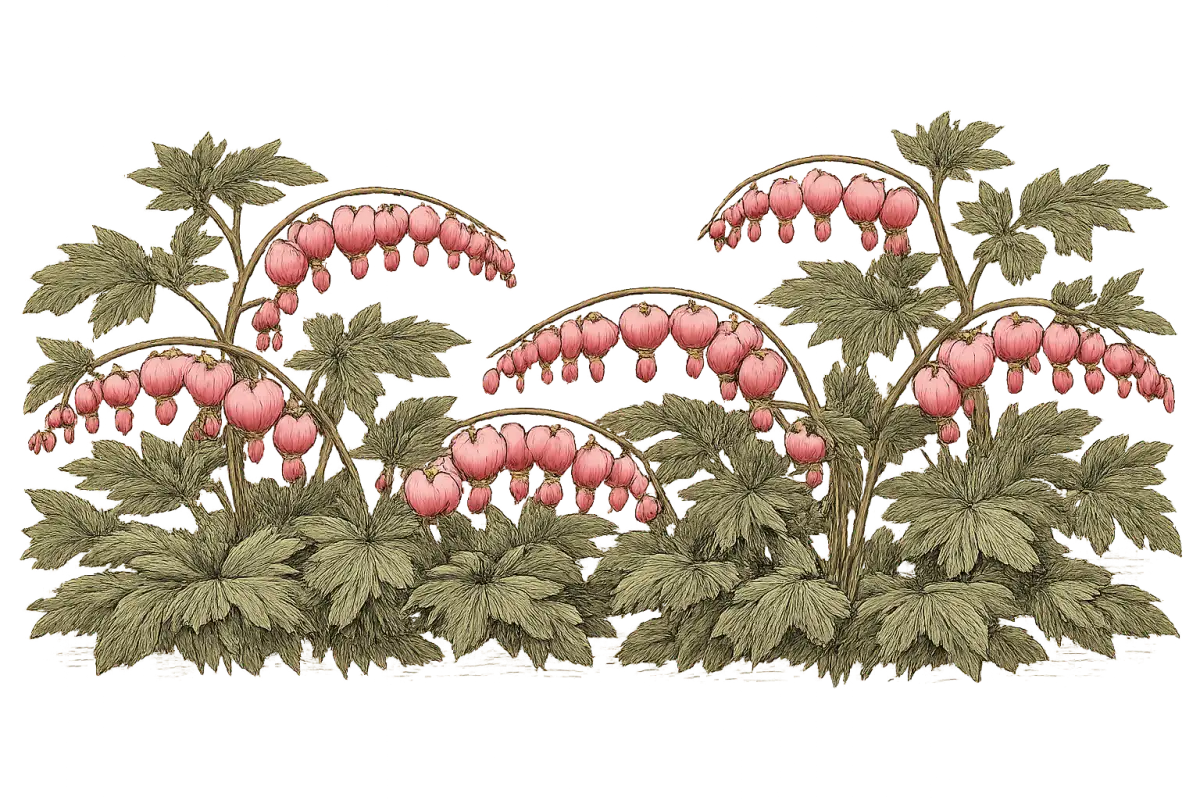
Cold Zones (3–5): The Classic Bleeding Heart's Home Territory
If you garden in zones 3 through 5 — the upper Midwest, northern New England, high-elevation Mountain West, and much of Canada — you are in the sweet spot for L. spectabilis. Cool summers mean the foliage persists well into summer, sometimes September in zones 3 and 4. The plant has time to complete its full cycle, build root reserves, and come back stronger each year.
Classic Pink is the original species and still one of the best: pink outer petals with a white inner tip, the teardrops of the heart shape perfectly formed. Widely available, easy to establish, impossible to fault for spring impact. This is the variety planted by generations of gardeners before any of the fancy selections existed, and for good reason.
Gold Heart is what most design-minded gardeners will reach for instead. The flowers are the same classic pink-on-white, but the foliage is a brilliant, warm golden yellow that lights up dark shade gardens even before the first bud opens. The contrast between those golden leaves and the pendant pink hearts is, frankly, breathtaking. In part shade the gold holds; push it into deep shade and the color drifts toward green. If you plant one bleeding heart in a cool zone, make it this one.
Alba offers something quieter: pure white flowers against pale lime-green foliage. It lacks the drama of the pink forms but has a refined, almost luminous quality that works beautifully in white-and-green shade gardens, or paired with blue-flowered companions like brunnera or pulmonaria. Elegant without effort.
Valentine breaks the mold entirely — deep cherry-red to crimson flowers on dark reddish stems, a significant departure from the traditional pink palette. More compact than the species type. If you are building a darker, moodier shade planting with deep burgundy heucheras and dark-foliaged companions, Valentine anchors it perfectly.
In zones 3 and 4, dormancy is your least pressing concern. Mulch heavily in late fall — three to four inches — to protect crowns from deep freeze, and remove the excess in early spring as temperatures rise. Nearly any spectabilis variety performs beautifully here.
Zone 5 gardeners can also consider adding a fern-leaf type alongside their spectabilis for extended bloom. The two groups have different peak moments and complement each other without competition.
Mid-Range Zones (6–7): Two Types, One Garden
Zones 6 and 7 are transition territory, and the most interesting zone for designing with bleeding hearts because both major groups perform here — just differently.
L. spectabilis still works well in zone 6. Expect the foliage to yellow and collapse in August, leaving a six-week gap before fall. Gold Heart and Classic Pink are reliable performers. Site them with care — morning sun, afternoon shade — and surround them with hostas or ferns that will expand to fill the space when they go dormant.
Zone 7 brings a shorter active window for spectabilis. Foliage often begins to decline in late June and is fully gone by mid-July in warmer parts of the zone. You can still grow it successfully here, but be realistic: it is a spring-only plant in zone 7, and it needs a genuinely shaded spot to get even those weeks of display. The hotter your summer, the harder spectabilis works to be there at all.
For reliable all-season performance in zones 6 and 7, the Dicentra eximia hybrids are the workhorses.
Luxuriant is the variety most consistently recommended for warm climates — it is considered the most heat-tolerant eximia-type bleeding heart available. Cherry-red flowers on vigorous plants, blooming from May through frost in favorable conditions. This is the variety Penn State Extension and Missouri Botanical Garden point to when gardeners in zone 7 ask what will actually hold up.
King of Hearts offers deep rosy-pink flowers on a very compact plant — just eight to twelve inches tall. One of the longest-blooming of all bleeding hearts, flowering May through September with minimal interruption. Its small size makes it ideal at the front of shade borders or tucked into containers where a spectabilis would be far too large.
Burning Hearts is worth seeking out if you want something a little unexpected: red flowers combined with distinctive silvery-blue ferny foliage. The foliage color alone sets it apart. Compact at ten to twelve inches, less commonly stocked locally than Luxuriant and King of Hearts, but available from mail-order perennial nurseries.
A well-designed zone 7 shade border might include one Gold Heart spectabilis at the back for the spring spectacle, flanked by hostas to cover the gap, with Luxuriant and King of Hearts in front providing color from May through September. The two groups take turns without ever looking at odds with each other.
Warm Zones (8–9): Fern-Leaf Types Only
In zones 8 and 9, L. spectabilis is no longer a practical landscape plant. It may bloom briefly in early spring — sometimes beautifully — but the heat arrives so quickly that dormancy follows within weeks. The root reserves are taxed, recovery is slower, and year after year the plant becomes less vigorous rather than more. Save yourself the frustration.
Luxuriant is the universal recommendation here. Cherry-red, long-blooming, and the most heat-tolerant eximia hybrid in wide distribution. Give it consistent moisture and a shaded spot and it will perform reliably through the long hot season.
King of Hearts is the compact companion — rosy-pink, front-of-border scale, reliable from May to September. Plant the two together for a range of colors and sizes.
Ivory Hearts, the white-flowered fern-leaf type, is the choice for gardeners who want the all-season performance of eximia types without red or pink. White flowers on finely divided ferny foliage, blooming spring through fall.
In zone 9, even the eximia types benefit from attentive moisture management through the hottest months. Consistent mulching and drip irrigation rather than overhead watering will keep them performing through summer heat that would cause other shade perennials to fail.
The Pacific Northwest (Zones 4–8): Where D. formosa Comes Home
Pacific Northwest gardeners have an additional option that deserves specific mention: Dicentra formosa, western bleeding heart, is native to this region and performs exceptionally well in the mild, wet climate of zones 4 through 8 along the Pacific Coast. It is more shade-tolerant than D. eximia, spreads pleasantly by rhizomes through woodland settings, and is essentially at home in conditions that replicate its native forest floor habitat. For naturalistic Pacific Northwest gardens, it is an ideal ground-level planting under conifers and deciduous trees.
Quick Reference Table: Top Picks by Zone Group
| Zone Group | Top Varieties | Type | Why |
|---|
| 3–5 | Gold Heart, Classic Pink, Alba | L. spectabilis | Peak performance; cool summers, long season |
| 5–6 | Gold Heart + Luxuriant | Spectabilis + eximia hybrid | Spring drama plus all-season bloom |
| 7 | Luxuriant, King of Hearts, Valentine | Eximia hybrids + spectabilis | Heat tolerance; spectabilis as spring accent only |
| 8–9 | Luxuriant, King of Hearts, Ivory Hearts | Eximia hybrids | No summer dormancy; heat-tolerant |
| PNW (4–8) | D. formosa, Luxuriant, Gold Heart | Formosa + eximia + spectabilis | Native-adapted; shade-tolerant spreader |
Light and Soil: The Woodland Blueprint
Bleeding heart evolved on the shaded forest floor — dappled light filtering through a deciduous canopy, deep soil rich in decomposed leaves, consistently moist but never sitting in water. Every care decision flows directly from that origin. When you replicate those woodland conditions, the plant largely takes care of itself.
Morning Sun, Afternoon Shade
This combination is the sweet spot for bleeding heart across most of the country. Morning light is cooler and gentler; it supports photosynthesis and encourages flowering without the heat stress that afternoon sun delivers. East-facing beds, the east side of buildings and walls, and the dappled light under deciduous trees all provide this naturally.
In zones 3–5, full sun is tolerable if the soil stays consistently moist. Cool summer temperatures mean afternoon heat rarely rises to the level that triggers early dormancy. But even in cool zones, some afternoon shade prolongs the display.
In zones 6–7, afternoon shade is not optional for spectabilis types. Afternoon sun causes foliage to yellow and go dormant weeks earlier than it should, shortening the season you planted the thing for.
In zones 8–9, full shade is the target for the eximia hybrids. In the hottest climates, the tradeoff of slightly fewer flowers for cooler, healthier plants is always worth making. North-facing beds and the north side of buildings are excellent here.
It is important to understand that it is not light itself, but heat and drought, that trigger summer dormancy in spectabilis. Hot afternoon sun delivers both heat and drying simultaneously — which is why avoiding it is so consequential in warm zones.
Soil That Feels Like a Forest Floor
The phrase you will encounter in every reliable source on bleeding heart is "moist, well-drained, humus-rich soil." Let's unpack what that actually requires in a home garden.
Moist means the soil holds moisture between rain events without drying out completely. It does not mean wet. Constant saturation is fatal to bleeding heart roots — the plant's fleshy root system has almost no tolerance for waterlogged conditions.
Well-drained means water moves through the soil within a few hours of rain or irrigation. If water pools for more than four hours after a heavy rain, that spot will kill bleeding hearts through crown rot.
Humus-rich means high organic matter content — the kind of deep, crumbly, sweet-smelling soil found on a forest floor with decades of decomposed leaves. The organic matter is what allows soil to be simultaneously moisture-retentive and well-drained: it holds water like a sponge while also creating the pore structure that allows drainage and root respiration.
Soil pH should fall between 6.0 and 7.0 — slightly acidic to neutral. This is naturally achieved in areas under deciduous trees, where fallen leaves acidify the soil over time, and is compatible with most common shade garden companions like hostas, ferns, and astilbe.
To amend existing soil: Dig the planting area 12 to 15 inches deep and work in three to four inches of compost, leaf mold, or well-aged manure. If drainage is poor, raise the planting area into a low mounded bed or add coarse grit to the bottom of the planting hole. Avoid using peat moss as the primary amendment — it compresses over time and acidifies soil below the ideal pH range. For heavy clay soils, raised beds are often the most practical solution. Sandy soils need generous compost and consistent mulching to hold moisture.
Mulch is not optional. Apply two to three inches of shredded bark, shredded leaves, or leaf mold around plants each spring. Mulch retains soil moisture between waterings, keeps the root zone cooler than air temperature in summer (directly extending the active season of spectabilis types), and breaks down over time to add humus — replicating the very forest floor conditions the plant evolved in. Keep mulch pulled back one to two inches from the crown to prevent rot at the base.
Planting, Watering, and Feeding
Planting
Plant bleeding heart in early spring — as soon as the ground is workable — or in fall, at least six weeks before hard frost. Spring planting aligns with the plant's natural emergence and gives roots a full season to establish. Fall planting allows root development over winter; the plant is ready to grow the moment temperatures warm in spring.
Set the crown — the growing point where roots meet stems — just below the soil surface. Too deep delays emergence; too shallow exposes the crown to freeze-thaw cycles that can heave it out of the ground. Space plants two to three feet apart. Bleeding heart spreads moderately over time, and starting with adequate room prevents overcrowding and reduces the need for early division. Water deeply immediately after planting, then apply your two to three inch layer of mulch, keeping it away from the crown itself.
Watering
Consistent moisture is the most critical ongoing care requirement for bleeding heart. The plant's native habitat — the woodland floor — is naturally moist, never waterlogged, never bone dry. Replicate that balance and the plant is largely self-sufficient.
During the active growing season, aim for one inch of water per week from rain plus supplemental irrigation. In dry periods, water deeply one to two times per week. During flowering, maintaining consistent moisture prolongs the bloom period noticeably. As spectabilis approaches dormancy in warm zones, reducing water somewhat is fine once foliage begins to yellow — the plant is entering dormancy regardless. But do not let dormant roots dry out completely; keep the area lightly moist through summer.
Deliver water at the base of the plant, not overhead. Drip irrigation or soaker hoses are ideal — they keep foliage dry, reducing the risk of fungal disease in humid climates. Overhead sprinklers wet the foliage and create conditions that encourage the leaf spot and crown rot problems that otherwise rarely trouble well-sited bleeding hearts.
One critical note: dry conditions are the primary trigger for early dormancy in spectabilis types. If your plants are going dormant in June when you expected them to last until August, drought stress is almost certainly the cause. Check soil moisture before assuming heat alone is responsible.
Feeding
Bleeding heart does not need much. Rich soil and annual compost top-dressing are usually sufficient. Amend the planting hole generously with compost at planting time, and top-dress with an inch of compost each spring as new growth emerges. If growth seems weak after the plant has been established for a year or two, apply a balanced granular fertilizer (10-10-10) in early spring at half the recommended rate. Avoid high-nitrogen fertilizers — they push leafy growth at the expense of flowers.
Managing Summer Dormancy: The Design Challenge
Summer dormancy in L. spectabilis surprises every gardener who encounters it for the first time. The plant puts on its spectacular spring display — arching stems loaded with pendant hearts, lush blue-green foliage filling a generous space — and then, as the heat of summer arrives, it yellows completely and disappears underground. The roots are alive. The plant will return in spring. But the space it occupied is now empty, and if you were not expecting it, the effect is disorienting.
This is the most important thing to understand about old-fashioned bleeding heart before you decide where to plant it.
When the Gap Arrives
The timing depends almost entirely on your zone:
Zones 3–4: L. spectabilis may hold its foliage into September. The gap is short and modest — often only a few weeks before fall arrives anyway.
Zones 5–6: Foliage typically yellows and collapses in August. A four-to-six-week gap through late summer.
Zones 7–8: Foliage begins to decline in late June and is usually fully gone by mid-July. A two-to-three-month gap through the heart of summer.
Zone 9: Plants may go dormant as early as late May after a very brief bloom. In zone 9, D. eximia hybrids are strongly preferred over spectabilis for this reason.
What Not to Do
When you see the foliage yellowing, do not cut it back. Every year, gardeners who are new to spectabilis see the yellowing leaves in June or July and assume the plant is diseased or dying. They tidy it up, cut it back, and wonder why the plant returns weaker the following spring — or fails to return at all.
The yellowing foliage is actively transporting nutrients back into the roots for storage. The plant needs this process to build the energy reserves that fuel next spring's growth and flowering. Cutting the foliage while it is still yellow — not brown and papery — interrupts this cycle. Allow foliage to yellow completely and the stems to pull away easily on their own before removing anything. This is the same principle as allowing daffodil foliage to die back naturally, and it matters just as much.
Also: mark your plants before they go dormant. Fleshy dormant roots sit completely underground with nothing to indicate their location. Driving a trowel through them while planting something else nearby is very easy to do and genuinely damaging to the plant. A golf tee, a plant stake, or a photo of the bed in spring costs you nothing and prevents a frustrating amount of accidental damage.
Companion Planting: The Elegant Solution
The most beautiful response to the summer gap is not working around it — it is designing with it. Surround spectabilis with companions that expand right as it begins to fade, filling the space with foliage through summer. When this is done well, a viewer looking at the bed in August would never know there was a gap.
Hostas are the single best companion for spectabilis. Their timing is nearly perfect: hostas emerge slowly in spring while bleeding heart is at its peak, then expand rapidly in May and June just as bleeding heart begins to yellow. By the time spectabilis is fully dormant, established hostas have created a dense, lush canopy that fills the space entirely. They thrive in the same conditions — shade, consistent moisture. Place hostas behind or alongside bleeding heart and the transition is seamless.
Ferns — lady fern, ostrich fern, cinnamon fern — emerge late enough in spring (late April through May) to avoid visually competing with bleeding heart's peak display, then fill out through summer with a naturalistic texture that is deeply at home in the same woodland conditions. In informal shade gardens especially, ferns are invaluable.
Astilbe blooms in June and July, precisely when spectabilis is going dormant. Its feathery plumes in pink, red, white, or purple fill both the visual and temporal gap simultaneously, in the same shady, moist conditions bleeding heart prefers.
Brunnera macrophylla (Siberian bugloss) offers heart-shaped leaves — pleasingly ironic alongside bleeding heart — that emerge in spring and persist through fall, with some varieties evergreen in mild climates. The silver-patterned leaves of 'Jack Frost' add distinctive visual interest throughout the entire season.
Heuchera (coral bells) and hardy geraniums round out the toolkit: heuchera for its evergreen to semi-evergreen colorful foliage in every shade from lime to deep purple, and hardy geraniums like 'Rozanne' for their habit of spreading gently to fill gaps from late spring through fall.
A proven combination for a four-foot-wide shade border section: one Gold Heart spectabilis at the back, two medium hostas on either side slightly in front, one astilbe in front of those, and a low brunnera or heuchera at the edge. In spring the whole composition is built around the bleeding heart. By August, the hostas and astilbe own the space, and the dormant bleeding heart roots are safely tucked away below them.
Design placement matters, too. Position spectabilis toward the back or middle of shade borders, not at the front edge. A bleeding heart planted at the front edge leaves an obvious hole at eye level when it goes dormant. Plants in front can only conceal what is behind them.
 Where to Plant